

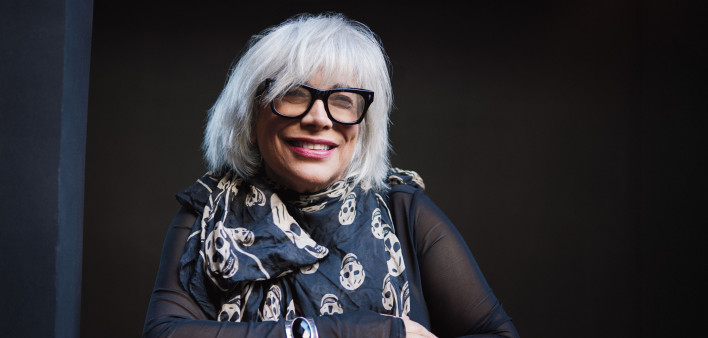
What a time to be alive! New York City in the early ’80s percolated with artistic energy. As a talented, vivacious young singer with drive, Sherri Lewis thrived in the era’s whirlwind of cultures and creativity. She partied and performed with music and fashion icons and fronted the band Get Wet, singing their 1981 hit, “Just So Lonely,” on TV’s American Bandstand and Solid Gold (through a 2026 lens, the band’s videos recall a mash-up of Amy Winehouse and early Cyndi Lauper). Also during the early ’80s, a mysterious killer was taking root in the city: the AIDS epidemic. Lewis found herself in the center of this too. After getting a blood test for her marriage license, she learned her status on April 12, 1987, her 33rd birthday. Fast-forward nearly four decades: Last year, Lewis celebrated what would have been unthinkable—her 71st birthday. She first graced our cover in May 2008 for the feature “HIV: Behind the Music” as she starred in the hit HIV-themed podcast Straight Girl in a Queer World. Lewis was profiled again in a 2016 article, “One Down, One to Go,” as she celebrated being cured of hepatitis C (you can find those articles and counelss others in the POZ online archives). In the following essay, Lewis recounts a lifetime of insights as an artist, a woman, a recovering addict, an advocate and all-around powerhouse long-term survivor. —Intro by Trent Straube
I am now 71. I’m in disbelief and proud to have made it to this age. So many didn’t. I’ve counted days, months, years and hours just to cope with the death sentence I was handed in 1987 when I was diagnosed HIV positive on my 33rd birthday. It was just weeks before my most coveted day—my wedding day. Getting married was my biggest dream—that and getting a record deal.

“I was popular and talented. By 1987, I already had my 15 minutes of fame.”Courtesy of Sherri Lewis
By 1987, I had already had, as Warhol would say, my 15 minutes of fame. While I wasn’t famous, I was always popular—and talented. At 5 years old, I was on the TV show Romper Room and other kiddie shows. And by 1979, my dreamboat bisexual boyfriend Zecca and I had a band, Get Wet. I was the lead singer with the stage name Sherri Beachfront, complete with a beach-ball pocketbook and an endless supply of Betsey Johnson colored crinolines, bustiers, gloves and windowpane tights! This was New York City, in the dangerous and colorful East Village. Lou Reed was in the house at our first gig at Max’s Kansas City and asked us to open for him at Columbia University. We did! What a magical time! What I wouldn’t give for that energy now—and to jump around nonstop in very high heels!
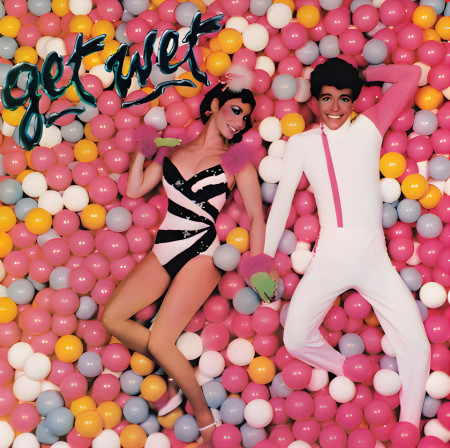
Neil Bogart, who signed Donna Summer, the Village People and Joan Jett, came to our show and introduced us to superstar producer and multiple Grammy winner Phil Ramone. That night we went to see Billy Joel, who was produced by Ramone. Bogart courted us with an offer at his new label, Boardwalk Records, and we were off to the races. I swear we made that record out of cocaine, which no one thought was addictive then! By 1981, we had a Top 40 hit single, “Just So Lonely,” and two MTV videos. We appeared on American Bandstand, Solid Gold and The Merv Griffin Show. And we had a European promotional tour, including TV shows.

Lewis with Brenda Bergman in a 1979 promo for Max’s Kansas City in New YorkCourtesy of Sherri Lewis
Predictably, the drugs took their toll. Zecca and I broke up. The record company went bankrupt. And by 1983, I was strung out and homeless, giving our dog, Spliff, to other addicts to care for as I crawled into Straight & Narrow, a church-funded program for addicts located in Paterson, New Jersey. No touchy-feely stuff there. It was combative and punishing. It was a population mostly of men who had done time. There were only about 15 women. Two were white, one was Jewish. Guess which one. I volunteered to be there. I was desperate to be clean and sober and get back to performing.
People began getting sick, but I was focused on going to 12-step programs. Back in New York, I got a job at Betsey Johnson’s boutique because she knew me. Then I picked up a Christmas job at Macy’s. A friend of mine brought in her friend, George, from Cambridge, Massachusetts. I was wearing a dark brown wig to cover my purple hair courtesy of Manic Panic on St. Marks Place. I was nervous and talking a mile a minute, but he got my phone number and called. I was a miracle on 34th Street!
By 1986, I was clean and straight. No sex, booze, pills, injectables, cocaine or heroin. Just cigarettes. And the love story of George and I began. He had a 15-year-old son. We all hit it off. I became a regular on the Boston–New York shuttle, adapting to my New England life, auditioning while in New York and going to 12-step meetings. Then we got engaged!
At this time, I got a call from a friend’s mother. She was crying. She said her daughter Laurie was very sick—they didn’t know what was wrong with her—and could I visit? Laurie and I had briefly shared my apartment. I remembered her having high fevers, rashes and hospital emergency runs only to be told to take aspirin and stay in bed. At the height of AIDS, that’s what they told this bright young woman. When I went to see her at the hospital, I discovered she was on an AIDS ward. A basket next to her door had a gown, masks and gloves for you to put on to protect yourself before entering her isolated room, and a sign on the door read: “CAUTION: Body Fluids”!
Laurie was so skinny I barely recognized her. Her mother was sitting in a corner wearing dark sunglasses. “We know what she has,” her mom said, “but we’re not going to talk about it.” Laurie was waving her arms in the air as if to catch something, hallucinating from a brain infection, her eyes unfocused. I stayed the day but was overwhelmed.
Back in Cambridge, when I went to get a blood test for my marriage license, I asked for an AIDS test, which was brand-new then. The doctor didn’t see the need. “You’re a female! No one tests positive here! This is Massachusetts!” Three weeks later, with my wedding invitations in the mail, my gown being made and a yacht reserved in New York Harbor for the special day, the doctor called and said, “I’m so sorry. Your test results are positive.” I dropped to my knees. The doctor requested I come to the hospital and talk about my HIV. I called George and said, “It’s bad news. You need to come home.” He cried and raged behind a closed door yelling at G-d.
We went to the hospital and met the doctor. I asked, “When will I get sick? How far has this disease progressed?” “I don’t know,” he said. “What can I do?” I asked, trying to control my shaking. “Take good care of your health.” What does that even mean? He shook my hand, wished me good luck and walked out of the room. I was the first person he ever told they were HIV positive.
I was fortunate that I landed in Cambridge, where some of the best HIV specialists were launching their careers. I met my doctor there during her residency. She’s now a top HIV specialist at the Clinical AIDS Research and Education (CARE) Center in Los Angeles, where I go today. We’ve walked this parallel path together for all these many years.
In Cambridge, I saw a psychiatrist who was trained to work with the terminally ill. In one of my sessions, she asked if I’d be willing to meet with a housewife who had AIDS and was afraid to leave her home except for her therapy. She had never met another woman with HIV. The following week, we met in my doctor’s office. I was heartbroken for this mother who trembled while clutching her bag. I simply shared my HIV story with her. She was quiet, withdrawn and terrified. I’ve thought of her through the years—how brave she was and so alone.
I shared about testing HIV positive immediately! I was so frightened that I had to share my status in my 12-step group. They embraced me and told me I was going to be all right. I needed to share it as soon as possible in the hope it could help others. Some people whispered in my ear that they were positive too. One of those people, Denis, was already educating about HIV in schools. He encouraged me to do the same, so I went to a training session at Boston Living Center. One day, I got a call from Denis. He was very sick and couldn’t make his speaking commitment. He asked me if I would do it for him. That was my first speaking engagement. Denis died just weeks after. I’ve now done hundreds over these years. Every time I’d speak at one, I’d share about Denis. I also share about my bisexual boyfriend in the band, my IV drug use and my history of sexual abuse that started when I was molested as a teenager.
My husband tested negative, which was a huge relief, but he was in and out of rage. We were not going to have children. We separated. I got my own place—George was supportive—and I worked as an AIDS counselor through a program at Harvard University. I performed with a theater troupe educating about substance abuse and HIV prevention, and before I knew it, I wrote and performed my own story: Life is a Beach. I got to sing with the Boston Gospel Choir. My final performance in Boston was with them at the Hatch Shell on the Esplanade, which I loved.
We got divorced, and I got a boyfriend. We were together for seven years—and it even included sex, unlike my marriage! My health was stable. With no effective HIV meds, I got into Chinese herbs, acupuncture, vitamin C and macrobiotics, and the gym replaced dance classes. Life was good.
It was just a matter of time before my asymptomatic run ended. My T-cell count dropped from 750 to 230. I had fatigue, and a rash appeared just as the new HIV drugs, commonly known as the cocktail, came out. My cocktail was three times a day—a total of 15 pills a day with food. It was toxic, but my T cells returned. Progress was moving rapidly thanks to the activists. Months later, my medications changed to only twice a day, but the side effects were miserable. My dancer’s body morphed as I developed a belly and skinny arms and facial wasting. But med improvements have now led me to a regimen of one pill a day and less lipodystrophy. I’m looking for that vaccine!
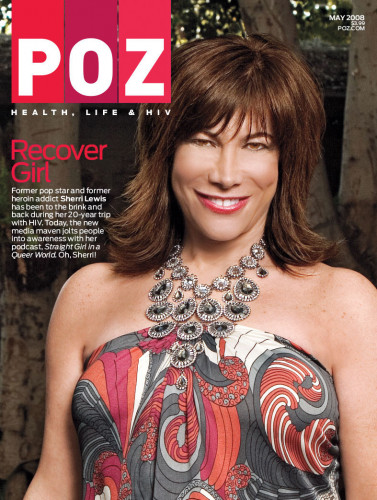
Sherri Lewis on the May 2008 cover of POZ
I broke up with my boyfriend and needed a change, so I moved to Los Angeles in 2000. Dating while being HIV positive was no good. Eventually, after the pain of being rejected or hearing something derogatory, I just stopped. But I still longed to get pregnant and have a family of my own. It was depressing. But I connected with a small HIV group called Women at Risk in Culver City. They had a speakers bureau with few engagements. I quickly got to work on expanding that. Soon we were booking several speaking engagements a week, and our trainings were well attended.
Also in the early 2000s, I hosted a podcast—Straight Girl in a Queer World, for the LGBTQ cable network Here TV—that was all about HIV and AIDS. I did 60 episodes. In one of them, I interviewed Sheryl Lee Ralph [the acclaimed HIV advocate best known for Broadway’s Dreamgirls and TV’s Abbott Elementary]. We became fast friends. She invited me to sing at her DIVAS Simply Singing! event in 2008 to raise HIV awareness. It was a thrill! There are always so many fabulous divas, such as Patti LaBelle and Jennifer Hudson, at her annual fundraisers. She invited me again and gave me a Divas Award. When I was sick with cancer a few years ago, she called me up at the hospital. What a friend!
In recent years, I joined the board for STORIES: The AIDS Monument in West Hollywood. It was unveiled in time for World AIDS Day last year. Board members continue to stay involved through the One Institute. It’s the country’s oldest active LGBTQ organization and creates tours and storytelling events at the monument.
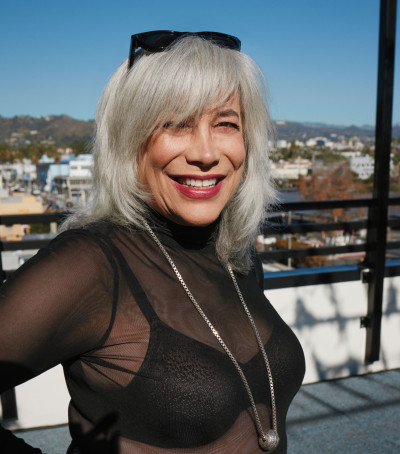
Sherri Lewis in Los Angeles, 2025Ari Michelson
At 71, I’ve made it through COVID-19, hepatitis C, colon cancer, homelessness and multiple losses, and I’m currently caring for my 95-year-old mother, who has dementia. I am grateful for this incredible life and blessed I can remember it.
To be handed a death sentence on your birthday doesn’t make sense. But almost 40 years later, I see it as a gift, because I was able to help others.
When I think back to my golden days in Cambridge, I remember my therapist’s beautiful Victorian house, where her peaceful office was located. I remember the time I was getting ready to write her a check and she stopped me. “Today, it’s on the house,” she said. “It’s our last visit before you move to California. When I took you on I was supposed to help you to come to terms with dying, but all you ever wanted to talk about was life! Now go live it!” I went back to my car and wiped my tears.
Life is grand.
SIDEBAR
Stories: The AIDS Monument
By Trent Straube
November 16, 2025, marked a milestone for the Los Angeles HIV community. That was the official unveiling of STORIES: The AIDS Monument, a 7,000-square-foot outdoor plaza in West Hollywood Park. The monument includes engraved quotes, 147 bronze pillars whose tips illuminate like a candlelight vigil and a collection of curated oral stories and events documenting the history of the HIV epidemic.
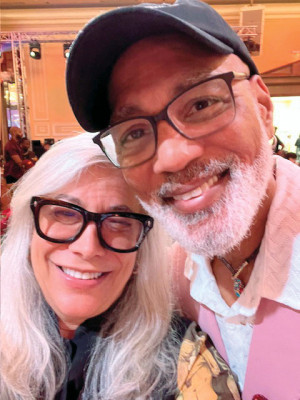
Long-term survivors Sherri Lewis and Phill Wilson in LACourtesy of Sherri Lewis
Long-term survivor Sherri Lewis, a former Top 40 singer turned storyteller, not only attended the cere-mony but actually helped make the monument a reality by serving on the board. “My purpose was to represent HIV-positive women,” she tells POZ. “It’s important to keep the stories alive, and it is my only footprint on this earth to show I was here and I count.” She recalls chatting with fellow long-term survivor Phill Wilson, the former CEO of the Black AIDS Institute. “We were in the green room having some food and drinks before the event started, and I told him, ‘My body aches. I think I need to change my meds.’ To which he replied, ‘Honey, we just got old!’”

STORIES: The AIDS MonumentCourtesy of the City of West Hollywood

Aerial view of Stories: The AIDS Monument, which opened in West Hollywood on November 16, 2025Courtesy of the City of West Hollywood




Comments
Comments