

In 1999, after her husband died of AIDS-related causes, Migdalia Morales, who was herself diagnosed with HIV in 1985, moved from Virginia to New Jersey to be near her daughter. Almost immediately, she craved peer support. “I always try to find a group wherever I am because I need to feel like I belong,” she says. A little research led her to Hyacinth AIDS Foundation, an HIV and AIDS services nonprofit founded the same year she was diagnosed. After an intake at the agency, which had called her a cab to get her there, she joined a weekly support group for Jerseyans living with HIV. Twenty-six years later, she still attends it!
Every Tuesday at Hyacinth’s Trenton office, Morales says about 10 to 13 folks “sit down and talk and help each other. It’s a family thing. It’s diverse—we have males, females, LGBTQ. It doesn’t matter— we’re all one.” Before her mom died in 2018, Morales would take her to the meeting. Recently, she says, the group has been helping her cope with her daughter’s severe depression, anxiety and need for brain surgery to treat fluid buildup. “Everyone in the group’s always asking me, ‘How’s she doing?’ or saying, ‘She’s gonna come out of it OK’ or ‘God’s got you.’”
In addition to hitting her weekly support group, Morales serves on a committee of Hyacinth clients who advise the agency on its direction, attends an online peer group that meets Wednesday nights, started a Hyacinth game night that meets the last Thursday of the month (“I love Uno”) and attends a monthly knitting class (“We even got guys doing it, including a staffer”). The agency has also helped her with housing-related red tape. And she loves Hyacinth’s annual summer picnic for staff, clients and loved ones held at a park in New Brunswick.
“Nobody ever has a sour face” at Hyacinth, she says. “They always greet you with open arms.”
She’s not the only one of the agency’s roughly 1,500 regular clients who feels that way. Much of that Hyacinth love was on display at the organization’s 40th anniversary gala last November at the Hilton in Short Hills, New Jersey. The agency said the fundraiser drew more than 200 guests and raised about $70,000 (to add to its $12 million annual operating budget).
The event honored the statuesque Dominique Jackson, who played Elektra Abundance on the TV show Pose, as well as New Jersey Assemblywoman Shanique Speight, who represents Newark. Speight says she was moved by testimonials at the gala from many Hyacinth employees who had begun as clients. “When you look at Newark, an underserved area, the resources and ability to fight stigma against HIV/AIDS that Hyacinth offers are very important,” she says. “People know they have an organization to lean on when it comes to health.”
At the gala, Kathy Ahearn-O’Brien, Hyacinth’s executive director since 1999, said from the stage: “We will not relive the 1980s. We will fight to keep our doors open for another 40 years. We will keep pushing forward for every client, every advocate, every person who deserves to live free from stigma and fear.”

Hyacinth’s 40th anniversary galaCourtesy of Hyacinth
Her words earned a standing ovation. But if Jersey’s first and still most prominent HIV and AIDS organization is feeling strong as it passes the four-decade mark, it—like countless such agencies nationwide—still faces the herculean challenge of providing for its clients living with HIV and preventing new infections at a time when President Trump’s second administration has all but abandoned its first-term pledge to end the epidemic in the United States. What’s more, Republicans in Congress are slashing health coverage, and the Centers for Disease Control and Prevention (CDC) is abandoning prevention initiatives with mind-boggling speed.
Can Hyacinth, named for a flower that blooms in early spring, symbolizing rebirth, keep hope alive in the immediate years to come?
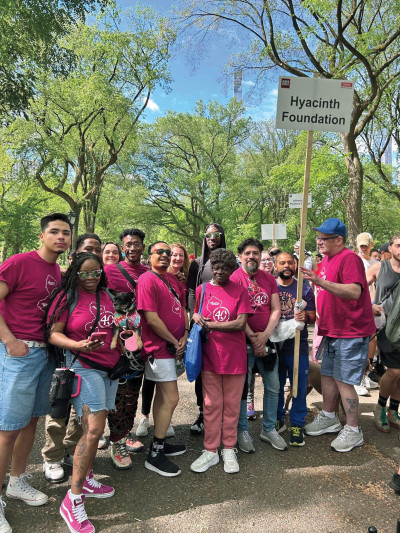
Hyacinth at North Jersey PrideCourtesy of Hyacinth
THE EARLY DAYS
By 1985, New York City had already founded several organizations to address AIDS, foremost among them Gay Men’s Health Crisis (GMHC), which benefited from both the wealth and volunteer time of a legion of gay men and their allies in the face of a new disease that was devastating that community. One woman who had several friends at GMHC was Margaret Nichols, PhD, known as Dr. Margie, a Jersey City lesbian who ran a queer-serving psychotherapy practice. She was watching her own queer community in the Garden State as well as people who used injection drugs—often straight, Black or Hispanic—get clobbered by the new disease.
“I’d already watched two of my own staffers die from AIDS,” recalls Nichols, still a practicing therapist, “and my colleagues and I felt like it was our obligation to do something.” Additionally, she says, GMHC was being overwhelmed with help requests from New Jersey, which it simply couldn’t handle.
Her friend, the pioneering gay New York City therapist Michael Shernoff, MSW, who died in 2008, helped Nichols arrange for folks at GMHC to train her and other Jerseyans to become volunteer hot-line workers and “buddies”—a concept GMHC pioneered that involved pairing individuals with AIDS-related illnesses with a good Samaritan to help them with daily tasks and provide friendship and company. A section of Nichols’s own therapy office served as Hyacinth’s first headquarters. The group was funded by a $15,000 grant from the New Jersey government and some private donations. Nichols was joined in her work by others, including Bill Singer, a gay Jersey lawyer who started Hyacinth’s legal department and traveled to people’s sickbeds to help them write wills.
“When I look back on my life, Hyacinth is one of the things I consider a huge accomplishment, because it was so needed,” says Nichols. She helmed the agency until 1989, by which time she’d fought bitterly but successfully with the state of New Jersey for the additional funding that allowed Hyacinth to open sites in Newark and New Brunswick and hire more staff. Among the services that Hyacinth set up at that time, she says, was sending people into pediatric wards to care for infants who’d been born with AIDS and seldom lived long.
As both the epidemic in Jersey and the agency grew (it currently has eight sites statewide with 120 staffers total), Hyacinth benefited in the mid-’90s from the arrival of Axel Torres Marrero, a Puerto Rico– and New York City–raised young gay man who’d been involved in ACT UP NY. After attending Rutgers, the State University of New Jersey, he was hired in Hyacinth’s prevention department. Under the mentorship of Hyacinth’s executive director at the time, Riki Jacobs (who died in 2009), Marrero quickly became a lobbying powerhouse for the agency and—by extension—for the entire HIV community of New Jersey. “Riki quickly realized that my brain was geared to policy,” says Marrero, who has been Hyacinth’s policy director since 2004.
An early win was expanding disability benefits in Jersey for people living with AIDS, followed by preventing the mandatory HIV testing of people in New Jersey prisons. But Torres Marrero says his greatest victory was finally getting needle exchange—distribution of clean needles to prevent the transmission of HIV and hepatitis C via contaminated syringes—passed in the state in 2007, after a long battle. “I have addiction in my family,” he says, so that triumph meant a lot to him.
Since then, he says, wins have included raising the income eligibility cap for the state’s AIDS Drug Assistance Program (ADAP) as well as constantly getting new HIV and other meds onto the state’s ADAP formulary.
Asked what his 30 years at Hyacinth have meant to him, Torres Marrero chokes up and says, “Other people I know struggle with their passion not matching the work they do. I don’t. I want to do this.” And of the agency itself: “I’m Latin, which means that family means a great deal to me, and this place really is a family—where I get to be that weird analytical person who’s still a bulldog and gets shit done.”
TOUGH TIMES AHEAD
Ahearn-O’Brien shares Torres Marrero’s passion for the work. She says that when she was coming out as a lesbian in the ’80s, “my community was dying, and I thought, What is going on here?” Eager to help as well as “work in a place where I could be who I am,” she left the corporate world and went to Hyacinth in the late ’90s as a part-time worker on the agency’s AIDS Walk event and climbed her way up what she calls “the back of the house kind of stuff”—finance, HR, operations—until she succeeded Riki Jacobs in 2009.
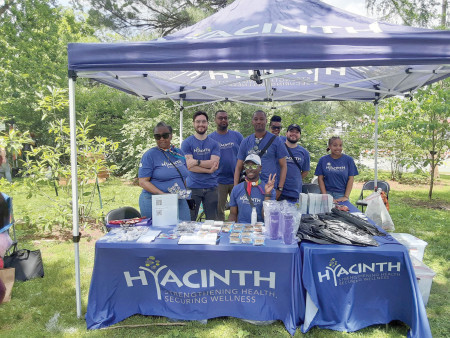
Hyacinth at AIDS Walk New YorkCourtesy of Hyacinth
She remembers a moment from early in her Hyacinth years: “A woman who worked in prevention was crying, and when I asked her what was wrong, she told me she’d just found out that a client of hers was found dead in a doorway, outside in the cold. And in that moment, my life changed, because you don’t go back from that. Once your life is about providing comfort and serving, I don’t see how you walk away.”
And that, she says, includes now, a time when a far-right GOP Congress, egged on by President Trump, has toughened Medicaid eligibility in a way that experts say will knock millions nationwide off the program. It’s also signaled it wants to decimate the CDC’s HIV prevention, testing and surveillance dollars and has eyed deep cuts to parts of the HIV-serving Ryan White CARE Act, including housing, food assistance and help for substance use and mental health issues.
“The bottom line,” says Ahearn-O’Brien, “is that nothing’s changed for us since Trump came back in.” She’s grateful, she says, that New Jersey joined an 18-state lawsuit against Trump’s executive order withholding federal funding for anything deemed DEI (concerning the promotion of diversity, equity and inclusion). “That’s protected us,” she says, “but it doesn’t mean we don’t have whiplash” from the administration’s relentless assault on everything Hyacinth does and the people the agency does it for—LGBTQ (especially transgender), low-income and Black and Hispanic people.
And more threats loom. With CDC prevention funding on the chopping block, “I could lose half my agency budget,” she says, “because I think New Jersey gets $30 million of that money, and there’s no way the state is going to make that up.”
Torres Marrero echoes her worry. “I have never in my life seen this level of coordinated assault and malice” from the federal government “against Black and brown people, LGBTQ people and poor people,” he says. “And I’m an ACT UP veteran!” Even if Congress preserves funding, he says, he can’t breathe a sigh of relief, because the Trump administration has demonstrated its willingness to choke back money appropriated by Congress.
Says Ahearn-O’Brien: “I’ve been saying to my team, ‘Look, I’m gonna have to say things publicly that will scare you, like that we may have to shut our doors.’ I tell them, ‘I don’t know what’s gonna happen, but I can tell you we’re gonna fight like hell.’ In my mind, HIV protesters are the best protesters in the world.”
STILL A FAMILY AFFAIR
Despite uncertain times, Hyacinth goes on providing not just meat-and-potatoes services but a happy home away from home for its clients. Take Conneil J. Gavin, 65, of New Brunswick, a gay Black man who recently retired from his near decade-long role as chair of the HIV/AIDS Planning Council of Middlesex-Somerset-Hunterdon counties. When he was diagnosed with HIV by a county health worker in 2006, she sent him straight to Hyacinth, where that very day he joined the psychosocial support group.
“I was immediately welcomed and supported so I didn’t even have an opportunity to sit and grieve over being positive,” he says. His Christian upbringing had always made him feel “wrong” about being gay and that he would go to hell. “But everyone I met that day at Hyacinth,” gay and straight alike, “reassured me that I wasn’t wrong, and they filled me with positivity.”
He still participates in Hyacinth’s weekly men’s support group, which has been held online since the emergence of COVID-19, but he longs for the in-person meetings to resume. And along with Torres Marrero and other Hyacinth folks, he has attended the annual AIDSWatch event in Washington, DC, where people living with HIV and their advocates from across the country lobby lawmakers for continued HIV funding.
Ask him what role Hyacinth has played in his life, and Gavin answers, “to educate me, support me and celebrate me. Because whenever I go into their office, everyone greets me with excitement. ‘Glad to see you!’ they call out.” Just like the bar in Cheers, he admits, “it’s where everybody knows your name.”
Migdalia Morales agrees with him. “Hyacinth has given me support, stability and positivity,” she says. “When you go in there for the very first time, you’ll feel welcome. It’s like my second home and my second family.”




Comments
Comments