

My brother, Dick, is having a hard time preparing the chicken, despite my hovering and constant instructions. I think he’s a little afraid of it. I’m encouraging him to get under the skin with my pasty concoction of garlic and butter, really slide his fingers under there, but the process is giving him the creeps.
“More butter!” I command, but he’s already recoiling from the chicken, his greasy hands bowed in a state of surrender. “You’re impossible,” I pronounce. “Allow me.” I step forward and take a handful of the paste and start stuffing it under the skin myself.
“This is what you’re writing about?” my husband, Michael, asks incredulously. “About the three of us living together and roasting a chicken?” He’s watching our kitchen prep from a safe distance. “Are you sure you want to write about us? Don’t people already think we’re in a throuple?”
My brother and I squeal, “Ew!” in nearly perfect harmony.
“It’s about family,” I say, finally. “The one you have and the one you make. And how you have to help each other out when you get old.”
YouTube/National AIDS Memorial
Michael and I reflexively glance in my older brother’s direction. He glares back at us. Dick is 78 years old, which can sometimes feel like a generation ahead of me. I’m 65, and Michael, at 62, is the youngest in our household.
“I mean, all of us are getting old,” I say. Now, Michael is the one glaring at me. I can’t win. Talking about age is a losing proposition in a house filled with three gay men who are careful to crop our bellies from photos and utilize every possible filter on our phone cameras.
And yes, my brother is also gay, and his name is Dick King. I know what you’re thinking, and, trust me, he’s heard them all.
Michael has started chopping vegetables for a salad. “And we’re actually going to be…on the cover of POZ magazine?” Michael asks. My husband isn’t comfortable with a lot of attention, which makes him a completely alien creature. My brother and I are theater kids to our core. We could find a spotlight in the produce aisle of the supermarket and use the banana bin as a stage.
“That’s my understanding,” I say.
“And I qualify for all of this?” Dick asks, as if we haven’t had this conversation already. He just likes hearing it again.
“Yes, Dick, you’re going to be on the cover of the magazine too, in all your glory,” I reply. Dick lifts one shoulder coyly and bats his eyes like a blossoming ingenue.
All of us qualify, as my brother put it. HIV became part of our lives a long time ago, even if it crept into our personal histories in very different ways.
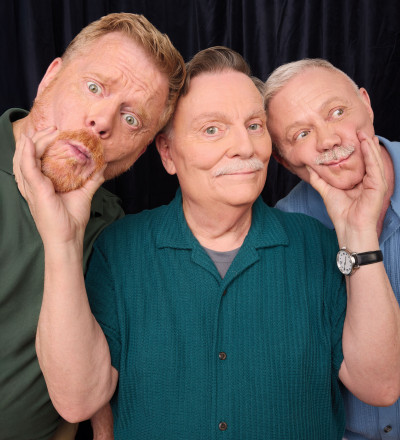
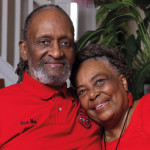
Left to right: Mark S. King; his brother, Dick; and his husband, Michael MitchellDarrell Snedeger
I was diagnosed as HIV positive in Los Angeles in 1985 and haven’t shut up about it since, devoting my life to writing and speaking out as a person with HIV. When you survive this long, trauma comes with the territory, but I have been otherwise fortunate and fairly healthy along the way. The biggest downside to living with HIV for the past 41 years is what it says about my age and how quickly life rushes along.
Dick lived in Los Angeles during that time and was thrust into the HIV scene as well but from the vantage point of someone watching his life partner become sick and die over the course of a few agonizing years.
Dick and his partner, Emil, were once my role models of what gay life, and love, could look like. They had it all, it seemed. And then came the plague and Emil’s diagnosis and the exhaustion and love and heartbreak that come with caring for a partner who is slipping away.
Some images remain in your mind’s eye forever, flashing by when you settle into bed and close your eyes. For Dick, one of them is asking the man he deeply loved not to drink the glass of Scotch too quickly, the one laced with Seconal from a secret stash, the one Emil wanted when he was ready to leave this life on his own terms.
“Wait,” Dick said to his frail lover that night so many years ago. “I want to tell you I love you again before, before—just wait. Please wait.”
Dick has remained HIV negative, but I dare anyone to claim my brother doesn’t know what it’s like to live with HIV. Those are fighting words.
I am watching Michael garnish his salad with cherry tomatoes. He really knows how to make a gorgeous salad. He also knows I am going to tell you about his HIV diagnosis, as private as he is. But Michael understands that hearing what happened to him could help someone, even if the story still hurts.
Michael played by the rules his whole life. He was devoted to the boyfriend he met in college, and they practiced monogamy throughout their relationship, during the worst of the AIDS crisis in the 1980s and ’90s. After they split, Michael remained diligent about safer sex. Every time.
And then one night in 2004, after decades of successfully avoiding HIV, the roommate of a friend attacked Michael. The sexual assault was so violent that Michael ended up in the emergency room. For hours, he lay in shock on a gurney in the hospital hallway because the staff did not know what to do with a gay man who claimed he had been raped. They did not offer Michael post-exposure prophylaxis to prevent HIV transmission. Within two months, Michael tested positive.
It took years for my husband to work through the repercussions of the attack. He tells me he is fine. I believe him, even if I have learned never to physically hold him too tightly. I love him very much, and I am so, so careful.
Yes, HIV lives in this home too. Our past pain and our present joy cement us together into a dark, colorful collage.
Michael and I opened our home to my brother a year ago. He needed someplace to retire affordably, and we had an extra room and a welcome mat for him. It has been a gift for all of us.
We’ve also carried each other, sometimes literally. Last year, Michael had spinal surgery that laid him up for weeks, and then, Dick had a knee replacement. For months, I was the designated “guy who picks things up off the floor.” You would be surprised how many things end up down there. I finally got one of those long grabber doohickeys, but they only used it to point to things they wanted me to pick up. I didn’t mind too much. Our love for one another stretches pretty far, and it hasn’t snapped yet.
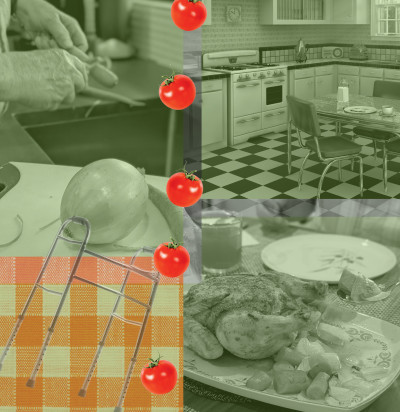
The walker Michael used to get around after surgery barely made it into our storage room before we pulled it out again when Dick had his knee replaced. Then back into storage it went, sitting next to a pair of crutches in what has become our private medical supply stockroom. Whenever I’m searching in there for some damn thing, I could swear the walker actually perks up expectantly, as if hoping to be of service.
Not now, walker. Maybe later. Probably later.
YouTube/National AIDS Memorial
Dick is setting the table. It’s a chore he’s more comfortable with, like loading the dishwasher or walking down to the mailbox. We’re all still finding our lane around here.
“Mark, can you hear me?” Michael is asking. “How many are we tonight?”
“I hear you; I hear you,” I respond. I just don’t pay attention, I think to myself. Even if I am putting off getting the hearing aid the doctor has recommended. “There will be seven of us.”
“OK,” Michael says. “Maybe stop writing the POZ magazine article in your head and get the chicken in the oven?”
Dick is placing paper napkins on the table settings, the kind that make you feel fancy. Usually, it’s a folded paper towel, but tonight is Sunday dinner, and family is coming. They are our chosen family, friends we have known for decades.
Leigh will bring those rolls we all like. Charles will bring ice cream. Lynne will bring me the soda I love, and Jimmy will bring flowers for the table.

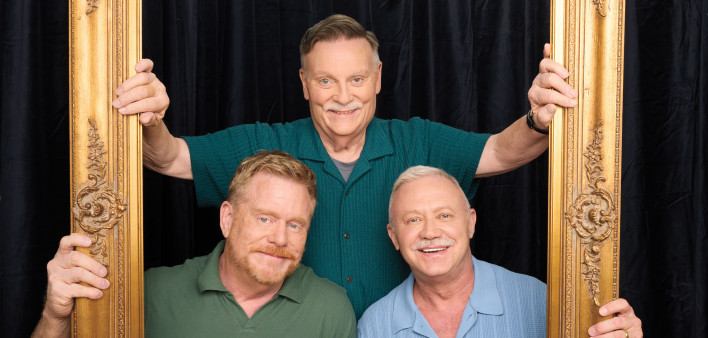
Mark S. King (top) with his husband, Michael Mitchell (middle), and his brother, Dick KingDarrell Snedeger
You hear a lot about chosen family, but the truth is, it takes work. You have to badger people to get them to commit to getting together regularly, even when you’re feeding them. But our family is worth the work. They are a crucial lifeline.
We need family more than we might realize. Isolation is a constant threat as you age. Older people living with HIV have fought HIV stigma all our lives, but now, we’re adding ageism and the loss of social networks to the mix. Researchers tell us that a chosen family—anyone you pull into your orbit for love and comfort—provides support that can lower stress, counteract loneliness and serve as protection from discrimination.
The thing with chosen family is that you need to keep choosing, keep building your own support system and keep offering support to others. It means asking yourself an important question: Whose life do I need to step into a little more closely? Who might need me and doesn’t know how to say it?
Everyone has lives, and even in retirement those can get busy. You have to pierce their daily schedule, make time for them, keep calling, keep inviting.
AIDS wiped out a generation of gay men. We need to rely upon those who remain as well as broaden that circle to include younger friends and family who might be better equipped to step in when we need them.
Dick has begun putting out the dinner plates featuring a 1960s pattern that Michael has collected. They always make the table look so inviting.
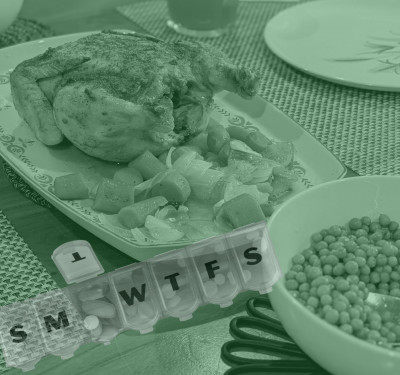
Earlier today, the dining table was piled with prescription bottles. Our monthly pillbox organization fell on the same day for the three of us. We looked like we were in the middle of a game of poker, with little mountains of plastic bottles as our strange winnings.
I remember a time, back before successful HIV medications, when someone organizing their collection of pills meant they were probably going to die. That’s what all those bottles meant to me. I was usually right.
Now, organizing all our pills means we are going to live. It’s profound, really, the psychological shift in how I view my medication. The entire history of HIV treatment can be summed up in the nonchalant way we drop pills into little plastic boxes and snap the covers shut.
It’s not all over, of course. Not yet. We’re still volunteer guinea pigs, as people living with HIV have always been. Now, we’re being closely watched to see how our bodies handle the aging process. I imagine I’ll be watched until the very end. If that helps the next generation live a longer, happier life or leads to a cure I won’t live to see, then that is OK with me.
Nothing, and no one, lasts forever, and that is an unspoken truth in this household. This home we have built together is very likely our last stop. It’s a practical fact of life more than a morbid assessment. So we remind one another to use the handrail on the stairs and to take our meds, and we make sure there is a secure rubber mat in the tub.
Dick is finishing the table, and Michael’s salad looks terrific. I think everything is almost ready.
I just need to straighten up the house a little bit more. Family is coming.
Mark S. King is the author of My Fabulous Disease: Chronicles of a Gay Survivor and a GLAAD Award–winning writer.



Comments
Comments