

In the 1980s, most people living with HIV didn’t think they would live another decade, let alone into their 70s and 80s. In the 1990s came effective treatment, which has only improved since then. Now, it’s not unusual for folks with the virus to be facing both the sweetness and the challenges of old age, just like anyone else. In fact, in recent years, people ages 50 and older made up more than half of the roughly 1.2 million Americans living with HIV.
It’s not uncommon to see people living with HIV on treatment aging into their 80s. Author and activist Larry Kramer, activist Jane Fowler and author Edmund White, all of whom were HIV positive, lived until their mid-80s. While research shows that folks with HIV are at somewhat higher risk for earlier onset of some conditions, including cardiovascular, bone and organ disease, as well as certain cancers and depression, research also shows that folks with treatment-suppressed virus and CD4 counts of 500 or higher are generally projected to live as long as their HIV-negative counterparts—until their late 70s or early 80s.
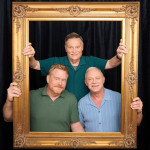
Here, POZ profiles four very different older Americans living with HIV approaching their 80s. What are their challenges? What are their sources of continued contentment and joy?
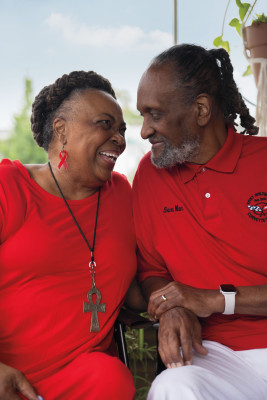
Anna Fowlkes (left) and Paul JohnsNicole Munchel
Anna Fowlkes, 79
Baltimore, Maryland
Diagnosed with HIV in 2006
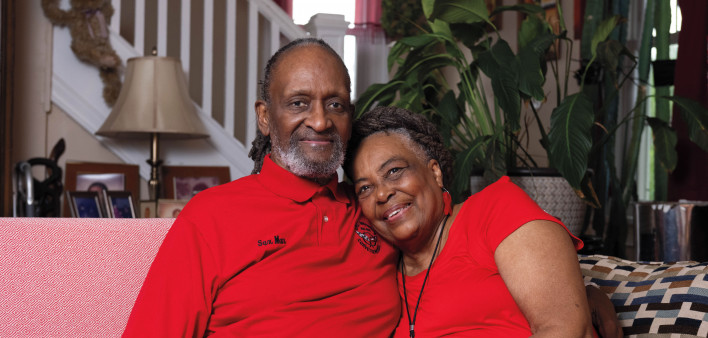
In 2017, the cover of the September issue of POZ featured Fowlkes, then 70, and her boyfriend of two years, HIV-negative musician Paul Johns, then 72. They first met at a music festival, then again at a church HIV awareness event, where Fowlkes publicly disclosed her status to let older folks know they weren’t immune to HIV. Fowlkes contracted HIV in her late 50s from a boyfriend.
Once they were dating, Fowlkes, a former home health aide, wound up looking after Johns after doctors found a growth on his pituitary gland. “She didn’t need me,” laughed Johns at the time, “but there was quite a while when I needed her.”
Nine years later, the couple are still together, and Johns needs Fowlkes more than ever. About five years ago, says Fowlkes, Johns started repeatedly asking her questions like “What is today?” and “How old am I?” Says Fowlkes, “I knew the signs of Alzheimer’s and dementia because I’d worked in home healthcare.” She took him to a specialist who said he was exhibiting signs of cognitive decline.
But it was only after he was tested for amyloid plaques—a key marker of Alzheimer’s—via a blood test the Food and Drug Administration authorized last year that Johns’s diagnosis was confirmed. “I wasn’t shocked or surprised,” says Fowlkes.
Since then, she says, Johns continues to decline, but he’s far from needing to be watched every second, and, unlike some Alzheimer’s patients, he’s not aggressive or hostile. “He still has a great sense of humor and makes me laugh every day. He’ll say, ‘Hmm, I think I’m getting on your nerves.’ How can you be mad at someone when you’re laughing? I’ve learned to cope. Sometimes, I just shut down and say nothing, and he’ll say, ‘You’re not answering me.’ And I’ll say, ‘Well, I’ve answered that question so many times!’”
Thankfully, Fowlkes knows that she needs to take time out for herself. With the long-term care policy that Johns bought years ago, she’s able to pay friends and family with whom Johns feels comfortable to come over and watch him when she goes out to lunch with old friends once every month or so or to get her nails done.
She even vacationed in California for a week while a friend stayed with him. “I knew he was safe and in good hands,” she says. “My friend spoiled him!”
And thankfully, says Fowlkes, her own health is solid, except for arthritis. “My body is getting old, so if I don’t have housework or laundry to do, I’ll relax. And if I don’t get up, Paul won’t get up. But he likes to know where I am. If I go to the market, he’ll come with me because he likes the ride and waits in the car.”
The couple also likes to go hear live music together—Johns was once music director for the soul legend Wilson Pickett. “I’ll play Smokey Robinson’s Sirius XM station in the car because it makes Paul happy,” she says.
Fowlkes still drives from Baltimore to Washington, DC, every other week to be a paid facilitator for two different HIV support groups. “Every time I go, I feel good,” she says. She insists she feels no bitterness that Johns developed early Alzheimer’s less than a decade after they met. Rather, she’s philosophical about it.
“Years ago,” she says, “I read an article where an 85-year-old woman with cancer said to her doctor, ‘Listen, I’m old enough to die.’ You reach a certain age where you’ve got fewer years ahead of you than behind you. So now, we just go with the flow. Growing up in a very religious family, I was taught to accept whatever comes my way. I never say, ‘Why me?’ I say, ‘Why not me?’”
Fowlkes says she’s got a son and grandchildren to help her when it gets to the point where she, as well as Johns, needs taking care of. Until then, she has this advice for herself and others aging with HIV: “Don’t think about what might happen—-just enjoy the fact that you’re alive and well.”
And she says caring for Johns is no burden: “If you love someone, the things that happen aren’t necessarily challenging. If you have to clean them up, you just do it. That’s the for-better-or-for-worse part of loving someone.”

The Rev. Dr. Dee CalmettCourtesy of Dee Calmett
The Rev. Dr. Dee Calmett, 76
Palm Springs, California
Diagnosed with HIV in 1983
About 20 years ago, recalls Dee Calmett, “I said to someone, ‘When I get older, I’m going to live as a woman.’” At that point, Calmett was living as a gay man, one who’d left behind his life as an evangelical pastor in his 30s, no less. “I’d always felt like a two-spirit, like there was a man and a woman living inside my body,” Calmett says. “There was such a battle going on inside me that I decided suicide was the only way out.”
Happily, she didn’t take that route. Instead, about seven years ago, she met some other transgender and nonbinary people who encouraged her to pursue her true identity. She found a doctor who confided that he, too, felt he was a two-spirit, and he started her on hormone therapy. She changed her name from Damien to Dee. (She says the “Rev.” in her name for reverend is because she’s an ordained minister, and the “Dr.” indicates her doctorate degree in spiritual science.)
Asked what word summarizes her journey the past several years, she answers: “Growth. It’s not really about transitioning, because this is what I’ve always been—I just didn’t know it.” And she proudly contributes to her newfound community, organizing talent- or fashion-show fundraisers for Palm Springs’s Transgender Health and Wellness Center.
That’s in addition to her full-time job as a patient navigator and volunteer coordinator for DAP Health, Palm Springs’s sprawling LGBTQ health services nonprofit. There, she also oversees Miss Dee’s Boutique, which gives free used clothing to people in the area experiencing homelessness. “We’ve since given clothes to almost 900 people,” she says.
As if all that weren’t enough, she also hosts Miss Dee’s 5th Sunday Transdenominational Sing, an ongoing choral event that raises money for regional charities.
Diagnosed in 1983 with what was then called AIDS-related complex, she followed up her stint as an evangelical pastor with one as a female impersonator—one named Ivana Tramp by no less a drag ally than Joan Rivers, for whom Calmett opened years ago. But her performance years were also marked by heavy drinking and drug use (she once drank a whole bottle of Grand Marnier before getting onstage). A period spent using meth, during which she approached what she thought were two hot men but turned out to be a pair of palm trees, was her wake-up call. In 2000, she cleaned up her act, relying on SMART Recovery, an alternative to 12-step programs that treats recovery as a set of learnable skills and draws on cognitive behavioral therapy.
That paved the way for her gender journey. Does she regret not transitioning earlier in life? “A part of me does, because the hormones kick in a lot better” younger in life, she says. “But overall, my whole life experience—related to HIV, to being transgender, to being in the ministry and even drug addiction—has helped me to meet people exactly where they are.”
She admits she never thought she’d live as long as she has. “I feel like I’m alive with purpose,” she says. “To always be coming from a place of kindness is my superpower, even if I have to speak a harsh reality, like taking the car keys away from a friend who’s been drinking or doing drugs.”
She finds joy in taking Minnie, her 12-year-old Maltipoo dog, out on walks or drives. And she says she’s driven by hope. She stocks her fridge with water bottles she labels “Joy,” “Peace”, “Happiness” and “Abundance.” “Every morning,” she says, “I reach in and grab one. And whatever it’s labeled, that’s what I envision filling every cell of my body as I drink it.”
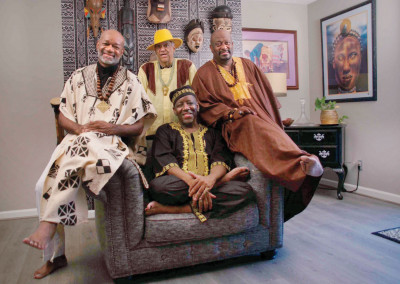
The Rev. Elder Claude Bowen (top center) with friendsCourtesy of The Rev. Elder Claude Bowen
The Rev. Elder Claude Bowen, 79
Atlanta, Georgia
Diagnosed with HIV in 1996
The Rev. Elder Claude Bowen finally realized he wasn’t going to die anytime soon when he made it past the two-year anniversary of his 1996 HIV diagnosis without getting sick. When diagnosed, he says, “I was told that I wouldn’t live to 45.” So to have proved that wrong “is a personal joy.”
And Bowen has used the extra time well. A former postal worker who moved from Los Angeles to Atlanta in 2006, in part to be closer to his grandkids, he’s heavily involved with Atlanta’s THRIVE SS group for gay, bisexual and same-gender-loving Black men living with HIV. With a half dozen of his buddies from the group, he attends happy hours, potluck dinners and house-music dance parties, goes on regional road trips and more.
He’s the group’s oldest; the youngest is 59. “We’ve bonded through being HIV positive,” he says. They also have keys to one another’s houses and promise to check in on one another if someone on the group text thread doesn’t answer within two days. “We’re a real brotherhood,” he says.
A former ordained deacon with the Black LGBTQ Unity Fellowship Church, Bowen is no longer involved with the church but still makes spirituality a big part of his life, meditating and listening to jazz in bed for hours each morning, before getting up and having a cigar and coffee before breakfast. He also likes meditative writing. “I’ll reflect on what I’ve been through, but I’ll only read it a month later,” he says. “Then I’ll think, Oh, you came through that and you’re all right.”
Bowen says he derives joy from telling younger people what it was like living with HIV in the “bad old days” before effective and easy-to-take medication. “I tell them that we had to have friends’ memorials services or funerals at clubs because the churches wouldn’t allow it and that we hid our status for fear that our families would abandon us. So when I see the younger ones who are living with the virus get into HIV care, that’s a reward for me.”
Coming up on 80 feels great, he says, even though he has neuropathy in his legs and feet from the chemotherapy he underwent to beat prostate cancer. He admits he has survivor’s guilt when he thinks of his many friends who’ve died. “Why are they gone and I’m still here? But then I accept that if I’m still here there’s a plan for me. So I embrace that.”
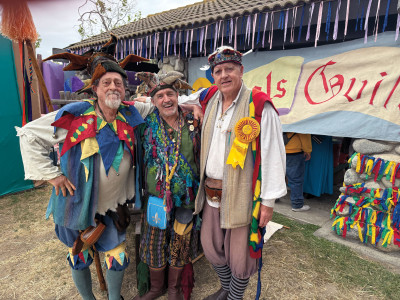
James Patrick Kelly (left) with friendsCourtesy of James Patrick Kelly
James Patrick Kelly, 79
Los Angeles, California
Diagnosed with AIDS in 1981
As we age, it helps to have a passion, and James Patrick Kelly’s passion is definitely Renaissance faires (RFs). The retired media ad salesman has been attending them since 1969, even before he moved to Los Angeles. “I was young and cute,” says Kelly of his early RFs. Since then, the RFs he goes to throughout California have come to represent community to him. “About 90% of my friends in my life now are in some way connected with them. It’s a creative community full of performers and artists—like summer camp for hippies without any adult supervision.” At a recent RF, he says proudly, “I was the 13th King of Fools.”
Kelly also revels in community right at home. He lives with two longtime friends and fellow RF-goers, Richard and Jerry, in the Echo Park home he bought in 1992 and has since renovated. That arrangement started when he invited Richard to come live with him while Richard recovered from bladder cancer. The trio live with their two poodles, Horgos and Kento, named after late friends. “We live here and garden, enjoy one another and take the dogs and a Frisbee to Griffith Park,” says Kelly.
They also support one another through their health issues, which for Kelly includes a rare, severe autoimmune disorder called VEXAS syndrome that causes enlarged red blood cells. “I have low hemoglobin and am weary all the time,” he says. “Even walking is difficult.” He’s about to have his second blood transfusion for the disorder, after which, he says, “I’ll feel fine.”
Kelly is also a longtime HIV survivor, having been diagnosed in 1981 with the emerging syndrome in gay men that a year later would come to be called AIDS. He lost a man he calls his “beloved honey” to the disease in 1998. He credits Los Angeles HIV treatment pioneer Michael Gottlieb, MD, with keeping him alive all these years. “Once, I had only nine T cells,” he says, “but at this point, HIV really doesn’t affect my life much at all.”
And speaking of his life, he says: “I’ve had a wonderful one. I live with people who love me and take care of me. I love my family and get along with my siblings. I own my house. I have enough money to live. And I have creative friends that I have a good time with.”
Does he think he’s lived this long with HIV for a reason? “I think I’m here to take care of my friends, to lead a creative life and to be happy,” he says simply. “And I’ve succeeded at that in spite of illness and death.”



Comments
Comments