


“Culture war” emerged as a term in the United States in the early 1990s as a catchall for the fault lines between conservatives and progressives over abortion, censorship, school prayer and more.
AIDS, Art & the Origins of the Culture War, journalist and curator Robert Atkins gathers more than three decades of his writing to argue that art and AIDS are essential to understanding the culture war. Now 70, Atkins was an early chronicler of the cultural response to HIV, writing for Artforum, The Village Voice and others. He also cofounded Visual AIDS, which launched the iconic red ribbon and the annual Day With(out) Art.
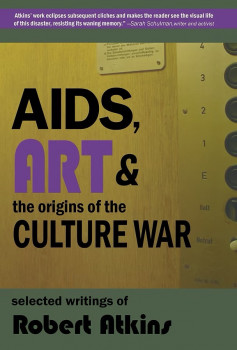
Out this spring, AIDS, Art & the Origins of the Culture War features a new essay offering a long view of our moment through art, AIDS and the past 50 years. The rest of the volume organizes his writing by theme—AIDS, censorship, queer expression—pairing substantial essays with excerpts from media forums, interviews and event summaries that reveal how art, AIDS and the culture wars intersect.
In the book’s foreword, editor Jeff Weinstein provides context for early AIDS cultural criticism and Atkins’s centrality in that work while underscoring the urgency of the present. After the Trump administration decided not to commemorate World AIDS Day last year, Weinstein asked Atkins what he thought about the current knife into the heart of our recognition and safety: “I’m appalled at the end of 2025 that the Trump administration is withdrawing U.S. recognition of World AIDS Day,” Atkins told him. “Symbols are important, we know. But perhaps worse is that HIV drugs are being priced beyond the means of people who need them.”
In the interview below, Atkins discusses with POZ his process writing the book, the role of images in his work and the links he sees between the ongoing HIV response and the broader crises unfolding in the United States.
What was the impetus for the book?
Over 20 years ago, I hired somebody to gather all my articles from across the many publications I wrote for into Word docs. This was a big project, as some of the sites I wrote for are no longer around, and many, like The Village Voice, were slow to make their archive easily accessible. That was back when I was in New York, before I made the decision to change my life and move to California. Then, for many years, I did not work on the project, but once Trump was reelected, it seemed essential to get this stuff out. Since September, with my publisher Amarna, we have been working our butts off to get it out this spring. I did not want to work with another publisher who might have a long, drawn-out process; I did not want to wait until the fall. The writing seems so relevant now.
What is it about art and AIDS that makes them useful to understand the last 50 years?
Both provide positive examples of succeeding in such a cantankerous world. I think art is the most powerful form of consciousness, of intelligence. Think about when Gran Fury put a sign over the East Village reading, “All people with AIDS are innocent.” Now we can argue about if that was art, but we can’t argue that it worked to change consciousness.
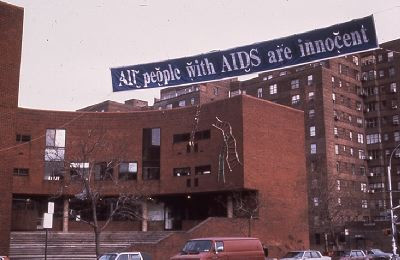
All people with AIDS are innocent, 1989, New York.Gran Fury
I think AIDS activists were and are crucial in putting words to experiences. Think about the public health advocates who, decades into the crisis, long after mainstream media stopped paying attention, made the point that an emergency can’t go on for 25 years. That’s no longer an emergency. As Jeff Weinstein’s essay points out in the prologue of my book, there were 600,000 deaths last year globally.
How did it feel looking back on this body of work while having an eye on the present?
I couldn’t get beyond a certain point in the process without welling up with tears. And I know why. I look back on that era and I think, how did we ever do as much as we did? Remember, there were a lot of friends who were ill and needed help. I was lucky. I had a live-in relationship that was actually a good source of support. Still, I don’t know how I had the time to do it all. In thinking about the present, whatever Trump is doing, I feel like we’ve seen it before, and we’re really fortunate he’s such a bumbler, in addition to being weirdly brilliant, trying to get everything he can get right now to keep himself out of jail.
Are there lessons in the older writing that you hope are useful now?
I don’t know. I don’t really agree with the idea that one learns directly from the past. I think there are things to learn from the past, but it’s not so obvious or direct. If you look at Reagan and the epidemic, that is a story that points out a good way to suppress a portion of the population’s voice, but now we’re drowned out by too much social media around certain issues. In some ways it’s the opposite. I think the book suggests one has to look really closely at what is possible.
With that in mind, do you have any hopes for the book?
I hope it will make clear that there’s always something you can do. The book includes writing about the early days of Day With(out) Art and about the initial circulation of the Silence = Death image. Both grew out of conversations between people. I hope it will remind people of the importance of their own points of view and how conversation can bust through the forces of alternate truths and lead to activists establishing their genuineness. I am thinking about this now as we witness the Epstein survivors, the activists emerging from the Minneapolis siege. Who isn’t thinking about that image of the boy in the blue hat being used by ICE? As with HIV, what is happening with the [Epstein] files and anti-ICE activism are studies of how the effectiveness of images is really important.
In the book and in our conversation, you toggle between art, activist images and news media. As a critic, do you think there are differences between how you or a reader should consider different visuals?
Art is just another form of the image industry. That’s why I have absolutely no trouble seeing Silence = Death as an artwork. Things can mean different things at different times in different audiences. I think that the variability of art is so interesting. I remember giving out red ribbons on New York City buses, and it really was the only way you could engage someone in a conversation about HIV. But it was not without risk for me or them. You could lose your housing if someone thought you had HIV. Anyone who’s publicly seen to be with HIV had to really look around before he opened his mouth. I sense that same level of fear coming out of Minneapolis right now. It is a risk to stand up for oneself and others.
Theodore (ted) Kerr is a Brooklyn-based writer and organizer whose work focuses on HIV and AIDS, community and culture.

Comments
Comments