


What is an AIDS poster? Over the years, they have been used to share lifesaving information, spread activist messages and promote events. For historian Ian Bradley-Perrin, PhD, an AIDS poster is something more: “a record of optimism,” a way of tracking the story of hope, effort and community amid an ongoing crisis.
Bradley-Perrin shares this view as curator of Love & Fury: New York’s Fight Against AIDS, an exhibition at New York City’s Poster House, an institution that board president Valerie Crosswhite describes as “dedicated to showing the global history of posters” while maintaining “a deep commitment to our local audience.” The 40-plus posters in Love & Fury honor both goals. Drawn from the worlds of public health, protest and advertising, these posters were displayed on the city’s streets and subways and in its civic spaces from the earliest days of the epidemic through the early 2000s and had a worldwide impact.

Poster by Boris VallejoCourtesy of Poster House
As visitors enter the exhibit, they are met by a poster promoting the New St. Marks Baths, a legendary bathhouse that closed during the moral panic of the early AIDS years. Dated 1979, it depicts a fit man riding a fantastical beast, reflecting the sexual exuberance of a specific moment while casting melancholy for an audience that knows what comes next.
This dichotomy flows throughout Love & Fury. Across from the hunk on the sci-fi dinosaur hangs a jaunty Keith Haring illustration of a penis warning about condom use, part of a section on safer sex. Nearby, visitors can get close to posters made by some of the earliest people knowingly living with AIDS, activists who pooled their knowledge and dwindling time on earth to share prevention messages and in doing so saved lives.
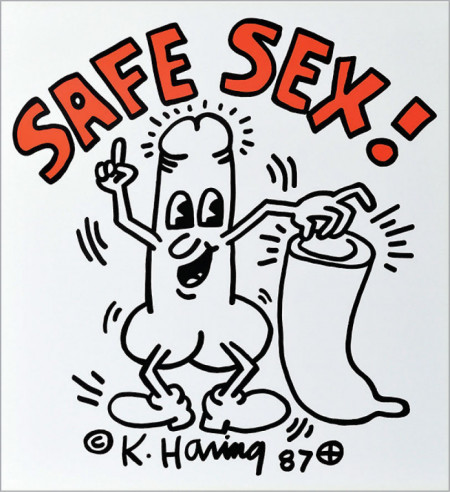
“Safe sex!”Copyright © Keith Haring Foundation/courtesy of Poster House
For Bradley-Perrin, optimism is inseparable from context. A poster, he says, “forces you to think about the person who designs the poster” and the audience it was made for. Among the most famous works in the exhibition, the Silence=Death poster captures this idea. Created in 1986 by a group of gay men who felt isolated in a world being reshaped by AIDS, it now serves as an inverse of the St. Marks Baths poster: Born of desperation, it endures decades later as the symbol of AIDS activist power.
One unexpected thread of optimism in Love & Fury is the role of New York’s fashion industry, explored through scholar Natalie Nudell’s book In American Fashion, which tracks how, devastated by loss, designers and store owners used their platforms—including posters—to raise money and awareness. The largest work in the show captures this: a wall-sized Benetton ad in which the word AIDS appears among a cascade of vibrant faces.
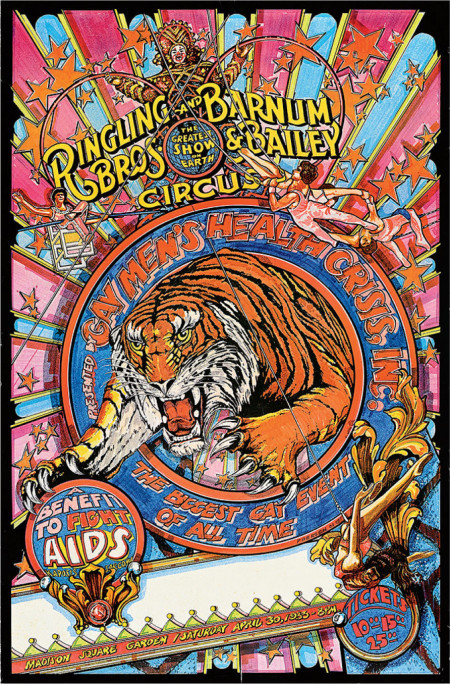
Poster by Enno PoerschCourtesy of Poster House
AIDS posters are not only about the past. Trevor Ladner, director of education programs at One Institute, uses them to connect generations, sharing AIDS posters on social media, in curricula and via programming to bridge history and the present. For young people, he argues, they reveal “the labor and creativity that went into organizing before the advent of widespread digital communication.”
Bradley-Perrin agrees. Yet now that the exhibition is open, he is learning what posters alone cannot communicate: what came next. At events and tours, visitors share the impact these images had on them, filling in the human story behind the artists’ intent. For an ongoing crisis, that may be exactly the right way to look at them.




Comments
Comments