

The first thing I noticed wasn’t anger. It was confusion.
People stopped in front of the claw machine at Lakefront Park in Kissimmee because it looked harmless—teddy bears, bows, tiny outfits inspired by Keith Haring’s iconic visual language. Some smiled. Some laughed. Some filmed it on their phones. Then they won a toy, pressed it to their ear and heard a childlike voice asking why no one was protecting their health care.
The smile disappeared. Their posture changed. They stood still.
In that moment, the illusion broke. What they thought was entertainment was actually testimony.
That moment—that pause—was a return to HIV activism. Not as protest signs, but as interruption.
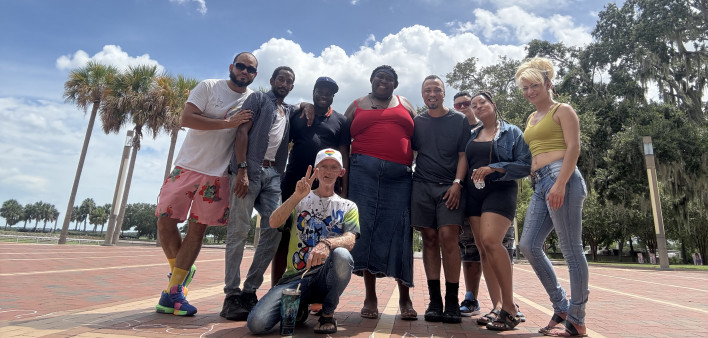
In the summer of 2025, I led five artistic activism experiments across Central Florida in response to growing instability around HIV prevention and care. These were not traditional demonstrations. They were invitations. A collective mural inspired by [the Afro-Puerto Rican music and dance] Bomba tradition. A public collage station where participants created messages to senators. A photographic intervention featuring members of our own community. A performance by Bomba dancers wearing hand-painted garments. And finally, the claw machine—a piece designed to disarm people with innocence and confront them with truth.
I wasn’t trying to recreate ACT UP. I was trying to answer a quieter question: Are people still willing to act?
That question became personal earlier that spring when I attended AIDSWatch in Washington, DC, through the National Minority AIDS Council fellowship. Sitting in those rooms, I felt something I had not felt in years—fear. Not the fear of the unknown epidemic of the 1980s but the fear of erosion. The realization that access to care, prevention and stability could quietly weaken, that progress is not permanent, that infrastructure requires vigilance.
For many people in Florida—especially in Latinx, Black, immigrant and LGBTQ+ communities—HIV has never been just a medical condition. It has always been tied to housing, immigration status, language justice, insurance access and survival. And yet, many people I spoke to during our activations had no idea these systems were under pressure. Almost everyone said some version of the same sentence: “I didn’t know this was happening.”
That lack of awareness wasn’t apathy. It was distance.
Activism today looks different than it did decades ago. Social media has made visibility easier but physical presence rarer. Comfort has replaced urgency. Biomedical advances like PrEP [pre-exposure prophylaxis] and long-acting injectables have transformed HIV from a death sentence into a manageable and preventable condition. For those of us who are HIV negative, the fight is no longer about surviving HIV—it is about ensuring access to the tools that prevent it in the first place.
Through support from the Center for Artistic Activism and Latinos in the South, I used artistic experimentation as a civic tool. Each activation followed a simple principle: make people think, make them feel and give them an opportunity to act. We observed carefully—who stopped, who engaged, who asked questions, who walked away. Florida’s weather challenged us constantly. Winds broke mural panels. Rain emptied the park. But the people who needed the space kept returning.
What surprised me most was not how many strangers participated but how deeply the work resonated with those already living closest to uncertainty. Participants from behavioral health programs, volunteers, undocumented community members, members of the Central Florida HIV Planning Council and individuals navigating recovery became our most consistent collaborators. Many told us the gatherings became ritual—a place where they could process uncertainty, visibility and fear together.

The legacy of HIV activism has always included artistic intervention, particularly from artists and communities of color who have long used creativity as a tool of survival. ACT UP understood that public imagination had to shift before policy could follow. Today, the threat feels quieter, but it is no less real. Florida remains one of the states with the highest rates of new HIV diagnoses, and the communities most affected continue to be those with the least margin for disruption.
What does it mean to bring HIV activism back in 2026?
It does not mean replicating the past. It means adapting to the present. It means recognizing that the radical act today is not necessarily confrontation but creation—creating spaces where people can understand what is happening, where they feel visible and where action becomes possible.
In October 2025, I had the opportunity to present these works in a gallery exhibition at The Bakery Atlanta [an arts nonprofit] as part of Encuentro, organized by the Latino Commission on AIDS as their official National Latinx HIV/AIDS Awareness Day event. Bringing these pieces into a gallery space allowed the conversation to expand beyond the park—reaching new audiences, slowing people down and inviting deeper reflection on what is at stake and what is still possible.
For World AIDS Day, I coordinated a large-scale participatory red ribbon installation—an invitation for collective memory and collective responsibility. This piece created space for people to remember those we have lost, honor those still living and recognize the fragile but powerful systems that sustain care and prevention.
These projects are not conclusions. They are beginnings—openings into new paths of possibility, creation and joy. They remind us that artistic activism is not only about responding to crisis but about building futures where our communities feel visible, protected and alive.
Because testing the waters revealed something important.
People are not indifferent.
They are waiting.
And sometimes, all it takes to begin again is a claw machine—and a small furry messenger named Osito.
What three adjectives best describe you?
Artistic, likeable, spicy.
What is your greatest achievement?
I had a solo art show in Atlanta last year.
What is your greatest regret?
Not starting my diet yesterday.
What keeps you up at night?
RuPaul.


1 Comment
1 Comment