

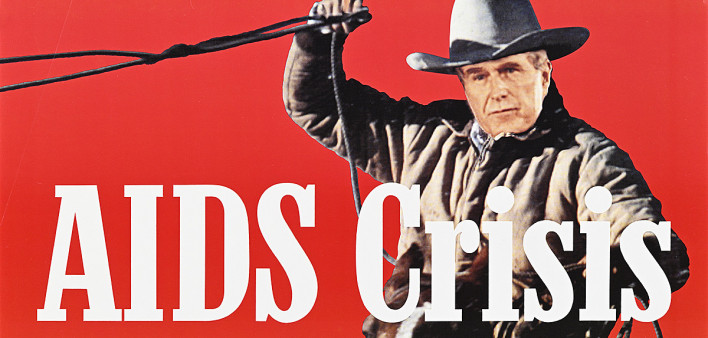
When AIDS first struck New York City in the 1980s, the crisis wasn’t met with an appropriate, organized campaign from the government. Health care specialists didn’t even know what caused the epidemic, and it wasn’t like the general public could google information or join Reddit discussions about HIV and AIDS. How did people share information and mobilize?
Answers are on display in the exhibition Love & Fury: New York’s Fight Against AIDS at Poster House in Manhattan.
View this post on Instagram
Curated by HIV historian Ian Bradley-Perrin, PhD, the show collects posters, flyers, advertisements and similar items spanning 1979 to 2003. As Poster House explains:
“When AIDS hit New York, posters spoke where institutions stayed silent. In a city wired for visual competition—crowded streets, subway ads, nightclub flyers—posters became lifelines. They were how people found clinics, mourned the dead, demanded justice, and fought for the living.
“This exhibition explores how graphic design shaped New York’s grassroots response to AIDS from 1979 to 2003. Public health campaigns, agitprop, benefit flyers, and club handbills offer more than messages—they map how communities built survival systems from below, often before the state would act.
“These posters were not ornamental. They served as a communications infrastructure: maps to clinics, calls to protest, love letters, and warnings. They made an invisible epidemic visible, and they did more than express grief—they organized. As scholar Douglas Crimp has written in his book Melancholia and Moralism, AIDS demanded both “mourning and militancy.” These posters ask viewers to see the epidemic not only as a public health crisis but also as a fight over who is seen, who is heard, and who is allowed to live. While posters were a medium for reflecting an experience, they were also intended to affirm and secure life itself.”
You don’t have to travel to Poster House’s Chelsea location to enjoy these stunning visuals. Visit Poster House’s Facebook page and Instagram page for images and discussions.
View this post on Instagram
What’s more, the exhibit’s website offers a Timeline of Action & Loss that includes not just a history of the epidemic but also a collection of the show’s artworks. Each item includes a write-up offering history and context.
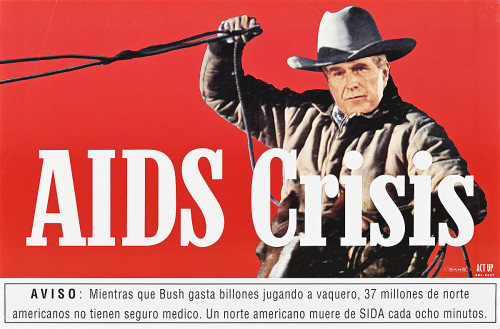
“AIDS Crisis,” 1990, by ACT UP/GangCourtesy of Poster House Permanent Collection
For example, the poster above, titled “AIDS Crisis,” was created by ACT UP/Gang in 1990. It’s helpful to know that the image is a riff on the classic Marlboro Man cigarette campaign, replacing the macho icon’s face with that of then-President George H.W. Bush. The new image makes the case that Bush, with his inaction against AIDS, is much like cigarettes: a public health threat. Although Bush did sign the Ryan White CARE Act into law in 1990—the legislation funds HIV care and treatment to low-income people affected by HIV—his administration only approved a third of the requested budget.
You can read more details on the museum’s placards with each artwork—the text is also found on Poster House’s website.
(As a related sidenote, the Ryan White HIV/AIDS Program remains vital in 2026, providing care to over half the 1.2 million people living with HIV in the United States; however, the Trump administration and state governments have been cutting Ryan White budgets, which could lead to a dramatic rise in new HIV cases.)
View this post on Instagram
Folks able to visit the New York exhibit can also attend in-person events, including numerous tours as well as Community AIDS Memorial Quilt-Making Workshops on Saturday, April 25 and Sunday, April 26. Saturday, August 1, there will be a screening of What Wondrous Love is This, a documentary in which Brooklyn-based journalist and director Tim Chaffee explores the work of his mother, Barbara Chaffee, MD, a public health doctor in Binghamton, New York, who confronted the simultaneous epidemics of drug addiction, AIDS and HIV in the 1980s and ’90s and later faced her own personal struggle with cancer.
Love & Fury: New York’s Fight Against AIDS runs until September 6 at 119 W. 23rd St, New York City.



Comments
Comments