

This Pride season, meet some of the queer members of the HIV community who’ve been fighting back the hardest, day in and day out—and even notching victories.
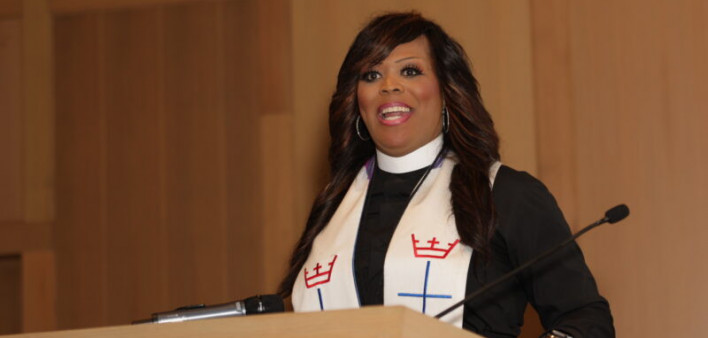
The Rev. Elder Carmarion D. Anderson
At the annual AIDSWatch conference in March, just outside Washington, DC, several participants living with HIV held a mock funeral—complete with black caskets and pallbearers—during which they got up and read their own obituaries owing to likely deaths from impending cuts to lifesaving HIV programs, like the Ryan White CARE Act. Thankfully, those cuts were averted—for this year at least.
And presiding over the mock funeral was a very real religious figure—the Rev. Elder Carmarion D. Anderson, minister for Congregational Leadership for the United Church of Christ National Ministries. “This is about dignity, and together, we are here not to mourn, but to warn,” Anderson declared to those assembled. “When HIV funding is cut, lives are lost.”
It was not the first time in the past 18 months that Anderson, who is transgender, has brought spiritual heft to activist campaigns in the face of assaults on transgender people as well as on HIV funding. In June 2025, she gave a sermon at DC’s National City Christian Church as part of last year’s National Trans Visibility March. “We as a community have abundant power,” her words rang down from the pulpit. “We didn’t travel all the way to Washington, DC, to sit silent while the world legislates our erasure.”
Born and raised in Dallas, Anderson plays a unique role in fighting stigma within the Black church against LGBTQ people and those living with HIV. “In a Black church, congregation members will listen to their faith leaders before they listen to CNN or MSNBC,” she says, “so normalizing this conversation around HIV and prevention is crucial.”
She’s constantly traveling to preach the good word. Last year, she attended Gilead CommUnity Vision 2025 in Amsterdam; in March, she participated in a rally for the Christopher Street Project, a transgender lobbying group, where she gave the invocational prayer.
And she knows that her fortifying words are needed in dire times for both transgender people and those with HIV. “Every day is difficult to navigate for us right now,” she says. “We ask ‘What else am I going to lose? Am I going to be put in harm’s way?’ But I know I’ve been called to make sure that my visibility is used for education and empowerment. As a faith leader, I can advocate—just like a politician.”
The Rev. Lauren Banks
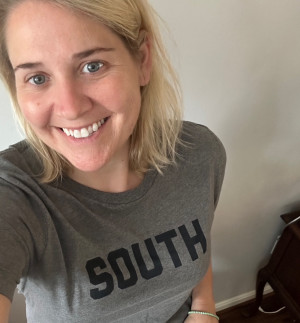
Lauren Banks
In a country with more than 1 million people living with HIV, roughly 50,000 of the most vulnerable among us rely on funding from the longstanding federal Housing Opportunities for Persons With AIDS (HOPWA) program to keep a stable roof over our heads. That’s why HOPWA recipients were horrified last year when the Trump administration’s budget for 2026 called for eliminating the program entirely.
And it’s also why those same folks—and the HIV advocacy community at large—were shocked when, in early February, Congress ultimately not only spared the program but also gave it a 5% bump, from $505 million to $529 million.
That coup can be heavily attributed to the tireless work of Lauren Banks, executive director of the National HIV/AIDS Housing Coalition (NHAHC) since 2021, and her team of four stipended interns—including MJ Maestas from Colorado, Valerie Pinkston from Mississippi and DeKeitra Griffin from Louisiana—all of whom are living openly with HIV and have experience being unhoused. The NHAHC team went to Washington, DC, twice in the past year to, in Banks’s words, “tell their legislators how their housing was the thing that changed their lives and allowed them to become virally suppressed or to overcome addiction.”
And they were joined in DC by more than 40 others last September for NHAHC’s Hit the Hill for Housing event, which pulled off more than 45 visits to lawmakers’ offices in one day. Along the way, says Banks, their personal stories made huge differences, even in the offices of Deep South Republicans.
For example, says Banks, when Pinkston, who relies on HOPWA funding, was sitting across from the staffer who handles appropriations for Mississippi Republican Senator Cindy Hyde-Smith, Pinkson began to cry and said to him, “I need you to promise me you won’t make me homeless,” recounts Banks. “And she said, ‘Yes, ma’am, I promise you.’ It was one of the most powerful advocacy moments I’ve ever seen.”
And with this year’s White House budget once again calling for the elimination of HOPWA, NAHC has yet more work to do. But Banks is hopeful that NHAHC and its allies can not only spare the program again but get it another funding bump. “We should always ask and fight for more,” she says.
It’s all highly personal work for Banks, an Episcopalian priest who worked at AIDS Alabama before landing at NHAHC. “A big piece of this work for me is my faith,” she says, “and as someone queer from the Deep South, I see how people living with HIV have been screaming at us for years that housing is their No. 1 need. That’s what motivates me every single day.”



Comments
Comments