

This Pride season, meet some of the queer members of the HIV community who’ve been fighting back the hardest, day in and day out—and even notching victories.
Asia Russell
Since President Trump reentered the White House in January 2025, his administration has assaulted the President’s Emergency Plan for AIDS Relief (PEPFAR), the once-celebrated U.S. HIV treatment and prevention program started by President George W. Bush in 2003 that has saved millions of lives worldwide.
Trump and his deputies, like Elon Musk, Robert F. Kennedy Jr., Russell Vought and Peter Marocco have done everything in their power to diminish PEPFAR, including nearly completely dismantling the U.S. Agency for International Development (USAID), PEPFAR’s key implementation partner, withholding pre-exposure prophylaxis (PrEP) from everyone except pregnant and breastfeeding women, and refusing to flow funding that Congress had previously appropriated to PEPFAR.
The result is the slow drop-off in HIV treatment rates in countries including Zambia, where the Trump administration has been threatening to withhold further HIV aid if the country doesn’t agree to share its precious minerals with the United States.
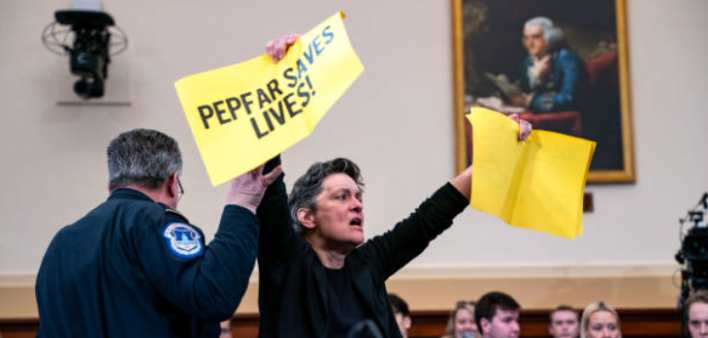
A tireless fighter against all this carnage is Asia Russell, the longtime executive director of Health GAP, which played a key role in getting PEPFAR started in the first place. Along with fellow advocacy groups like AVAC and countless groups on the ground in PEPFAR-recipient countries, Health GAP has fought back against the administration in myriad ways, including convening twice-weekly emergency mobilization calls with advocates and service providers worldwide last year when the assaults began, disrupting official administration hearings and partaking in a massive protest in front of the State Department in April 2025 that featured 200 coffins—to symbolize impending deaths around the globe due to U.S. cuts.
Right now, says Russell, the danger is that the administration is holding back money that Congress has already appropriated for global AIDS. “Unspent money is piling up in a worrisome way, which is what we’re currently fighting back against.” On top of that, she asserts, other large funders, like the Global Fund to Fight AIDS, Tuberculosis and Malaria and the country of France are not chipping in their fair share.
“This is an ongoing mental health crisis for everyone at the grassroots level,” she says, in various countries that are “cobbling together resources to keep clinics open at all costs.” Often, those are clinics opened expressly with PEPFAR money to serve vulnerable populations like trans people, gay men and sex workers who often face stigma and hostility when they go to mainstream government clinics.
Russell calls what’s left of PEPFAR at this point “a shadow of its former self, almost like a person who’s wasting.” But she insists that the wreckage can be rebuilt if the midterms bring a Congress more willing to hold the White House to account—and if a pro-global-aid administration comes to power in 2029.
Until then, Russell is letting her rage fuel her. “How dare a group of unaccountable, unelected privileged white men march in and declare that they’re taking a machete to programs that taxpayers are proud to fund?” she asks. Even while she laments what she calls other entities, like France, not fully stepping up, she says the past year, with all its harm, has been “clarifying” for her. “I’ve recognized in this time of crisis that I want to be with the builders and the helpers.”
Omar Martínez González
Omar Martínez González
After Delia Ramirez started her first term in Washington, DC, in 2023 as a Democratic congress member from Illinois, she quickly became a member of the bipartisan Congressional HIV/AIDS Caucus. In the wake of the Trump administration calling for massive cuts to HIV funding, she spoke out forcefully against those cuts, sharing testimonials from constituents showing how much they relied on the funding.
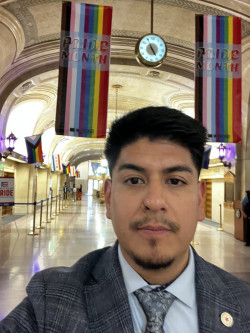
That she became an HIV ally almost immediately is due largely to the work of Omar Martínez González, 35, who until recently was the policy and advocacy senior manager at AIDS Foundation Chicago. In that role, he lobbied members of the Illinois congressional delegation from both sides of the aisle to be champions in DC for the Ryan White HIV/AIDS Program, the Centers for Disease Control and Prevention and other key HIV funding streams—so much so that Ramirez early this year honored him from the House floor. He also fought to ensure that the interest of immigrants living with and vulnerable to HIV were represented at the federal level, and hosted workshops at AIDSWatch to empower immigrants living with HIV to engage in advocacy on Capitol Hill.
Martínez González also played key roles in the successful efforts of both the national campaign Save HIV Funding (SHF) to retain those federal dollars and in the group PreP4All’s ability to get a small PrEP-access pilot program going during the Biden administration in five jurisdictions nationwide. The program remains active. He’s been doing HIV work since he volunteered at Chicago’s BEHIV (Better Existence with HIV) as a teen. “I wasn’t out yet,” he says, “but I knew I was queer, so seeing queer people talking about sexual health really impacted me.”
Earlier this year, after the Trump administration called out AIDS Foundation of Chicago as a “far-left nonprofit” that “peddle[s] divisive, work identity politics,” Martínez González, who is a Deferred Action for Childhood Arrivals (DACA) recipient, left the agency so that he would not be on the administration’s radar. “As someone who’s not a U.S. citizen having to interface” with the administration, he says, “I felt I had to insulate myself.” He’s now working in the Chicago mayor’s office, helping to spearhead mental health services. “I hope I can help Chicagoans even more directly this way,” he says. “I’m in this fight not just for the immigrant community but for anyone who’s underserved.”




Comments
Comments