

This Pride season, meet some of the queer members of the HIV community who’ve been fighting back the hardest, day in and day out—and even notching victories.
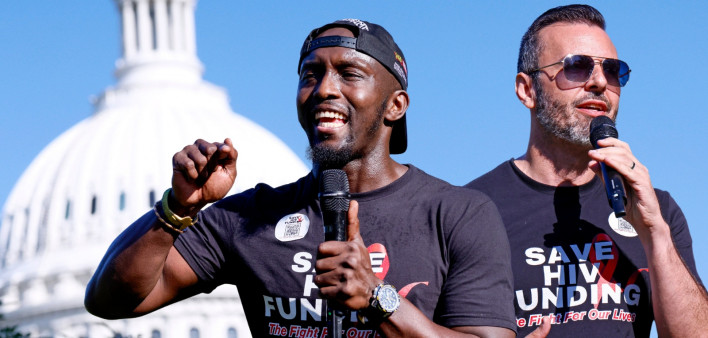
Maxx Boykin and Jeremiah Johnson
Throughout much of last year, HIV advocates were worried that Congress would greenlight deep cuts, proposed in the White House budget, for HIV prevention at the Centers for Disease Control and Prevention and in the Ryan White CARE Act, which provides treatment, care and other essentials to more than half of Americans living with HIV.
But on February 3, final passage of a five-year spending package for Fiscal Year (FY) 2026 maintained funding for domestic and global HIV programs, and support for housing people with HIV actually got an increase of $24 million. On February 5, President Trump signed the funding into law.
The dollars were spared in large part due to the sustained, carefully planned work of the Save HIV Funding (SHF) Campaign, a joint venture between the groups PreP4All, the HIV Medicine Association and AVAC. Two key LGBTQ players in that campaign were Maxx Boykin, SHF’s campaign manager, and PreP4All executive director Jeremiah Johnson, who started SHF in 2023 to push back on HIV cuts already being proposed by some Republicans.
Boykin, who previously worked at the Center on Budget and Policy Priorities, came on board SHF early last year, when the group convened stakeholders at Johns Hopkins to chart a path for itself. Around that time, the group also kicked off campaign calls every Tuesday at noon. “It filled a unique gap in the field because people were craving weekly updates,” says Johnson.
SHF also created an advisory council to fold in groups like the U.S. People Living with HIV Caucus, Positive Women’s Network–USA and the National HIV/AIDS Housing Coalition. “We wanted to have multiple lines of communication open to mobilize folks,” says Boykin. SHF’s first large mobilization was at the annual AIDSWatch conference in late March, where the group mounted a funding rally and visits to lawmakers offices commenced.
The campaign reached out to lawmakers on both sides of the aisle. “Our most active champions have certainly been Democrats,” says Johnson, “but we also kept in mind that HIV funding has had the benefit of having bipartisan support for the past 35-plus years. We didn’t want to just toss that away, and we couldn’t.” SHF logged more than 300 meetings with lawmakers.
Then it all started to pay off. “We started seeing more Republicans get more visible in their support in the second half of 2025,” says Johnson, including on Hill Day on September 5 with SHF’s celebrity advocates Javier Muñoz, the Hamilton actor living with HIV, and Peppermint, a former RuPaul’s Drag Race contestant.
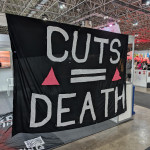
SHF also took a page from the famous AIDS Memorial Quilt and created a “Cuts Kill” quilt campaign, with more than 20 different quilts displayed in Washington, DC, the day after Hill Day. The quilt panels told different stories of how cuts would impact communities, such as leading to more drug overdoses.
Post-success, says Boykin, “Advocates have to be ready to come together to hold the Trump administration accountable to make sure that the money is now actually spent.” He says other campaigns can learn from SHF. “We had a consistent presence with lawmakers for many months,” says Boykin.
Of course, with Trump’s budget request for next year once again calling for major HIV cuts, SHF’s work is far from done. “At a time when we are seeing several emerging crises among state AIDS Drug Assistance Programs,” says Johnson, “the new White House budget request to Congress for FY27 has once again proposed to slash billions in HIV funding, meaning that in the coming months we will again have to battle for the survival of our field.”

1 Comment
1 Comment