

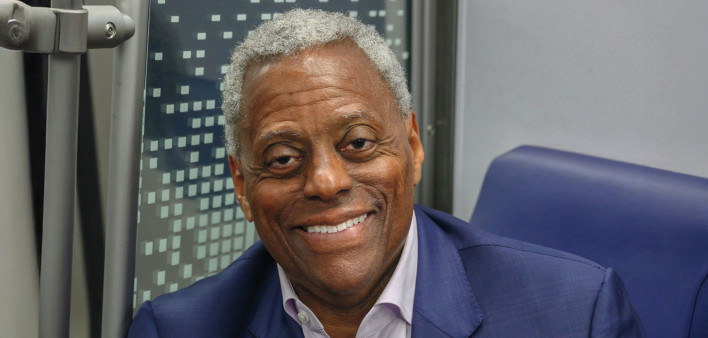
In 2016, Jesse Milan Jr. made history by becoming the first Black gay man to lead AIDS United. After nine years at the helm and over 40 years of HIV advocacy, Milan retired in July, the same month he turned 69.
“I realized that in 2025 I would be 40 years from 1985, when my late partner was diagnosed with AIDS and died,” says Milan, who lives in Ellicott City, Maryland. “And there was some nice symmetry about a 40-year commitment that literally started in my own home.”
When Milan reflects on his tenure at AIDS United, he sees the many accomplishments the organization has achieved.
“We created a road map for ending the epidemic that was the basis for what President Trump did in creating the Ending the HIV Epidemic initiative,” he says. “We created new initiatives, like the Southern HIV Impact Fund, which has given away nearly $16 million to organizations in the South.”
He also highlights AIDS United’s work within the harm reduction and transgender communities via the Harm Reduction Futures Fund and the Transgender Leadership Initiative.
“I’m proud that I was able to be the steward for creating those [initiatives],” he says. “We kept AIDS United’s mission alive and, I believe, our reputation intact.”
In February, AIDS United announced Milan’s retirement and named his successor, Carl Baloney Jr. A succession plan had been in place since 2023 thanks to Milan, who brought the idea to the board.
“I needed it to be an organic decision that was part of our business structure,” he says. “It wasn’t just about me. It needed to be owned by the organization.”
The succession plan was finalized and approved last year. It addressed three issues: what to do if the CEO had to depart due to an emergency, what to do in case of a planned departure and what to do if the CEO recommended a successor ahead of a planned departure.
Milan’s departure was planned, and he wanted Baloney to succeed him. He believed it was time for the next generation to take over.

Jesse Milan, Jr.Liz Roll
“It’s a model that I hope every CEO thinks about, especially as they’re hitting their own personal milestones with their organizations or their life,” he says. “This movement is not just about us. It’s about the organizations and the institutions that we lead.”
When the news was announced publicly, Milan didn’t know what the response would be.
“It had been a flood of appreciation, love and gratitude that had just washed over me,” he says. “I felt that I had made the right decision. I had a shocking and surprising sense of calm because the years of worry about how and when I would do this had now ended.”
Milan spent the months leading up to his departure working closely with Baloney to ensure a smooth transition while working tirelessly to repeal Maryland’s outdated HIV crime law. In May, the state’s governor signed a bill into law that decriminalized HIV.
“I got to be there for the governor’s signing,” Milan says. “I shook his hand and told him how much I appreciated that he was signing this law. And he looked directly at me, grabbed my hand and thanked me. That was beautiful.”
Milan also started making plans for the people who meant the most to him, particularly those at AIDS United.
At a farewell dinner prior to his last board meeting, he sang “What I Did for Love” from the musical A Chorus Line. “It’s about leaving your colleagues,” he says. “I have loved this organization and this community, and I know I have received love back from them.”
At his final staff meeting, Milan personally thanked every staffer and said his goodbyes. “I felt that I had done everything I needed to do. I was ready to leave,” he says.
Milan has since been living life like a retired person should. He’s taken up new activities, like line dancing, and has generally been having fun.
“In my first month, I took three trips,” he says. “One by plane, one by train and one by car. I went and saw three matinees—two at the movies and one on Broadway. And I gave three dinner parties.”
And in September, he celebrated 37 years of marriage to his husband.
But retirement doesn’t mean Milan is no longer involved in HIV causes. He sits on four boards, including the American Board of Internal Medicine, and various committees and is a member of the advisory council of U.S. Business Action to End HIV.
“It is important to me that I still have a role in this epidemic,” he says, “I’m a person living with HIV. It is my life that this epidemic is about, and I’m not ready to completely leave it.”
In September, he spoke on a panel at the United States Conference on HIV/AIDS in Washington, DC, that addressed the funding gap in service delivery for Black organizations. Then, he gave the keynote at the HIV/AIDS Caracon Symposium 2025 in Cincinnati in October.
Milan knows the fight ahead won’t be easy. But he encourages advocates to remember why they joined this fight in the first place.
“Whatever drove you to this movement has probably not changed,” he says. “Your commitment to do something for someone else is really beautiful. If you haven’t heard someone say thank you, I want you to hear it from me.”
Although today’s HIV advocates face different kinds of challenges, Milan emphasizes that the fight for people living with HIV has been hard since the beginning of the epidemic.
“You’re not the first, and, hopefully, you won’t be the last who makes the commitment to do this work,” he says. “Those in the past are grateful that you are doing it today, and those in the future will look back and be grateful that you’ve done it today too.”


Comments
Comments