

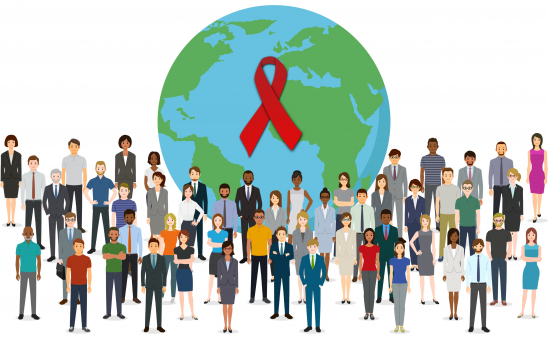
On this 37th World AIDS Day (WAD), the theme is the thought provoking “Collective Action: Sustain and Accelerate HIV Progress.
The theme of this year’s WAD is a call to action with the instructions /directions in the title itself.
HIV remains a high-stakes game with challenges in recent times on science, private and public health insurance, research funding and, public health to name a few.
Collective Action
The HIV movement has always been about people. The metaphor I’ve used over the past 43 years is one in which we all are pushing a rock up a hill, with the hill getting steeper and the rock getting bigger.
However, we’ve faced challenges and overcome barriers from the beginning. Our progress since 1981 has been grounded in collective action—patients, researchers, families, communities, activists—working together. This has produced results and allows us to talk about ending the epidemic.
Historically, AIDS activism’s foundation rests largely on the 1969 Stonewall uprising where LGLBT+ people became “visible.” Advocacy groups that followed during the AIDS crisis like ACT-UP (AIDS Coalition to Unleash Power) and TAG (Treatment Action Group) took Stonewall’s advocacy and visibility to the next level.
The global AIDS advocacy network brought some basic needs into focus. The earliest calls to action were funding for treatment and research. This was followed quickly by the call for involvement of communities infected and affected, before the term “lived experience” was in common usage.
Most observers agree that the clarion call, June 5, 1981, was, in retrospect, the ground zero of the AIDS movement as we know it today. On that day, the Centers for Disease Control and Prevention (CDC) published its first report of five cases of what we now know as AIDS, in gay men in Los Angeles and New York City.
While it seemed too early to call this a new disease, I felt there was something unsettling about the patient descriptions—a sense of urgency about them. Even more interesting, the cases had been reported by UCLA’s Dr. Michael Gottlieb, formerly a University of Rochester medical student and internal medicine resident.
We spoke on the phone. He repeated the theory proposed in the report—that a virus of some kind was targeting the immune system. From the pattern of illness in men who have sex with men, it suggested sexual transmission.
I told him that we had not seen anything like this in Rochester, NY.
His response has stayed with me all these years, “Then if I were you—I’d get ready.”
He was right. Within two months, we had our first case. Although I didn’t realize it at the time, my former student had become my mentor. And, like many of us in those early days, I would learn that epidemics shift the balance by creating a new set of rules and a new style of problem-solving. We needed to think on our feet and be flexible to accept new ideas. And we needed to be prepared.
Historians have called President Ronald Reagan’s “tepid response” to the growing epidemic an exercise in failed leadership. He had just been elected on the coattails of the conservative movement and he avoided the emerging public health crisis “like the plague” that it was.
The real administration leadership was taking place behind the scenes out of the public eye, at least for the moment. Two notable leaders were Dr. Anthony Fauci, Head of the National Institute of Allergy and Infectious Diseases (NIAID) in Bethesda, and Dr. C. Everett Koop, Surgeon General in Reagan’s administration.
Sustain Progress
Dr. Koop, an evangelical Christian pediatrician, by his own account, went against the administration’s directive to paint homosexuality in a bad light. Instead, he published a pamphlet that was mailed to every household in the United States, titled “Understanding AIDS.”
He explained AIDS in clear terms and unified the public health/government position as being grounded in science and sound public health principles, and not in the emerging culture wars. His closing comment reminded us that “We are fighting a disease; not people.”
And in San Francisco, a newly elected US Representative to Congress, Nancy Pelosi, went to work visiting her constituents in hospitals, friends and patients in what we would soon be named “AIDS outreach.”
Accelerate Progress
A necessary part of our progress came from Fauci’s efforts that put the AIDS Clinical Trials Group (ACTG) in place. The global network supported the research agenda that would lead to drug approvals and define medical care.
The 2013 film, Dallas Buyers Club, accurately portrays that era of the mid-1980s of trying to care for patients when there were no approved drugs. Instead, many of us imported unapproved drugs from out of the U.S. in an act of desperation.
In another often-unrecognized move during this era, Fauci took the bold step of inviting a group of community activists into his office rather than have them arrested while they camped in protest outside his NIH office. He recalls the episode in his book saying that he thought there was was more to be gained by working together in synergy rather than working apart. The people with lived experience were now represented.
These sacrifices of people in the early days of the AIDS movement need recognition as another form of leadership.
That effective combination of science, advocacy, and sacrifice has brought us to the current era where, globally, more than half of the people living with HIV today are age 50 and older.
Accelerating progress
This call to action has its challenges including overcoming disparities for African-American men who account for 60% of new HIV diagnoses yet only 14% of PREP users; implementation of treatment and prevention programs with long-acting injectables; rapid start antiretrovirals; status-neutral HIV care; continued education and support of patients; U=U; and sexual health.
Finishing the job and ending the epidemic are facing a variety of funding and organizational challenges at CDC, NIH, and in Ryan-White programs, Medicare and Medicaid.
How will we respond? This high-stakes effort has traditionally relied on leadership, innovation, courage to get the job done. And, pulling words from this year’s WAD theme—our collective action will push the rock to the top of that hill.
We will continue to “Sustain and Accelerate HIV Progress” as the theme directs us.
Dr. Bill Valenti is an infectious diseases physician in Rochester, NY. He has been doing HIV medicine, research and policy since 1981 and is co-founder with Dr. Steven Scheibel of the Community Health Network HIV Clinic (1989), now Trillium Health, a federally-qualified health center, in Rochester. He is Clinical Professor of Medicine, emeritus, at the University of Rochester School of Medicine & Dentistry.



Comments
Comments