


The day before World AIDS Day 2025, something sexy and powerful happened on the Tijuana side of the United States–Mexico border, which has become highly restricted on the U.S. side amid the Trump administration’s crackdown on immigrants.
About two dozen gay men living with HIV, both Mexican and American, came together wearing T-shirts declaring “Sidoso”—Mexican slang for “AIDS-y.” The term is usually used pejoratively but is increasingly being reclaimed by HIV-positive Mexicans as a term of pride, signaling openness about one’s status. And then, as phone cameras recorded them, the men kissed one another—not little pecks on the cheek but long, wet, sloppy kisses.
The event, the third annual World AIDS Day Besoton Sidoso (“AIDS-y Kiss-In”), was organized by the Mexican group Viviendo Positivo (“Living Positively”) and MPact Global, an international group supporting gay and bisexual men’s health and human rights that marks its 20th anniversary this year. The kiss-in was one of several global events and campaigns that MPact funds, helps organize or otherwise supports to disseminate sex-positive messages and promote resources for men who have sex with men (MSM) around the world.
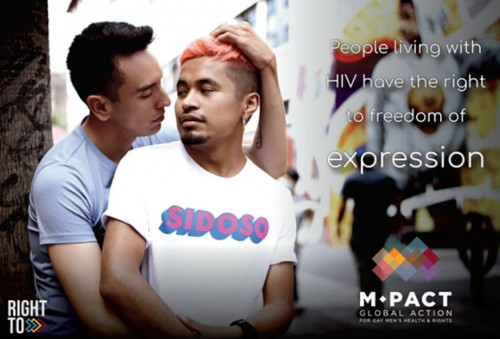
A still from MPact’s “Right To” campaignCourtesy of MPact
MPact is doing this even as many countries crack down harder on sexual minorities, such as gay men. That’s partly because, since the Trump administration has largely turned its back on global aid—especially to stigmatized communities—many nations no longer feel as though the United States, with its all-important purse strings, is frowning on them for anti-LGBTQ displays.
In such an atmosphere, MPact is more determined than ever to help communities of gay men push back on criminalization and stigma with a message of pride and an agenda of grassroots, for-us-by-us organizing that’s not reliant on governments.
That’s where the kiss-ins come in. The 2024 event, in Guadalajara, and the first one, in Mexico City in 2023, drew about 70 men, according to Andrew Spieldenner, PhD, a 54-year-old HIV-positive communications professor at California State University, San Marcos, who has been MPact’s executive director since 2021. Last year’s kiss-in was held in Tijuana, he says, “to highlight queer migrants and the people being trapped by the wall” at the border, for which the Trump administration has turbocharged further construction.
“I cried at the Guadalajara kiss-in,” Spieldenner says. “People made a point of talking to the media—people who aren’t used to holding that space, standing up and saying, ‘I deserve to be here.’”
And did he partake of the smooching? “Of course,” he says. “I kissed five guys!”
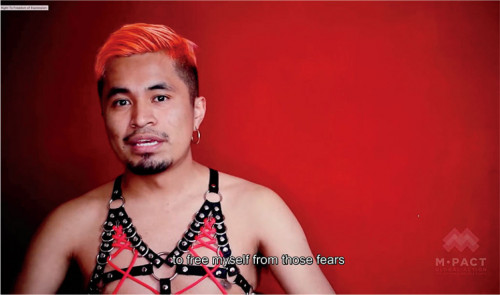
A still from MPact’s “Right To” campaignCourtesy of MPact
MPact was founded in 2006 by a group of gay and bi male activists who felt that the first full decade of the global HIV response, then being powered by the U.S. President’s Emergency Plan for AIDS Relief (PEPFAR), which was launched in 2003 to treat and prevent HIV worldwide, was overlooking MSM, who made up a disproportionate number of people worldwide living with or at risk for the virus.
“If you looked at the countries that had national HIV plans by that point, none of them were prioritizing gay and bi men,” says Spieldenner, adding that such plans were also not addressing other marginalized high-risk groups, including injection-drug users, sex workers and transgender women.
Spieldenner notes that many such countries would rather acknowledge drug users before recognizing gay and bi men. Or, he says, countries would minimize the scope of the epidemic among gay and bi men. “In 2010, Kenya reported that they’d reached every gay man with an HIV test—because they’d reached 200 gay men.”
MPact began as the Global Forum on MSM and HIV, advocating for that population in front of UNAIDS, the U.S. Agency for International Development (USAID) and the World Health Organization (WHO). Early on, the group, which changed its name to MPact in 2018, decided to fund gay and bi male grassroots groups in various countries.
George Ayala, PsyD, MPact’s first executive director—a New York City native who’d worked for groups including the Hispanic AIDS Forum—was friends with Robert Carr, a respected gay Trinidadian/Jamaican activist, in whose name a fund made up of government and foundation money was started for this purpose. Carr died in 2011, before the fund was actually launched.
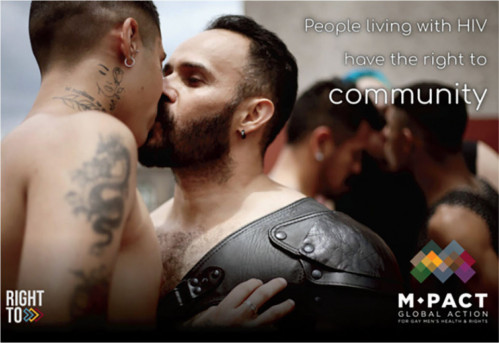
A still from MPact’s “Right To” campaignCourtesy of MPact
At that point, says Spieldenner, “MPact becomes the center of a lot of regional networks, an incubator of sorts.” Traditionally, he says, MPact—with funding from groups like the Carr Fund, the Dutch Aidsfonds and the Elton John AIDS Foundation as well as pharmaceutical money—has given out at least $1 million annually. A few years ago, he says, the group disbursed $2 million.
Once the more LGBTQ-friendly Obama administration took office, global advocates such as MPact were able to get PEPFAR to incorporate pre-exposure prophylaxis (PrEP, an HIV prevention regimen first approved in the United States in 2012) into its portfolio and the WHO to promote PrEP. MPact awarded grants that helped fund activities and initiatives in several countries to promote PrEP among gay and bi networks.
The Trump administration has since restricted PrEP for everyone in PEPFAR recipient countries, except for pregnant or breastfeeding women. Spieldenner says MPact and other groups are trying to carve out exceptions to that edict where they can, country by country.
MPact also supported groups in various countries to harvest and publish their own research because, says Spieldenner, “the core of MPact is about community ownership of our own data, advocacy and services.”
These days, as several countries, including Senegal, Uganda and Kenya, step up persecution and criminalization of LGBTQ people while the Trump administration turns a blind eye, MPact’s recipient groups have their work cut out for them. Last year, when the Trump administration all but decimated USAID, whose functions meshed with PEPFAR’s, it meant the elimination in several countries of special clinics where LGBTQ people and other marginalized groups could seek care and avoid the negative treatment they faced at basic government clinics.
Now, says Spieldenner, people have no choice but to go to the basic clinics.
Spieldenner, who previously was the volunteer chair of the U.S. People Living With HIV Caucus, succeeded Ayala as MPact’s head in 2021, after an open call for the job. “I think they picked me because I’m openly living with HIV, because I had the researcher chops and because I was already a visible advocate who’s worked with UNAIDS and had connections,” he says.
He leads Mpact along with senior director for strategic initiatives and communications Alex Garner, administrator and contracts coordinator Tony Nguyen, Mexico City–based community mobilization manager Axel Bautista and communications/social media associate Jesús Suárez.
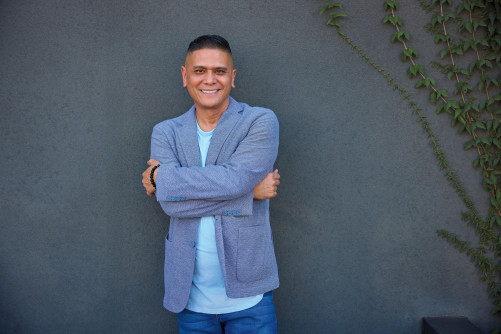
Andrew SpieldennerJimmy Galt
Spieldenner says that since he’s taken the helm, MPact has beefed up its social media presence, because “I want us to be just three clicks away from anyone in the world who wants to do organizing.” The group’s online followers have ballooned from 1,200 to 25,000 and its digital engagement points from a few hundred thousand to a million.
The group has also worked to make all its online imagery more sex positive, organizing fun photo shoots in locales worldwide with a broad variety of real-life gay and bi men posing shirtless and/or embracing or making out with one another. “We’ve done shots with throuples, trans men, different generations, different body types,” he says. “We’re showing sexy, fun and different kinds of intimacy.”
Thanks to this expanded online presence, MPact now gets direct messages on social media from gay men worldwide up to six times a week. “If it’s HIV stuff, we connect them to support in their own country, and if it’s a cry for help because they’re being persecuted, we connect them to LGBTQ asylum groups, like Rainbow Railroad.”
With a current budget of $2 million from sources including the Carr Fund; the Global Fund to Fight AIDS, Tuberculosis and Malaria; UNAIDS; and HIV pharma companies Gilead Sciences and ViiV Healthcare, MPact in recent years has funded 21 groups in Latin America and the Caribbean to address LGBTQ rights emergencies, including natural disasters, such as hurricanes, which can leave queer people without safe shelter.
In Argentina, for example, MPact is funding groups that provide migrant LGBTQ populations with mental health services to address the trauma of displacement and isolation as well as core medical services. According to Spieldenner, when a group of 120 gay and trans migrants arrived in Argentina, medical intakes revealed that half of them had a sexually transmitted infection they hadn’t previously known about. Groups in that country also use MPact money to hire interpreters for the large number of Russian LGBTQ migrants and other newcomers. Under Putin, Russia has cracked down on queer people and organizing.
MPact also helps groups in various countries relocate queer people after they’ve been harassed by police, the media and the community. Recently, says Spieldenner, MPact helped a well-known, heavily persecuted gay activist from a West African country, whose name and home country Spieldenner withheld for safety reasons, get to Canada by helping to secure him an invitation to speak at an event in Toronto. He’d been in hiding in his home country ever since his apartment was vandalized after he’d done an HIV prevention workshop. A note left behind by the vandals threatened that he’d soon be murdered.
“I felt a tremendous surge of feeling once we were able to safely get him out,” says Spieldenner.
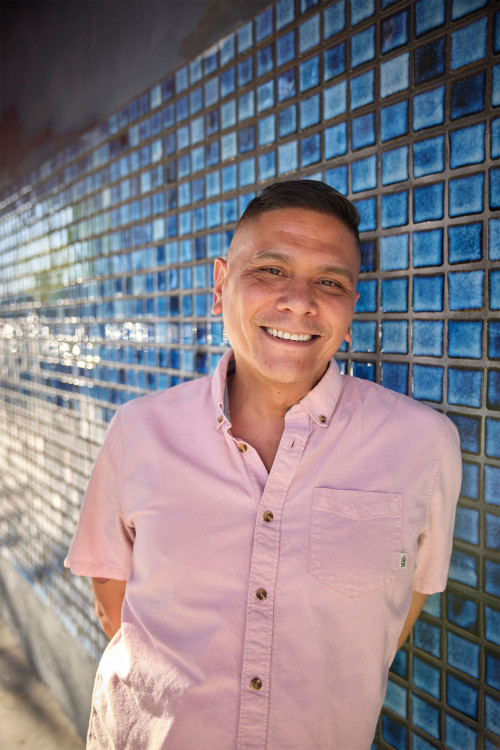
Andrew SpieldennerJimmy Galt
MPact’s efforts to become more digitally known, easily reached and just plain sexy have not escaped notice. “MPact under Andy’s leadership has become more visibly sex positive, with a bolder message for an era where backlash to gay men’s inclusion has been so intense,” says Laurel Sprague, a longtime advocate living with HIV and the research director of the UCLA School of Law’s the Williams Institute, a sexual orientation and gender identity research center.
She says that MPact’s booths at conferences “have sex-positive videos that focus on pleasure, well-being and sexual health rather than on science, and I think in this moment, it’s helpful to have this centering of the lived experience of gay men, especially those living with HIV, and their right to have a full, happy, healthy life.”
Sprague describes the support MPact gives to “national and local networks of gay men in countries that often are quite hostile to gay men and use HIV as a cudgel to harm them even further” as invaluable.
Acep Saepudin, a gay influencer living with HIV in Indonesia, where homosexuality is highly frowned upon, albeit not outright illegal, was invited by MPact to join its social media team at the 2022 International AIDS Conference (IAC) in Montreal. That same year, MPact engaged him in what he says was his first photo shoot, in Bangkok, alongside local models.
“MPact has always helped me feel confident about myself, including my body,” he tells POZ. In 2024, at the IAC in Munich, Saepudin was involved in MPact’s spicy Outlaws Wanted event, which featured Latin American OnlyFans porn stars Pablo Bravo and Danny Azcona and gay Mexican singer Christian Chávez. Saepudin will be involved in MPact projects again this July at the IAC in Rio de Janeiro.
Saepudin says that, overall, working with MPact “has given me a safe and meaningful space to continue creating” social media content that in his home country educates about HIV and advocates for the rights of queer people living with or at risk for the virus.
He needs the moral support too. “Speaking about these topics in Indonesia is extremely challenging. My Instagram account has been banned seven times due to mass reporting [of the content] by local users,” because, he says, “it’s perceived as a threat to morality and social order.”
In São Paolo, Alberto Pereira da Silva, a television personality who has done performance art related to his being gay and HIV positive, worked with MPact in 2024 to convene a group of Brazilians living with the virus. He’s also been working with the group to create social content on HIV topics, including taking oral versus injectable medication. He says that MPact’s support for HIV efforts in Brazil—where both treatment and PrEP are universally free, even if stigma sometimes holds people back from accessing them—has been crucial.
“Most HIV campaigns in Brazil talk only about the meds and the science but don’t focus on pleasure,” da Silva says. “MPact promotes being proud of being queer and the idea that you can be both sexual and safe.”
That’s just what Spieldenner wants to hear about how he and his team have repackaged MPact in recent years, especially as the group plans events to celebrate its 20th anniversary at the IAC in Rio, including an awards ceremony and a special meetup for Black Brazilians living with HIV.
Yes, he acknowledges, MPact and groups like it are doing their work in a far more hostile atmosphere, both in the United States and many other countries, than perhaps they were just a few years ago. “We see how fragile these systems [of support for LGBTQ and/or HIV-positive people] are and how easily they can be taken away,” he says. “Which is why it’s important for organizations like MPact to step forward, because people need to see, hear and know that we’re still advocating.”
But, he adds, don’t forget the joy. “I love our community. And as a queer person living with HIV, I believe that we deserve the best, we deserve connection and we deserve sex.”

Comments
Comments