

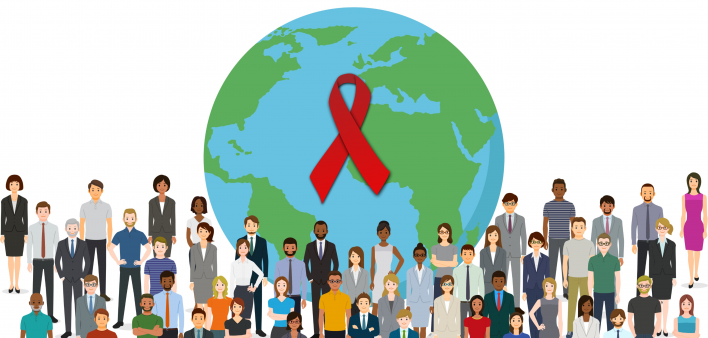
Monday, December 1, marks the 38th World AIDS Day, which since 1988 has been commemorated as a time to raise awareness and education; promote prevention; honor those lost to the epidemic and currently living with virus; and celebrate everyone involved in the fight to end HIV and AIDS.
For the first time in the history of this global observation day, “the U.S. government will not be commemorating World AIDS Day” per a directive from the Trump White House.
View this post on Instagram
Nonetheless, countless organizations (governmental and nongovernmental), service providers, communities, advocacy groups and individuals remain committed to shining a spotlight on the HIV epidemic and overcoming whatever barriers arise.
Search social media for events, related articles and awareness campaigns concerning World AIDS Day. We’ve embedded several samples throughout this article.
The World Health Organization (WHO) works with communities across the globe to spearhead campaigns and efforts related to World AIDS Day. The WHO provides the following top-line statistics, as of 2024, related to HIV:
- About 40.8 million people are estimated to be living with HIV in the world4; 1.4 million of them are children 14 years old or younger
- 3 million people acquired HIV in 2024. This marks are 40% reduction since 2010, when 2.2 million people became HIV positive.
- 630,000 people died from HIV-related causes globally last year. Since 2010, HIV-related deaths have been reduced by 54%, from 1.4 million.
- HIV continues to be a major global public health issue; the epidemic has claiming 44.1 million lives so far.
- 87% of people living with HIV globally knew their status last year; 73% of people with HIV maintained suppressed viral loads.
This last statistic is important to stress because people with HIV who achieve and maintain viral suppression experience slower disease progression, enjoy better overall health and are less likely to develop opportunistic illnesses. What’s more, people with an undetectable viral load don’t transmit HIV to others through sex. This is known as treatment as prevention, or Undetectable Equals Untransmittable (U=U).
In the United States, about 1.2 million people are estimated to be living with HIV, according to HIV.gov, but about 13% don’t know their status. Nearly 40% of new HIV cases are transmitted by people who don’t they are HIV positive. What’s more, the epidemic continues to disproportionately affect minority populations, people in the South and Black and Latino men who have sex with men.
Although new HIV rates have declined overall, progress is imperiled due to funding cuts and a hostile administration in the White House.
#WorldAIDSDay this year is a grim one Stories of the devastating impact of US, British and wider European aid cuts on the fight against HIV – particularly in sub-Saharan Africa – continue to mount as 2025 comes to an end… www.theguardian.com/global-devel...
— Madhu Pai, MD, PhD (@madhupai.bsky.social) December 1, 2025 at 6:15 AM
[image or embed]
View this post on Instagram
“We are at a crossroads,” Rachel Klein, deputy executive director of The AIDS Institute, said in a statement about World AIDS Day. “The question for the coming year is simple. Will federal leaders stand with people living with and at risk of HIV, or turn away just short of the finish line? When leaders underfund HIV programs, threaten the ACA, and make it harder for people to afford and maintain health care, they are not just debating policy. They are deciding whether people get the care, medicine, and stability they need to stay alive.”
“World AIDS Day allows us to reflect on the incredible progress made in the fight against HIV/AIDS, while also acknowledging the work that still lies ahead,” Randevyn Pierre, Head of U.S. External Affairs at ViiV Healthcare, told POZ regarding this year’s observance day. “That’s why ViiV Healthcare continues to work hand in hand with communities disproportionately affected by HIV to develop networks of care and support community-driven programming,” “We believe that collective action can make a difference. It will take all of us working together to end the HIV epidemic for all.” Pierre notes that ViiV supports organizations like MOBI in the New York City area and Allies in Hope in Houston, that are on the front lines in bringing attention to HIV in their communities, particularly among Black and LGBTQ populations who are disproportionately affected by HIV.
View this post on Instagram
“Every year, World AIDS Day invites us to honor the legacy of the HIV movement—the resilience, brilliance, and determination of communities who built systems of care long before the world invested in them,” writes Joseph Stango, a senior project manager at AIDS United in a blog post for the organization. “It is a moment to remember how far we’ve come, and to recommit to the work that still lies ahead.”
To read a collection of related articles, including a calendar of events, click #World AIDS Day.
View this post on Instagram


Comments
Comments