

“One of the things that’s exasperating for me as someone who watches a lot of film and TV is that in 2025, HIV is almost like a period piece,” says Los Angeles–based filmmaker and actor Timothy Guion Smith. The artist continues, “Producers and directors, TV networks—they never want to explore what it’s like to be positive in this day and age. It’s like they are only interested in exploring HIV within the context of the ’70s through the ’90s. Heaven forbid it’s a story taking place today—it’s like a B plot on a gay episodic.”
Frustrated with the portrayal of HIV in modern media, Smith, a Filipino American living with the virus, wrote, directed and acted in the short film Next of Kin. Featuring an HIV storyline, Smith’s film packs a whole lot of story and heart into 15 minutes. To date, it has been screened at Outfest Fusion in Los Angeles, the San Diego Asian Film Festival and San Francisco’s CAAMFEST 2024.
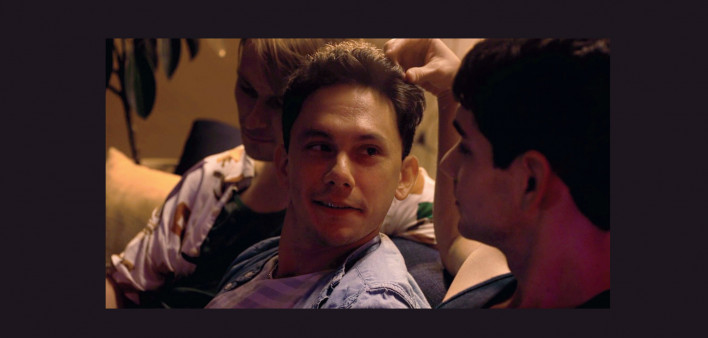
The film begins with a trio of adorable young gay men playfully flirting on a couch. (Alert: spoilers ahead!) As Tommy, played by Smith, and his friend with benefits, Andrew, are getting to know a new friend, Bryan, the scene evolves from steamy mutual kissing to a sweaty bedroom threesome. When the subject of condoms and safer sex comes up, Tommy mentions that he’s HIV positive and has an undetectable viral load, which means he’s on effective treatment and cannot transmit the virus sexually.
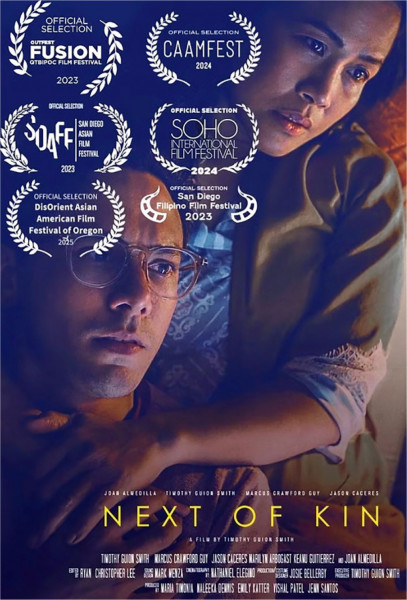
Poster promoting the short film “Next of Kin”“Next of Kin”
The disclosure sharply shifts the mood from sexy to shivery. Although he’s taking pre-exposure prophylaxis (PrEP), Bryan fears contracting HIV and peppers Tommy with questions, asking whether he takes his HIV medications regularly and how often he gets tested. Ultimately, Bryan rejects Tommy, who, uncomfortable and shook, goes home alone.
Then, in a series of flashbacks, viewers learn that Tommy has been living with HIV his whole life, having contracted it from his mother. In the movie’s last scene, he visits her, and she talks to him about how, although the stigma surrounding HIV has evolved since the early days of the AIDS crisis, it still manages with every rejection to be incredibly hurtful, “like a rock being pelted at us.”
She explains that it’s up to her and Tommy, as people living with HIV, to let go of the negativity and not let other people’s ignorance and fear weigh them down. In the film’s final moments, mother and son hold each other, bearing the burden of HIV stigma and together finding a way through with love.
The film is beautiful, heart-tugging and modern in its depiction of how HIV affects its disheartened hero. Next of Kin doesn’t offer a happy ending, a pretty bow to tie up its story. Rather, the film ends with the frayed edges of reality, uncertainty and hurt and the comfort of family. And although it’s about a Filipino American man and his Filipina mother, it doesn’t delve into racial issues or stereotypes, rendering the tale all the more real and relatable.
Smith is a native New Yorker. “I lived on Staten Island until I was 10,” he says. His Irish American father’s family immigrated to the United States around the time of the American Civil War, while his mother emigrated from Manila to New York City in 1981. “The community calls it Fil-Am, but I guess technically, I’m Filipino Irish American.” The family was working-class, so they didn’t have a lot of money for theater and live entertainment. Smith discovered acting via the movies.
“We would movie-hop a lot!” Smith says. “That’s one of my first memories, just illegally movie-hopping. That’s my memory of falling in love with storytelling.”
The acting bug also bit early. “The first thing I did as a performer,” Smith says, “was onstage with my brothers. It was an after-school kind of latchkey kid thing, where they just let the kids go onstage and do sketches.” Smith and his brothers performed a classic sketch by the radio, film and TV comedy duo Abbott and Costello where the two buffoons meet the Mummy. “It’s kind of the lore, if you will, of my family. The three boys up there onstage doing Abbott and Costello. What other 6- or 7-year-olds are doing that?”
Smith’s love for acting and storytelling grew as he did. When it was time to decide on a college, he chose New York University, where he focused on acting and musical theater performance. After graduation, he wound up in Los Angeles.
They never want to explore what it’s like to be positive in this day and age.
In 2017, while chasing the Hollywood dream, Smith shared a facet of himself that he’d been keeping private—his HIV status—via video.
“I was hearing all sorts of really aggravating things at parties or social events. And it got to a point where I had to take my voice back, to let people know someone in their own social circle is living with HIV,” he says. “For me to just find some ground to stand on, I decided to come out about it.”
“I came out about my status to family, friends and coworkers over a video that I posted to all my social channels,” Smith says. In the poignant video, he shares that when he was 19, he survived a rape that resulted in him contracting HIV.
“This incident happened,” Smith shares, “and then 90 days to the day after the incident, I went to get tested. I was never symptomatic. I never felt like I came down with the flu. I was at the student health center three months to the day and then found out I was positive. And that was so shell-shocking.”
Smith decided to use his disclosure video as a fundraising tool for HIV organizations in California. “We raised $6,000 spread three ways, for APLA [AIDS Project Los Angeles], Equality California and the last bit of it was for RAIN [Regional AIDS Interfaith Network].” He was surprised and delighted when the crowdfunding project extended past family and friends. “I was shocked that I basically told a bunch of my normie coworkers, posting it on LinkedIn and asking previous colleagues to donate, then there were all these VPs and stuff that I never sent it to, and they would drop like $100 or $250.”
Former classmates also chipped in, but Smith was truly surprised by some of his relatives who donated. “My MAGA family at the time,” he says, “there were some family members that were—the way that my aunt said it when she heard [about my HIV status] was like, ‘You never think about cancer until it hits your family, and you don’t think about this until this hits your family.’ And she only had the most loving, positive things to say to me, that she loves me unconditionally, all that stuff.”
Between the success of his video and film, Smith seemed poised to make more HIV art. “It’s funny because, obviously, I’m a lot. This is a rant, but I feel like somewhere along the way, I felt like we had enough of an understanding of misinformation and when things are being politicized. But I feel like it’s gotten to a new low this last year or two, to the point it discourages me from wanting to be an advocate,” he says.
“I still do my advocacy and my part. I just did this commercial. It was actually a little controversial. It was against Proposition 34. [Aimed at the AIDS Healthcare Foundation, the proposition requires providers to spend revenue from a federal drug discount program on patient care, not politics.] I came out about my HIV status, and that had a lot of airtime during the election. So I still do my advocacy work, but with how ugly things have gotten, it just gets me so angry.”
On a personal level, Smith is continually surprised by the misinformation about HIV that pervades our society, especially queer men. “When people finally have the opportunity to talk to someone living with HIV, you’re the projection of all their misinformation and their hate and their frustration and the entitlement they feel to reject you. That’s why I put my HIV status on my Hinge profile and my Tinder profile because I don’t want to deal with those conversations.”
He adds, “The annoying thing about those conversations is that those people want to use that opportunity to tell you why they have the right. And I don’t care. Don’t use me as your emotional dartboard.”
Which is another reason Smith decided to make Next of Kin—to rebel against common misconceptions about HIV and about Filipinos. “I wanted to subvert expectations and explore HIV from the perspective of a Filipina mother and her gay son who was born positive,” he says.
“I think it’s interesting with Filipinos because at a time when all the cases of HIV are decreasing, the Philippines actually has an alarming rise in cases, like exponential compared to other Southeast Asians,” Smith says. “Compared to other Asian-American ethnicities, Filipino Americans are disproportionately affected when it comes to HIV. Filipinos are like nearly a third [of Asian Americans with HIV], and the next closest ethnicity was 10%. I think there’s something to be said about that and even just getting awareness for that and encouraging people to talk to each other as a means of dispelling medical misinformation.”
Smith has been working on expanding his short film. “I was working on making this into a series, but my friends who are staff writers on shows tell me that TV is currently dead. The only thing that has a minimal pulse is feature work, but like micro-budget feature-type stuff.” What he had been creating as a series, he’s now reimagining as a two-hour feature.
“HIV is not the main focus, but it’s part of it,” Smith says. “It’s through more so the lens of something like HIV. Like we know that mental illness is something that’s not being addressed within the API [Asian Pacific Islander] community. What does mental illness manifest itself as? Substance use, riskier sexual encounters or higher incidences of nonconsensual sex. And I think HIV broadly is included in that. This isn’t a film about a mother and her son who are HIV positive. It’s going to be three generations of the family. What happens in this family? There’s addiction, there’s mental illness. It’s more like how these things are all related.”
Smith hopes to complete the film by 2026, but he’s realistic about how the industry works. “Now, it’s about getting the money and getting the script out there,” he says.


1 Comment
1 Comment