

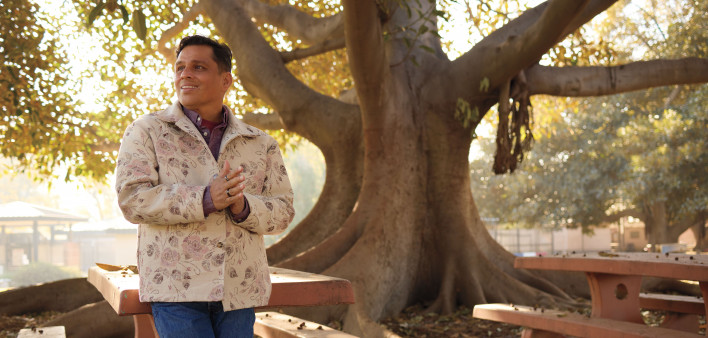
When advocate and speaker Daniel G. Garza shares his journey of living with HIV and other health challenges with crowds of high school and college students and young adults, he leaves little out. “I get up and talk about growing up Latino and gay, about addiction, about my life with HIV, about having anal cancer and living with an ostomy bag and about the connection between all of them,” says Garza, 54, who tested positive for the virus in 2000. He estimates that in one recent year, he spoke to a total of 3,500 people.
“Because when you talk about sexual health, it’s not just where you put your penis. That’s the physical part,” continues Garza, who lives in Laguna Beach, California. “The mental part is, ‘What’s the purpose of what I’m about to do?’ And the spiritual part is, ‘How is this going to make me feel—not just now, but after?’ When I speak, I’m not there to lecture. I’m just saying, ‘This is my story—use me as a map to decide where you’re going and how you’re going to get there.’”
That’s Garza when he’s not being particularly funny, which he is a lot of the time. The fact that he talks in a rapid-fire rasp, like a gay Latino Joan Rivers, adds to the laughs.
Discussing his bad mood while undergoing chemotherapy, he compares himself to “Imelda Marcos after losing all her shoes.” Waxing rhapsodic about his love of tacos, he says, “Hand me a carne asada with onions and cilantro and a very hot red sauce and I am putty in your hands.” If you ask about his life goals, he replies, “I want to be kept and rich and lie in a cabana somewhere—isn’t that the goal of every gay man?”
It’s easy to see why Garza has used humor to smooth out his journey of sexual health—and, more broadly, of his mind, heart and soul—which has been bumpy, to say the least. Born in Monterrey, Mexico, to a Mexican mom and a Texan dad of Mexican descent, at age 3, he moved with them to Dallas, where he endured a childhood of extreme bullying, targeting his gay mannerisms, as well as sexual molestation.
Coming of age realizing he was gay caused a split in him. “The American side of me was saying, ‘Everyone on TV and in movies is having sex, this is fun and OK, I love boys and I can enjoy this.’ But my Mexican side was saying, ‘God’s watching you, you’re going to hell, you’re the only boy in the family and a total disappointment because you’re not going to carry the family name.’ I was doing everything I could so that nobody could figure me out. I felt like a glass of Coke that you drop a Mentos into—I was about to explode!”
Garza was outed to his family at age 17—a reveal his sisters initially didn’t take well to. His parents, on the other hand, were supportive. “My mom was very upset that I hadn’t trusted her enough to tell her, because for years, she’d been asking, ‘Is there anything you want to tell me?’ And while my American side had always secretly thought, Yes. This is the after-school special moment I’ve been waiting for, my Mexican side had been like, You can’t say anything.”

Daniel GarzaAri Michelson
For twentysomething Garza, the ’90s were a blur of sex—sometimes with a condom, sometimes without—and alcohol and drugs. “I knew about condoms and safer sex, but all that info would go out the window with a line of coke,” he says. Toward the end of the decade, he was losing weight and was beset by fatigue and coughing fits. “But I had an excuse for everything,” he says. “I was smoking crack, so of course I had a cough.” Deep down, though, he feared the reason was HIV. He had actually fled a clinic early in the decade before getting the results of the one test he took.
Garza’s fear was confirmed when he became so visibly ill that a friend took him to a clinic, whereupon he was hospitalized for three weeks and diagnosed not just with HIV but with AIDS, as his CD4 cell count was just above 100. His family even summoned a priest to give him last rites, but Garza sent him away.
Quickly, he got on HIV meds as well as drugs to prevent the opportunistic infections that often occur with a very low T-cell count, but he was still so fragile when he left the hospital that he had to return a few weeks later. After that, when he finally felt up to it, he started volunteering for Valley AIDS Council in the border town of McAllen, Texas, assembling condom packets and lobbying for the translation of the group’s materials into Spanish.
“We’d have potluck days, and my sister would come and finally got the information she needed about HIV prevention and treatment,” he says. He adds, only half-jokingly, that if someone wants to promote HIV acceptance within a Latino family, “find a matriarch—educate that one woman in the family and you’ve got it made.”
But his new career as a burgeoning activist didn’t keep him from drinking and doing drugs; his substance use got so bad that in 2007, he wound up in rehab. “I learned to be a man and to hold myself accountable for what I’d done.” The rehab offered not only 12-step literature and programming but also an array of material—from the Bible to books on faith to poetry volumes—that set him on a spiritual path he’s still on. Today, he’s a Reiki master.
For the next seven years, life proceeded nicely for Garza. He met someone in Houston and moved to California with him, then, after they broke up, he met his current partner in 2012 via OkCupid. But in 2014, he started having trouble pooping and constantly felt bloated. “It was like everything I ate hit me wrong,” he recalls.
At first, doctors thought the issues stemmed from what turned out to be a hernia, for which he had surgery. But weeks after the operation, he was still experiencing the same issues. His primary care doctor gave him a digital rectal exam to investigate.
Garza turned out to have anal cancer, which is more common among men who have sex with men, especially those living with HIV. Treatment for the malignancy can be both painful and difficult. But anal cancer is preventable with regular screenings, which can include digital exams, Pap smear screenings for anal precancer and tests for human papillomavirus, a virus that causes anal as well as cervical and oral cancers. If a Pap test result is positive, follow-up testing includes an anoscopy, in which a slim probe with a camera is inserted into the anus.
In 2022, the large ANCHOR study showed that screening and prompt treatment of anal precancer can prevent progression to invasive cancer. But a lack of awareness about higher risk for anal cancer and how to screen for it—even among HIV doctors—and, until recently, a lack of uniform screening guidelines (see sidebar) mean that some people living with HIV, especially gay and bi men, are diagnosed when the cancer has advanced. With Garza, for example, by the time he was diagnosed, “I’d been presenting and educating about HIV and sexual health for 14 years, and no health provider had ever brought up anal cancer prevention.”
Two rounds of chemotherapy plus 38 rounds of radiation followed. He was supposed to have 40 rounds, but “My body just couldn’t handle it anymore,” says Garza. The treatment cured the cancer. He lost his hair, but a more serious consequence was that the treatment damaged his anus and rectum to the point where he needed a permanent ostomy, which is when an opening is created, usually in the abdomen, to divert waste. An ostomy bag, which must be emptied or changed regularly, is attached to collect the waste.
With typical humor to leaven hardship, Garza named his ostomy bag Tommy. He says, “I don’t think I’ll ever completely get used to Tommy, but I love him because he helped save my life.” Cancer tested him but ultimately taught him resilience. Garza also says his current partner was there for him every step of the way and acknowledges that the toll an illness takes on caregivers is often insufficiently discussed.
My own goal in life is to experience as much as I can.
Garza also says that as someone who for so long derived both affirmation and pleasure from sex, the changes to his body and self-image post-cancer have been difficult to face. “It’s been challenging to reconnect with my body,” he says. “And if you don’t see yourself as a sexual being, you can’t invite anyone to be a part of it, so intimacy has been difficult for me.”
When asked whether he thinks he’ll ever work through the emotional aftermath of the cancer, he says, “How can I say this without sounding bitchy? You just deal with it! You can tell me all you want about what’s going to happen [during or after a health episode], but I won’t really know until I’m in it. I’m about to hit 25 years living with HIV, and there are still things I don’t know about it.”
It’s that candor that makes Garza such a great advocate for and educator about sexual health. He has a new job as director of anal cancer, HIV and hepatitis C advocacy for Cheeky Charity, a nonprofit that aims to expand awareness, education, resources and advocacy to counter anal and colorectal cancer in the LGBTQ community by, among other things, promoting at-home, mail-in anal Pap smear swabbing.
“Part of my job will be traveling to Pride events, conferences and health fairs to speak to people about anal cancer, from prevention to treatment to posttreatment,” he says. “We want to work with not just patients but also caregivers. We can offer tips and insights if you’re going through treatment and support groups if you’re posttreatment.”
It won’t be a surprise at all if Garza brings his tell-it-like-it-is humor to the job, as he has to all of his sexual health speaking gigs. “After everything I’ve been through, good and bad, my responsibility is to share whatever wisdom I learned from it,” he says.
“My own goal in life is to experience as much as I can, talking about health issues and traveling the world doing my life coaching. This may sound cheesy, but one of my fears is that I’ll be forgotten after I die, so I work very hard to leave my mark on the world. For so long, I felt like I was nothing. Now, I want to be involved—I want to be part of something.”
Learn more about Daniel Garza and his work at @iamdanielggarza on Instagram.
Anal Cancer Screening for People Living With HIV
Learn about the new guidelines.
By Tim Murphy and Liz Highleyman
The overall incidence of anal cancer among people living with HIV is low, but it’s significantly higher than it is among HIV-negative people, especially for men and transgender women who have sex with men. This is why folks with HIV should be screened regularly for anal precancer, which are treatable lesions that could become cancerous.
According to government guidelines issued in 2024:
- All adults with HIV should be assessed annually for anal symptoms and receive a digital anal-rectal exam.
- If symptomatic, gay and bi men and trans women under age 35, and others under 45, should undergo standard anoscopy.
- Symptomatic gay and bi men and trans women 35 and older, and others 45 and older, should undergo high-resolution anoscopy (HRA), if available, with laboratory cell analysis and human papillomavirus (HPV) testing.
- HRA should be done regardless of symptoms if testing shows cell abnormalities or high-risk HPV types.
Outside of large metropolitan areas like New York, Los Angeles and San Francisco, providers are often still unaware of anal cancer screening guidelines, and HRA may not be available. If you bring this up with your provider and they don’t know about it or dismiss it, impress on them its importance. Even if they can’t do the screening, try to enlist them in helping you find the nearest provider who can.
What’s more, HPV vaccination can prevent precancerous anal lesions and anal cancer as well as cervical and oral cancers. The Gardasil 9 vaccine protects against nine HPV types that cause cancer or genital and anal warts. The vaccine is recommended at age 11 or 12, with catch-up vaccination through age 26. But some older people can still benefit, so ask your doctor.
Email dggarza@cheekycharity.org or call (951) 708-0989 for a referral near you. You can also search the LGBTQ+ Healthcare Directory or contact the National LGBT Cancer Network.
Click here to read more about Cheeky Charity.
1 Comment
1 Comment