

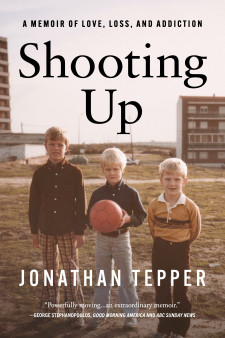
Jonathan Tepper spent his childhood and teenage years in Madrid’s San Blas neighborhood during Spain’s devastating heroin epidemic. When his American missionary parents moved there in 1985, their home became a refuge for people battling addiction, laying the foundation for Betel, a rehabilitation ministry that would eventually help thousands.
In his recent memoir, Shooting Up: A Memoir of Love, Loss, and Addiction, Tepper recounts his friendships with recovering addicts and the heartbreak of losing many of them to the AIDS epidemic. Blending personal memories with reflections on faith, grief and resilience, the book is a powerful story about hope, redemption and the transformative impact of unconditional love.
Read an excerpt below. Click here to order a copy or learn more about the book.
*****
After the accident, the doctors and nurses had worked for hours and saved Jambri and Mari Carmen’s lives. But some of them did not want to touch Jambri. He was HIV positive. The hospital staff feared needle pricks and scalpel cuts. In the operating room, they wore surgical goggles, waterproof gowns, and double latex gloves. The chances of infection were not high, but even the smallest possibility was too great a risk.
My father said the doctors were professionals and did their jobs by rote and reflex, but once the operation was over, Jambri felt the coldness of the interns as they did their rounds, and the nurses whispered in the hallway before they entered his room.
It was months before Jambri and Mari Carmen left the hospital and got back to Cuenca. When I saw him again, we shook hands, but he held mine at an angle and could not squeeze. The bones had set badly. Was that normal, or was that what happened when nurses were scared to touch a patient?
Why were people afraid of Jambri? Jambri was hurt, not sick; surely, he would be fine. When I worked with Jambri at the rastro [Madrid’s open-air flea market], I had shaken his hand and hugged him, and nothing had happened to me. I was living proof.
My parents had told us not to worry about befriending people who were HIV positive, and we didn’t. We had already lived with ex-yonkis [junkies] for the past few years. It was a little late for worrying about HIV.
Raúl, meanwhile, had caught a fever but thought all he needed was a little rest. His condition did not improve, and staying in bed, taking vitamins, and drinking water did not help. His fever got worse, and he started losing weight. Jenny took him to the hospital near their home. Surely, he would be back in a few days as soon as the doctors figured out what his problem was. Each day she went to visit him, and his fevers persisted, and he lost more weight.
When Jenny became pregnant, the doctor told her and Raúl to take some routine blood tests. Raúl was HIV positive, but Jenny and their daughter were not.
The day the doctor told him he was HIV positive, he called my parents. The words fought to come out between the sobs. Raúl understood he had a virus that had no cure. He had a disease that was claiming the lives of his friends one by one. With no cure in sight, the diagnosis sounded like a judge handing down a death sentence.
My parents did not tell us the news about Raúl and his diagnosis. If he wanted to tell us, he would, they figured. It was only when he was in the hospital, losing weight that we found out.
What? How come no one told us before? How could he be sick? It made no sense to me. Bad things happen to other people. We are not other people. It couldn’t be happening to Raúl.
The doctors in the hospital in Barcelona told Jenny that persistent, unexplained fevers were common. Night sweats were a grim ritual for people with AIDS; you had to get used to them, they said. She would have to be patient.
The vague reassurances and platitudes of the doctors became meaningless as the days led to weeks and the weeks turned into a month. There had to be a specific reason Raúl’s health did not improve, a hook to hang their hypotheses on.
The number of doctors that came by his bed increased week by week. Older doctors came by with younger residents, and they looked at his medical records and talked to him. For some of them, Raúl was a strange AIDS case, and they could not come by often enough. He did not yet show the classic low T-cell counts and signs of many opportunistic diseases, yet his weight kept falling. It was an intriguing mystery. But despite the doctors’ medical interest, Raúl continued to lose weight and grow weaker. He stayed in the hospital awaiting a breakthrough that appeared ever more unlikely.
September passed and then October. Jenny came to the hospital every day to visit him. Sometimes she brought their baby daughter, Séfora, along. Her second birthday was in November, and on her birthday, the family shared a cake and blew out the candles in Raúl’s hospital bedroom. Jenny was almost seven months pregnant with their second daughter, and she feared the baby would be born before Raúl got out of the hospital.
Raúl had been in the hospital almost three months, and the doctors still did not know what he had. He had lost almost half his weight and was in agony. The doctors kept coming by to look at his charts, but they were incapable of anything but empty expressions of curiosity.
One day, during their regular visits, Jenny pleaded with the head doctor, “If you don’t do something, he could die!”
The thought had not occurred to her before, and she wanted to take the words back as soon as she had said them.
“Yes, he could.”
The doctor was surprised she didn’t understand the awfulness of the virus.
One day, after dozens of tests, the doctors found the source of his sickness. He had contracted tuberculosis of the stomach and intestines, rare in Europe but not uncommon in Africa. It had punctured the stomach wall and spread. The doctors began a new treatment, and though Raúl’s condition improved, the damage was done.
Raúl was too frail to return to run the Barcelona center again. When he left hospital, my father recommended he and Jenny come back to Madrid. They took a flight so he would not have to face the seven-hour drive; the men in Betel Barcelona loaded up a van with their things and followed them to Madrid.
I accompanied my parents to see Raúl and Jenny. They had moved into an apartment on Calle Butrón, our old street in San Blas. Raúl was sitting on the sofa, wearing pajamas and wrapped in a blanket. He gave me a hug, put his arm on my shoulder, and said “How are you, Jonny?”
His arm was so skinny. He was El Tocho [“the Big Guy”]: he was not supposed to look like that. Would I ever punch his arm again, and would he only ever be strong in old photographs?
“I’ve often preached from Job,” he said, “‘man that is born of a woman is of few days and full of trouble.’ But now, I finally understand the book. Some people say they’re going through a wilderness—at times I think that I am never going to come out of one.”
Raúl struggled for words. “I want...I need to work again.”
Raúl and Jenny agreed to stay in Madrid and help my parents pastor the church. It would be less physically demanding than running one of Betel’s businesses or overseeing the men’s residences.
The first time Raúl came to church, Timothy ran up to Raúl to hug him.
“I don’t want you to die.”
I looked away in embarrassment. You can’t censor children.
“We will all die. Every one of us. Some of us sooner than others. Some of us know it, and others don’t,” Raúl said.
Timothy started crying. Raúl dried his tears with his thumb.
“I’ll be here as long as I can. Who else is going to give you collejas [playful slaps on the neck]?”
Timothy let go of Raúl, smiling amid the tears.
Just as Raúl had not known that he was HIV positive when he entered Betel, many of the other leaders did not know either. After Luis Mendoza died, my parents, Lindsay, and Myk encouraged all the directors and staff in Betel to have their blood tested. The center also asked all new addicts to get blood tests as soon as they entered the program. With each set of lab results, the Betel central office updated the medical files, adding pieces to the puzzle.
After everyone took their tests, perhaps when they felt we were old enough to know, my parents told us the news. Jambri, Majara, and Veneno had contracted the virus. Almost every addict I had grown up with was HIV positive. Unless scientists made a breakthrough with medicines, everyone would die soon.
It did not even seem real. How could all my friends be HIV positive? It couldn’t be true.
Spain was unique when it came to AIDS. In the U.S., it started out as a gay disease. Before it was AIDS it was even called gay-related immune deficiency (GRID). But it wasn’t only a gay disease. In Africa, AIDS was a heterosexual disease. In Spain, it was a disease of the yonkis. And San Blas was the epicenter of the earthquake.
AIDS hit Spain a few years after it had exploded in San Francisco and New York, and it was just as deadly. Spain had the distinction of having the most AIDS cases in all of Europe. It was the only country in the world where most came through intravenous infection. The Spanish government estimated that two thirds of all AIDS cases involved heroin addicts. An estimated 40% of all heroin addicts were infected. In jails, hundreds of addicts must have shared a few needles. How else did it spread so quickly?
It wasn’t just the addicts who spread the virus. Mothers were passing it on to their kids as well. Shortly after Raúl and Jenny came back from Barcelona, their second daughter, Raquel, was born. The first blood tests showed that mother and daughter were both HIV positive. Jenny had become HIV positive too. The doctors did not know if Raquel became infected during pregnancy or delivery.
Why did Jenny and little Raquel have to suffer when they didn’t even shoot up? How many wives and daughters in San Blas were HIV positive? No one knew how far the virus had spread.
So many leaders in the center were infected that my parents and Raúl organized a conference. Between coffee breaks and meals, we packed into the church to hear doctors and ask questions. Many addicts knew so little about AIDS that it appeared as random and capricious as a biblical plague.
All the leaders of the center came from around Spain to the conference, and my brothers and I sat at the back of the room and listened. Like nestlings with open beaks, we awaited the answers that came our way. We all learned how the disease developed, how the virus spread, and how researchers were struggling to find a cure.
Should they take their Retrovir and other drugs if they were getting headaches and nausea? How should they behave in Betel’s residences if more than half of the men and women were HIV positive? Should they marry and have family if they could give the virus to their kids? Could they build a life for themselves amid the bombs and trenches? Would they ever live a normal life?
Everyone was struggling under the weight of the questions. For many, this was the first chance they ever had to ask.
Some addicts were too ashamed to tell their fathers and mothers or even their own children. Many in the neighborhood died without their families knowing why they were ill. They lived and died behind a wall of silence. To them, a physical death was less frightening than rejection and a social death.
The diagnosis of being HIV positive was the dark line of demarcation splitting their lives in half. Before and after. Before was a more innocent, even naive time. After was the certainty of death. After was the shame of being infected. And there was the shame of feeling ashamed.
Raúl led a roundtable discussion on living with AIDS. He had regained most of his weight, although the tuberculosis had run down his defenses over time. His T-cell count was extremely low, like fallen soldiers leaving his immune system undefended. Jambri, Juan Carlos El Rubio [ “the Blond”] and others spoke, and then Raúl.
“AIDS has been positive,” he declared.
The audience gasped while people exchanged glances.
“Every time that someone has died, it has produced more seriousness, more compassion, and more love. We have cried tears for them and are sad that they are gone, but we are aware more than ever that we must make each day count. With our limited days, we have to live a life of quality instead of quantity.
“What God has done, and I don’t think He could have done it another way, is that He has broken something inside me. Having AIDS gives me more love and empathy for others. We are all on the same level.
“AIDS makes us realize there is not time to waste.”
Faced with the disease, Raúl was going to continue working in Betel and showing God’s love to his last breath. Others spoke openly, many for the first time, about carrying the disease and knowing they were going to die; their words were all variations on Raúl’s theme.
I did not have the virus, but knowing that almost all of my friends had it made me despair. They were HIV positive and had to live with it, yet it did not make them withdraw from life. The virus forced people to choose how they wanted to live.
Shooting Up: A Memoir of Love, Loss, and Addiction by Jonathan Tepper is published in the United States by Infinite Books. Copyright © 2026. Excerpted with permission. All rights reserved.


Comments
Comments