

Back in the 1980s and ’90s, Cuban-born Jo Gonzalez-Hastings was a Miami-based flight attendant who was close to many gay male colleagues—but none more than J.C., a fellow Cuban who was bald and “had the cutest smile with a little space in between his two front teeth,” she recalls. “Every time he smiled, you wanted to pinch his cheek.” The two were brutally honest with each other in the way only besties can be: “He’d tell me, ‘You look kind of rough today,’ and I’d tell him that he looked like a penguin with his black-and-white shoes.”
Then, J.C. became one of many of Gonzalez-Hastings’s flight-attendant friends to become sick with AIDS. She visited him shortly before he died. “He was in diapers,” she recalls. “He’d broken some of his teeth from a seizure. He was like a skeleton with skin on him.” He thanked her profusely for coming to see him, but she found the visit so traumatic that she was never able to visit a friend sick with AIDS again. “I’d call them, but I couldn’t say goodbye in person anymore,” she says.
Fast-forward to 1997, when, with her husband, she opened the Habana Café, a high-ceilinged, airy spot serving Cuban classics in coastal Gulfport, Florida, adjacent to St. Petersburg. Soon after, her husband heard about a program called Dining Out For Life (DOFL), in which restaurants and bars across the country pledge to donate a percentage of their take for one day or night to at least one of their local HIV service organizations.
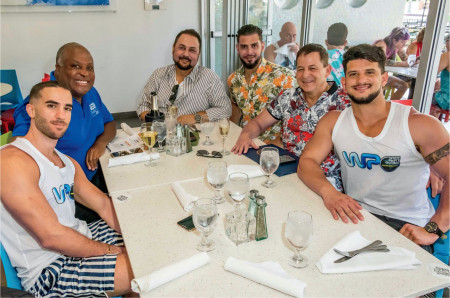
A Dining Out for Life event for DAP HealthCourtesy of CJ Tobe
When he asked her whether she wanted to participate, “I said absolutely,” she says. “I’d lost so many friends to the disease. But we also have a strong gay community here.”
They’ve now participated every year—except during the COVID-19 pandemic—publicizing the event and giving 25% of the evening’s take to EPIC (Empath Partners in Care), a member of Empath Health, which formed in 2021 from the merger of two hospices, Suncoast and Tidwell, both of which had cared for people dying of AIDS. Most recently, on April 23, Habana Café raised $550 for EPIC from the restaurant’s 25% take plus another $1,000 in direct donations from table envelopes.
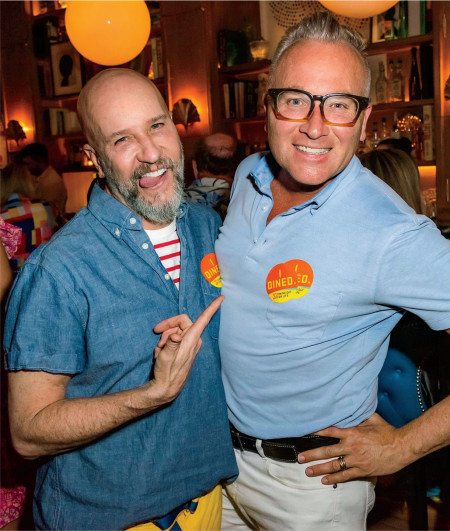
A Dining Out for Life event for DAP HealthCourtesy of CJ Tobe
The evening featured lip-synching drag queens as well as real singing by a hunky Cuban straight man named Victor, a regular performer at the café who makes male and female patrons alike swoon. Among the drag queens, the highlight may have been Chatty Patty (real name Christopher Munette), a longtime friend of Gonzalez-Hastings. Patty wowed the crowd with her black-wigged, black-pantsuit-clad rendition of Liza Minnelli’s classic song “Liza with a Z.”
As at other DOFL events nationwide, diners are invited—usually by “ambassadors,” volunteers who explain the DOFL cause to patrons willing to listen—to donate to the evening’s designated service organization in addition to what the restaurant is giving. At the April event, says Gonzalez-Hastings, “this gentleman came up to me with a $5 bill and said it was all he could afford. I told him that it made all the difference”—just as DOFL has been making a huge difference for 35 years now.
DOFL came to life in 1991 in Philadelphia at a service provider called Action AIDS, which in 2016 became Action Wellness. The development director at the time, Larry Biddle, had a lot of friends working in hospitality who were getting sick and dying. He and a volunteer, Julie Drizin, “wanted to raise money to make sure people with AIDS had access to services,” remembers Kevin Burns, then an Action AIDS case manager who went on to helm the organization until 2023.
And so, the third Thursday in February 1991, the first DOFL took place in Philly, with a small number of mostly gay-owned restaurants (including the defunct Astral Plane, a legendary eatery) giving 33% of that night’s profits to Action AIDS, totaling a couple thousand dollars. “It was a way for them to fill up the restaurants at a slow time of year, and it was a very easy way for people to come out and support the agency,” says Burns, whose staffers, along with Action AIDS clients, would volunteer as DOFL ambassadors at the restaurants.
In the ensuing years, says Burns, DOFL in Philly grew to more than 150 participating restaurants per year, with Astral Plane raising a total nearing $250,000. His agency used the money to pay for expenses the Ryan White CARE Act didn’t cover, such as the salaries of two full-time staffers who ran its program, through which more than 200 volunteers became “buddies” to homebound unwell folks, helping them with errands, groceries and chores and keeping them company.
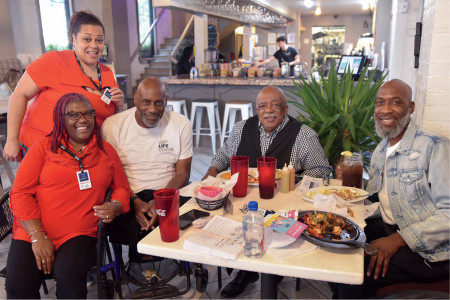
A Dining Out for Life event for the LGBT Life CenterCourtesy of Corey Mohr
The money was also used to help clients avoid eviction and pay utility bills, support the agency’s program for pregnant women living with HIV and employ addiction specialists.
But once the program resumed after COVID, Burns says, the yearly take dropped to about $60,000 to $70,000—likely due to significant rises in restaurant expenses after the pandemic that squeezed the wallets of both proprietors and their diners.
Nonetheless, Burns says that during his years as head of DOFL, “what really moved me was how many of our clients volunteered to be ambassadors at restaurants, being open to diners about the fact that they received services from us, because they were so grateful to the agency.”
A few years after Action AIDS kick-started DOFL, it went national—the Philly agency sold its trademark on the event for $1, says Burns. Now run by a volunteer board, DOFL is still held annually in almost 50 cities across the United States. The program involves 2,400 restaurants and 300,000 diners and raises about $4.5 million annually, according to C.J. Tobe, board president for Amplify Network, which oversees DOFL. Amplify also hosts an annual trade and best-practices conference for HIV service organizations, with this year’s, the second annual, to take place in Indianapolis from July 20 to 22.
Pre-COVID, as many as 65 cities nationwide had restaurants participating in DOFL, says Tobe, who also works for DAP Health (formerly Desert AIDS Project), the sprawling, multisite nonprofit that is the beneficiary of DOFL in heavily LGBTQ Palm Springs, California, which has had a DOFL night since 2004.
Tobe says that DOFL has special meaning for him because after he was diagnosed with HIV in Ohio in his early 20s, AIDS Resource Center Ohio (now Equitas Health), the nonprofit that cared for him, used DOFL money to fund his transportation to and from health and other key appointments for three years.
In Palm Springs, he says, DOFL usually raises about $200,000 a year for DAP—money that benefits the agency’s sexual health clinics as well as frontline services, including food, rental assistance, transportation and wellness services, such as acupuncture, massage and support groups.
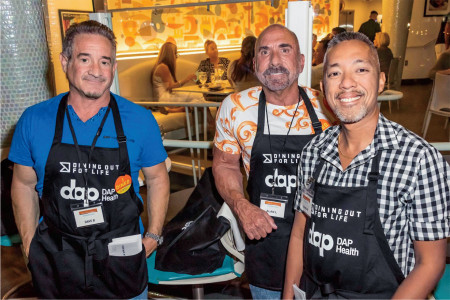
A Dining Out for Life event for DAP HealthCourtesy of CJ Tobe
Noting both the Trump administration’s hostility to healthcare and services spending (especially for LGBTQ folks and communities of color) and the increasing squeeze on states as the Ryan White HIV/AIDS Program is flat-funded despite the rising costs of medications and health plan premiums, he says, “the importance of agencies having unrestricted funds for any and all uses is so significant.”
He adds, “DOFL is a form of organized resistance—a way of people being able to say ‘Screw you’ to the federal government right now and give directly to causes they believe in.”
Part of the power of DOFL is that it looks a little different in every city, not to mention every venue, that hosts it. Cities don’t even hold the event on the same night; DOFL names an annual date every year—this year, it was April 23; next year, it’ll be April 29—but about half of venues choose a date that works better for them.
For instance, in Palm Springs, which this year participated on April 23, more than 60 venues became involved—including Townie Bagels, which donated 100% of revenues that day to DOFL and kicked in another 10% on top of that.
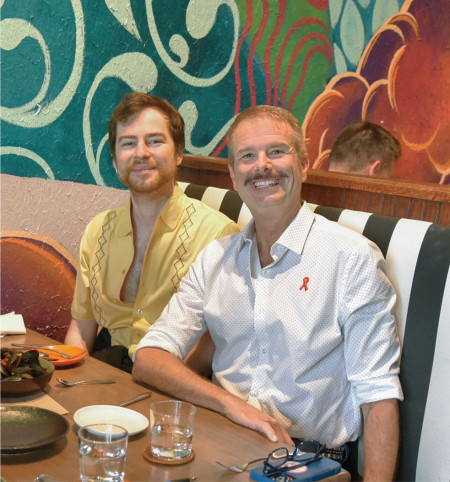
A Dining Out for Life event for the LGBT Life CenterCourtesy of Corey Mohr
“I’ve had a lot of friends who’ve passed [from AIDS],” says Bill Sanderson, who, with his longtime husband, Andy Wysocki, owns the bagel shop. (They developed the gay hookup sites BigMuscle and BigMuscleBear years ago in San Francisco, where, says Sanderson, they raised almost $1 million over 26 years for the AIDS Emergency Fund, now known as PRC, formerly the Positive Resource Center.)
Sanderson says this year, the shop’s DOFL day take—its latest since it started participating in 2016—plus the extra 10% raised $6,300 for DAP.
“We’ve been lucky,” he says of himself and Wysocki, “and we want to give back while we can. As humans, we can do three things—write a check, volunteer your time to a charity or hold someone’s hand. So this is how we try to do those things.”
In Tacoma, Washington, the gay bar The Mix has been participating in the city’s DOFL, giving 75% of its take for one day, almost every year since the bar opened in 2008. That’s according to one of its owners, Brock Leach, a college math professor who opened the bar with a fellow teacher. “It’s just a normal night at the bar,” he says of DOFL, “with many people picking up a DOFL dining option earlier and then coming to the bar after.”
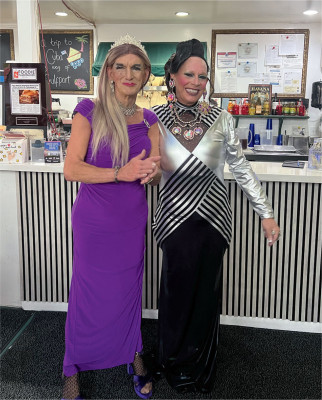
A Dining Out for Life event for EPICCourtesy of Jo Gonzalez-Hastings
Leach says he hosts the night in honor of an older generation of gay people in Tacoma who suffered the worst of the AIDS epidemic. “I know that seeing their friends disappear week after week profoundly affected them, and we want to do everything to make sure their voices are heard. I’m so grateful that nobody living with HIV that I know today is dying.”
Proceeds from The Mix and other Tacoma DOFL venues benefit the nonprofit AHAT Homecare (formerly Afford Housing and Treatment), which provides various forms of housing for low-income people with HIV, including formerly incarcerated and homeless individuals. Chace Hunter, its executive director, says the agency received about $15,000 last year from DOFL. That money, he says, goes mainly to transportation and nutritional services for which the agency otherwise receives no public funds.
“It pays for the proteins, like chicken and beef, that food pantries don’t provide,” he says. “It also gives us a lot of freedom to provide for our clients with few restrictions,” of the sort that are often tied to public money.
And in Chester, New Jersey, the restaurant Fresco Mexican, owned by Carlos Cervantes and Marco Rojas, gives 33% of its take on DOFL night—amounting to between $500 and $600—to EDGE New Jersey, which since the ’90s has provided housing (under many prior names) to people living with HIV and currently provides a wide range of treatment, care and prevention services.
Says Cervantes, “I lived through the AIDS crisis on Key West”—the island off Florida with a large gay population—“and it devastated us there. I lost a lot of friends.” For him, DOFL is “my way of giving back as a gay man.”
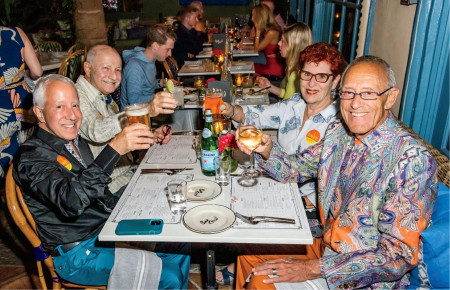
A Dining Out for Life event for DAP HealthCourtesy of CJ Tobe
Cervantes says that, like at many venues nationwide, DOFL night at Fresco Mexican is a low-key affair. “It’s not a drag spectacular,” he says. “Just a lovely evening of community.”
Back at Habana Café, in Gulfport, DOFL is indeed a drag spectacular—which seems to suit the patrons there just fine. This year, in addition to Chatty Patty’s impeccable Liza stylings, DOFL night featured the esteemed local queens Blaise Atrayl, Bitsy St. Claire, Honey Biscuit and Aphelia Dairy-Air.
“She created her own royal court,” says Chatty Patty of Aphelia, “so she’s the Duchess of Gulfport, and I’m the Duchess of Chatterton, because of my chatty mouth.”
But Chatty Patty has a serious side. She was diagnosed with HIV in 1993 and in 1996, thanks to a transplant of her own stem cells, survived non-Hodgkin lymphoma, a formerly common cancer associated with poorly controlled HIV. In the rough years that followed, she says, EPIC, with funding from Ryan White but also, importantly, from DOFL, was a lifesaver.
“If it wasn’t for EPIC and DOFL back when I had no money and was on disability and fighting for my life…..” She breaks off, crying, then, “I watched so many people die.”
But then, just like Liza, she rallies. “I’ll be hosting DOFL at Habana Café until I no longer can!” she declares.
And that’s not the only thing she shows up for at her special friend Jo Gonzalez-Hastings’s all-are-welcome café. “I’m having back surgery in June, but I’m hoping I can get back on my heels by the end of the July—I have drag bingo then!”
Visit diningoutforlife.com to learn more.
Editor’s Note: This article was updated to clarify that the beneficiary for the Gulfport DOFL was EPIC, a member of Empath Health.

Comments
Comments