

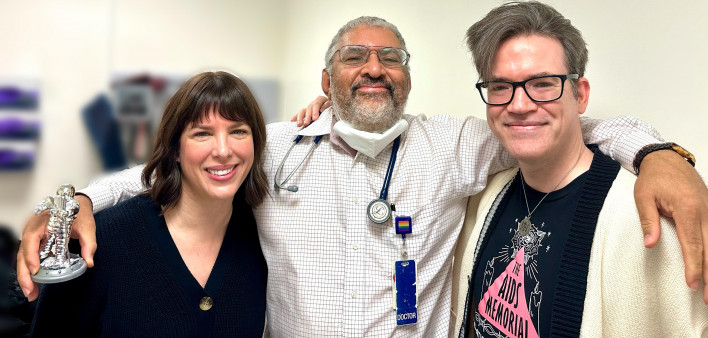
I first saw Gregory Townsend, MD, in the early summer of 1999, the year I started HIV medications. Dr. Greg was the perfect fit for a guy in his early 20s who was more afraid of the potential side effects of HIV drugs than the virus itself. My now wife Gwenn was at that appointment, where I was finally taking the medical condition of HIV seriously.
With just 38 T-cells, I had no choice.
My one caveat to starting meds was holding off for a couple of weeks, as Gwenn and I had a beach trip planned to celebrate my 24th birthday. Dr. Greg agreed to the terms. After some fun in the sun I was ready to hold up my end of the bargain, but after six weeks of pristine adherence I did the unthinkable and missed a dose.
In a panic, I emailed Dr. Greg. He congratulated me, saying most first-timers don’t get that far, which made me proud. Still, adjusting to the HIV regimen while navigating the brutal side effects was exhausting.
The good news was the treatment worked like a charm.
Gwenn really helped, too. She joined me for all of those early appointments as the antidote to my decade-long habit of glazing over in the doctor’s office. When Dr. Greg asked how I was doing, I’d say “I’m fine,” prompting a soft nudge from my love to spill the beans about having to pull over to vomit on the side of the highway after band practice.
We were a good team.
And no, my short-lived band, The So-So’s, weren’t that bad.
Looking back on how grueling those days were makes me so grateful that, over the years, most of my time with Dr. Greg has been spent sharing laughs. After my T-cell count became robust and viral load consistently undetectable, Gwenn stopped attending appointments because, well, she had other things to do.
Seeing Dr. Greg became more about sharing the absurdities of daily life, inspiring cackles that loudly echoed through the hallways of the Ryan White clinic. That hard-earned normalcy, however, took a turn a few months ago when he gave me the toughest news I’d received in the clinic since 1999.
Dr. Greg was retiring.
The day before our last appointment I was a mess, crying and then talking it out with Gwenn before more waterworks. I was truly acknowledging that this long, transformative chapter in my life was coming to an end. “I’m coming with you to that,” Gwenn said as she held me close. I couldn’t have imagined it happening any other way and Greg was so delighted to see her.
“GWENN!” he exclaimed, rushing in for a group hug in front of an audience of one med student and one resident who probably had four weeks of classes on “Why aDoctor Should NEVER Touch a Patient,” which I imagine being heavy on old General Hospital, Scrubs and Grey’s Anatomy clips.
I presented Dr. Greg with a little plastic MTV Video Music Awards moon man, explaining the nod to his appearance on MTV Staying Alive 2, a 2000 World AIDS Day special showcasing our plight as doctor, patient and partner of patient. “No pressure, but we represented the HIV/AIDS epidemic in North America,” I said, putting a little shine on our team’s early work.
My tear ducts were further moistened re-watching that program. At the time I’d just gone off that first round of HIV medications, despite improving T-cell counts and a diminishing viral load. I was feeling beyond wiped out after 10 months of nausea and diarrhea and, while thankful for the improved health, I’d been thoroughly defeated by the side effects.
Reliving that time in my life, I recalled how apprehensive I was wondering how Dr. Greg would react to my desire to stop meds. So I did what I always did and led with a joke that arrived in his inbox:
“I want a new drug, one that won’t make me sick.”
Dr. Greg’s reply opened with some simple questions of his own.
“One that won’t keep you up all night? One that won’t make you sleep all day?”
He didn’t just flex his Huey Lewis and the News bonafides. Dr. Greg said I didn’t have to feel so terrible, that we’d find a combo that worked without the quality of life tax. He did what a doctor should do: set his patient at ease by creating an environment where someone with previously tight lips felt comfortable disclosing what was really happening.
And we did find a better option.
As a result, Gwenn and I were able to travel far and wide to educate about HIV and the advances in treatment that had saved my life. That would have been impossible if Dr. Greg had pressured me to stay on a drug that necessitated close proximity to home, namely the half bath closest to the entrance.
A couple of years into that second drug regimen I started to notice mental fog. I was curious about “drug holidays,” a phrase born out of people with HIV leaving their pills at home when going on a long weekend trip. I figured Dr. Greg would bristle at my idea of two weeks on and two weeks off, and he did.
So we compromised: I’d try one week on and one week off. I had no problem sticking to the trickier regimen and we were both surprised by the results of my first labs: there were no alarming changes in T-cell count or viral load and, for the next decade, this would be my regimen of choice.
When Dr. Greg invited me to participate in a presentation he was giving at the University of Virginia, I was happy to help. He thought the audience of first-year med students would benefit from hearing the perspective of a lifelong patient born with hemophilia and diagnosed with HIV at a young age. More importantly, they got to see a doctor and patient laughing together in what could only be described as a friendship at best, and a true bond of trust and respect at the least.
When a student asked what my prognosis was Dr. Greg jumped in, explaining that if I treat the challenges of aging the same way I treat HIV, I had a normal lifespan ahead. He added that it’s entirely conceivable that I could outlive him.
That surprised me.
I hadn’t really dared to think about a future more than a few years ahead. When I got home, I recited the entire scenario for Gwenn and the reality of us growing older together was cathartic.
Part of surviving is accepting bittersweet victories.
As our final appointment was coming to an end, I joked that — medically speaking — Dr. Greg is the easiest position to replace on my health care team. “I know!” he said with a big, satisfied smile. “All of my patients are doing so well!”
I loved hearing that.
For them.
For him.
Before we left, I handed Dr. Greg a card. It contained a few sentences worthy of Hallmark before I cracked. In a state of desperation, I scribbled that we should still see each other every six months or so, suggesting we go to the movies “until one of us croaks.” Thanks for everything, Dr. Greg. I rest easy knowing that I’ll always hear that brilliant, infectious laugh.
Whether it’s in my heart or sharing a tub of popcorn at the next Dumb & Dumber sequel.
Either way, it’ll be my treat.




Comments
Comments