

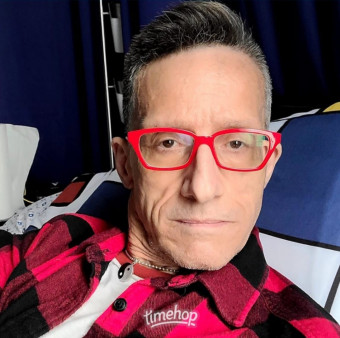
About two years ago, Paul Aguilar started to notice that it had become harder for him to take his daily HIV pill. It didn’t matter what he did. Whether he put it by the coffeepot, sat it next to the toothpaste or left it by his bedside, he’d forget to take it. If he tried to take his medication in the morning, he’d rush off to work having left it on the counter, unswallowed. If he tried at night, he’d fall asleep too quickly, overwhelmed by the day’s demands. The kicker? He was on other meds that he could remember to take. He could wolf down his statin and his vitamin D without a problem. But there was something about his HIV pill that his brain just couldn’t fathom.
“It was really frustrating, especially for my doctor,” Aguilar, a 61-year-old San Francisco native and resident, says. His doctor is one of the most well-respected HIV physicians in America, Ward 86’s Monica Gandhi, MD. She said two words to him that he had never heard before: pill fatigue. “I’ve been taking pills since I was 30 years old,” he says. “I’m going to be 62 in June, God willing.”
Pill fatigue is a documented phenomenon that often occurs as a result of the reality of taking too many pills as people age and is marked by the loss of desire to adhere to treatment, according to a 2014 study in Psychology, Health & Medicine.
“It was so anxiety-producing,” Aguilar says of having to remember whether he had taken his pill. After some discussions with his doctor, he decided to give long-acting injectables a try. It’s a plunge he’s happy he took. “It’s like this huge weight is lifted off my shoulders now. I don’t have to stress every day.”
Aguilar was diagnosed with HIV in 1988 at age 25. He was told he had five years to live and was immediately put on AZT. Six months later, the side effects from the drug were so intolerable that he didn’t take another pill until highly active antiretroviral therapy became available in the mid 1990s. He took pills every day ever since, up until his switchover to an injection.
“I’ve taken so many tablets and capsules,” he says. “I’m surprised I don’t rattle when I walk.”
After 30 years of taking pills, when the fatigue set in, Aguilar saw his viral load climb.
“There was a little blip, then a little blip, then it shot up to a million and a half,” he says. Within a month of going on long-acting treatment, his viral load became undetectable and has remained so since.
Aguilar’s story is a reminder of the ways that life circumstances can affect a person’s ability to adhere. Shortly after he first experienced pill fatigue, he also experienced homelessness. He was 58, living on a fixed income in one of the most expensive cities in the world and began having to stay with friends or sometimes live out of his car.
“For some housing programs, I wasn’t homeless enough because I had a car,” he says. “For other programs, I was too homeless. I was stuck between a rock and a hard place.”
He adds, “I really thought, This is it. I’m going to die in the streets.”
His homelessness made it even harder for him to take pills. If a routine couldn’t help him before, then there was no way he was going to be able to adhere to medication amid the stress of not having a stable place to sleep.
“That’s when my viral load started to spike,” he says. “There was no way I was able to take it on any kind of regular basis.”
Friendsmanaged to get him a room at Marty’s Place, a housing co-op for people living with HIV founded in 1993. When Father Richard Purcell first opened Marty’s Place, named after his brother, it was a place for people to die with dignity. Now, it’s a place for people to live.
“We’ve become a family,” Aguilar says. “A big, loud, noisy family.”
As an advocate who has experienced housing insecurity, he hopes that long-acting injectables can work for others who might be facing similar challenges.
With his housing situation sorted out, he’s been able to focus on his treatment. Aguilar says that early on, he experienced pain in his lower back from the injection, but after an honest conversation with his doctor, they changed the injection site from his lower back to his thigh, where he tolerates it better.
He also has occasionally noticed small, painless bumps on his skin where the medication settles before dispersing. Regardless, he says the benefits have been extremely welcome during a very tough time in his life. “My dad died, the love of my life died, I was homeless,” he says. “The one little thing that made so much difference in my life was not having to worry, because I had all this going on.”
Now that he’s made injectables a part of his life, he says he tries to talk to other people about the advantages of long-acting medication versus daily pills. Aguilar stresses that the most important thing is to have an honest talk with your doctor about long-acting injectables as an option and to remember that if you try a long-acting injectable and don’t like it, you can always switch back to pills.
“Just do it,” he says. “You can always go back to a pill once a day. But unless you have a debilitating fear of needles, it’s probably the best thing that you could do to relieve the pressure.”
And, he adds, nothing beats the peace of mind.
“I cannot express how important that lack of anxiety is,” he says. “It’s life-changing.”




6 Comments
6 Comments