

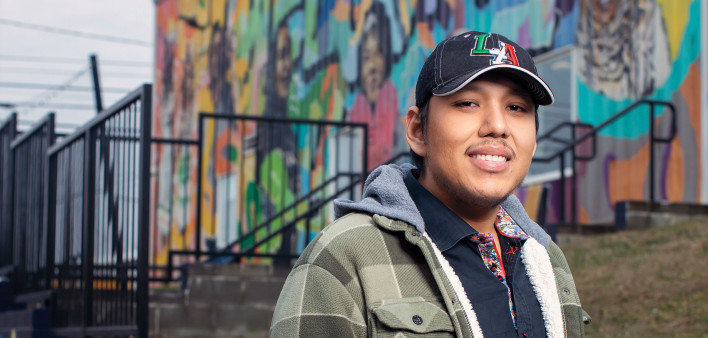
The U.S. People Living With HIV Caucus is a national organization empowering those living with HIV. When its participants went looking for steering committee members, they specifically sought candidates whose lived experience matched their mission to eradicate the virus. The HIV Caucus didn’t want a rubber stamp. The group wanted members who are equally committed to fighting the systemic injustices that put people at risk for HIV to begin with.
Raul Ramirez Perez of Nashville answered that call.
“There are far too few queer Latino men from the South who actually are advocating, putting themselves out there, visible for our HIV community,” Ramirez Perez tells POZ. “I have been a verbal advocate about HIV education, prevention and treatment. I deliberately have put myself in these spaces.”
His election to the HIV Caucus board is the latest milestone in Ramirez Perez’s remarkable activist journey.
A special education teacher by trade, Ramirez Perez also serves on the Nashville Regional HIV Planning Council, where he and fellow council members help distribute money and resources to organizations working to combat HIV in the Nashville region. Ramirez Perez is also active in Planned Parenthood’s Spanish-language Promotores program focusing on sexual and reproductive health for and by Latinos.
Ramirez Perez previously served as community liaison for the Tennessee Department of Health, a position that was phased out due to government budget cuts. According to Ramirez Perez, funding cuts are a threat HIV activists in conservative states have long been familiar with, regardless of who occupies the White House.
“I still see a lot of the people from the Tennessee Department of Health in these councils and committees that I’m a part of,” he notes, highlighting his resilience and persistence.
“I was 25 years old and living in California when I got the news that I was HIV positive,” Ramirez Perez explains. “And because I didn’t have any friends or family in the Los Angeles area, my experience finding out I was positive was not the best. There was no one to talk to, or to vent to, or to help me process what I was going through. So for a good chunk of the beginning of my HIV journey, I just hadn’t processed that I was HIV positive in a healthy way.”
That’s when Ramirez Perez moved back home to Tennessee, where he quickly became involved with the End HIV 901 Committee, a community-driven initiative aligned with St. Jude Children’s Research Hospital to curb HIV cases in the Memphis region.
“I really thought about this,” he says. “What do I want to get out of this? What do I want to accomplish? And I think the biggest thing is just providing that visibility and that presence that a lot of times isn’t seen in organizations like these. If I put myself out there and show my vulnerability and show myself transparently, then that will motivate other people to be like, Hey, I can do this too. Just being able to be that person that you can see yourself in. Especially as a queer person of color in the South, I want to push that because it just feels like it’s very isolating here.”



Comments
Comments