

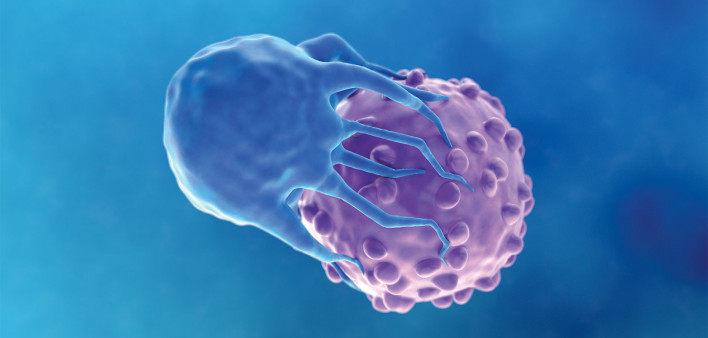
New studies add to the evidence that immune checkpoint inhibitors are safe and effective for people with HIV and cancer. These monoclonal antibodies interfere with receptors on immune cells that regulate immune response. For example, drugs that block PD-1 can restore lost T-cell activity, while those that block CTLA-4 promote T-cell multiplication.
In one recent analysis, Anna Coghill, PhD, MPH, of Moffitt Cancer Center, and colleagues compared the safety and efficacy of checkpoint inhibitors in 24 people with HIV and 24 HIV-negative patients. The overall response rate—indicating tumor shrinkage—was a bit lower for HIV-positive people relative to HIV-negative people (29% versus 38%), but the difference was not statistically significant. Overall survival rates were similar (63% and 67%, respectively), and the frequency of adverse events was also comparable.
In a second study, Florence Brunet-Possenti, MD, PhD, of Hôpital Bichat-Claud Bernard in Paris, and colleagues looked at real--world outcomes among 54 HIV-positive people with aggressive skin cancers who received checkpoint inhibitors. Overall response rates were 43% for patients with melanoma, 58% for those with cutaneous squamous cell carcinoma and 75% for those with Kaposi sarcoma.
“These findings support managing well-controlled people with HIV similarly to the general population and highlight the importance of including this population across all settings of skin cancer trials,” the authors concluded.
Two recent medical literature reviews assessed outcomes among HIV-positive people with non-small-cell lung cancer treated with checkpoint inhibitors. In both reviews, response rates, survival and adverse events varied across studies but were generally comparable to those reported for HIV-negative patients. Importantly, checkpoint inhibitor use did not lead to HIV viral rebound.
In fact, checkpoint inhibitors may help promote control of HIV, and they are being studied as a potential functional cure strategy. PD-1 is heavily expressed on exhausted CD8 killer T cells that fight HIV and cancer as well as on CD4 helper T cells that harbor hidden HIV. Several studies suggest that drugs that block PD-1 may delay viral rebound after stopping antiretrovirals and might help shrink the viral reservoir.

Comments
Comments