

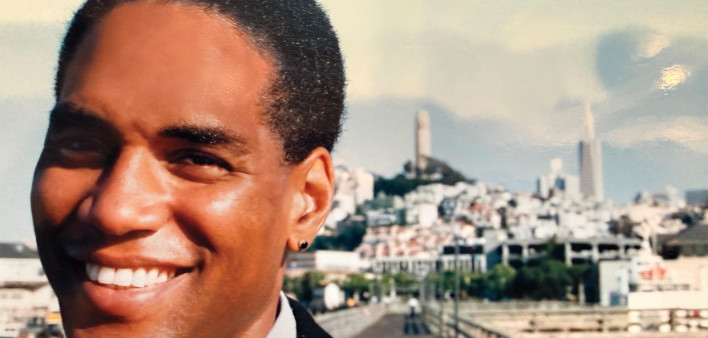
In April, Phill Wilson—who founded the influential Black AIDS Institute (BAI) more than a decade after his own mid-1980s HIV diagnosis—turned 70. Still living in his longtime home of Los Angeles, where he’s busy writing his memoir and enjoying a new relationship, he recently spoke with POZ contributor Tim Murphy about losing his first lover to AIDS, becoming a go-to expert on the epidemic in LA and why BAI’s work to close the HIV racial gap was significant but remains unfinished. He also has a fun, new hobby!
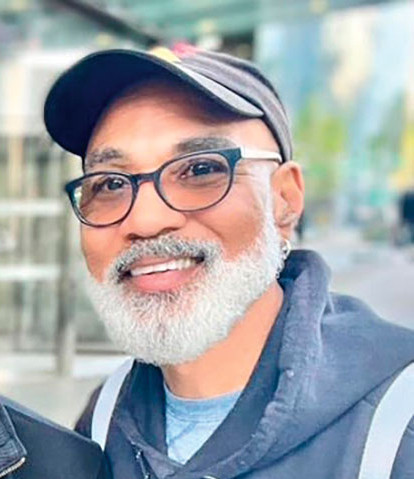
Phil WilsonCourtesy of Phil Wilson
Phill, what was going on in your life on the eve of the epidemic in the early 1980s?
My partner at the time, Chris Brownlie, and I were building our lives together as young gay men in Chicago. I was working as a marketing analyst at AT&T. I think I would’ve become a business entrepreneur if AIDS hadn’t happened. But I hope I would’ve still responded to the epidemic in some way.
In a previous interview we did, you talked about you and Chris in 1981 both having swollen lymph nodes and reading about this new disease in [the magazine] Blueboy. And then you and Chris moved to LA in 1982 and volunteered on the hotline of the newly started AIDS Project Los Angeles (APLA). When Chris died of AIDS in 1989, you were 32. Has that early loss impacted your life?
It totally changed the trajectory of my life. At the point of his death, my entire gay experience was in the context of a decade-long relationship with him. The impact of that period of time in my life has been my North Star up until today.
What did you do after his death until you founded BAI in 1999?
I was involved in the Black Gay and Lesbian Leadership Forum—an organization I founded. Shortly after, Mayor Tom Bradley asked me to become the AIDS coordinator for LA, writing all the city’s AIDS programs.
Then I worked for APLA until 1996, the year the [new lifesaving drug] cocktails came out. I got really sick from AIDS that year—at one point, they said I had a day to live. But then, I went on the cocktail and started to recover. By 1998, I felt like I needed to get back to work. So I looked around.
Between 1996 and 1998, a lot had changed [in terms of people getting better with the new meds]. But there wasn’t a lot of movement to address AIDS in Black communities.
What did that disparity look like?
In the white gay community, it was like when it goes from black and white to Technicolor in The Wizard of Oz. But Black men were still in the Wicked Witch’s castle being chased by monkeys. There was no Black mobilization, which was needed regardless of gender or sexual orientation.
Did your work intersect with the late, great Archbishop Carl Bean, who not only sang the gay disco classic “I Was Born This Way” but also started the Black LGBTQ Unity Fellowship Church in LA in 1982 and the Minority AIDS Project (MAP) in 1985?
Absolutely. In 1986, [political activist] Lyndon LaRouche had an initiative on the ballot in California to quarantine people living with HIV in, basically, concentration camps. I got into the effort to counter that and reached out to Black communities, where I encountered Archbishop Bean in the early years of Unity Fellowship, where I was a congregant, and the Minority AIDS Project. After we defeated the LaRouche initiative, he asked if I’d become the executive director of MAP, which I was for a short period of time.
What was Bean like?
Anyone who ever met him was struck by his charisma. He came out of a very traditional Black Christian evangelical experience and had a remarkable ability to help people understand that they deserved to be cared for.
You started BAI in 1999 and stepped down in 2019, even though BAI still exists. How would you summarize those 20 years?
Our goal and our mission was to create a Black AIDS movement, meaning our slogan, which was “AIDS in America is a Black disease.” We were able to get Black institutions and leaders to take ownership of the epidemic and acknowledge it was all of our problem. Another of our slogans was “Our People, Our Problem, Our Solution.” We moved HIV/AIDS from the periphery to a central issue in Black culture.
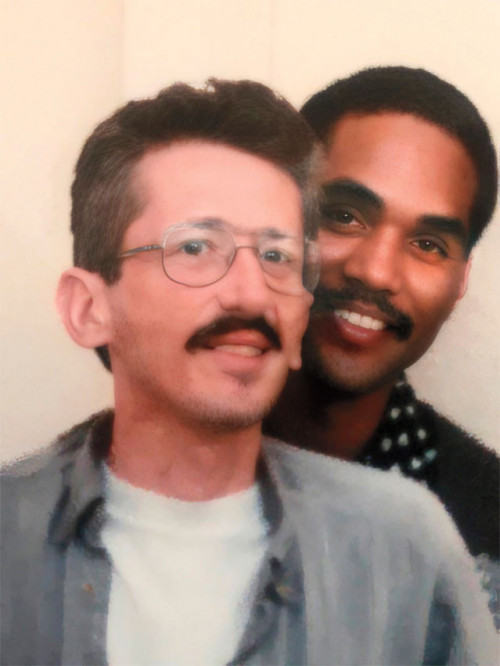
Phil Wilson (right) with his late partner Chris BrownlieCourtesy of Phil Wilson
What about closing the racial gap on getting tested and treated and having access to the best prevention? According to the Centers for Disease Control and Prevention—which many people who follow evidence-based science now mistrust due to right-wing interference—Black folks still make up 38% of new HIV diagnoses in the U.S. despite being only about 13% of the population.
The tragedy is, I don’t think we closed it. We improved access and outcomes in Black communities. But there remains a huge gap. White gay men were at the front line of HIV becoming a manageable chronic disease, whereas in Black communities, we are still at the point of educating people about the science of HIV/AIDS, which is a lot of what we did at BAI. We made progress but started so far behind. Also, once HIV became manageable among white gay men, the world turned its attention away.
With distance now from BAI, what are your feelings about your time there?
I’m very proud that we did work that nobody had done before. We focused attention in new ways and engaged folks who’d not been engaged. We created delegations of Black media, thought leaders and elected officials to attend the national AIDS conference. We were able to move traditional Black institutions from a place of blame and shame to one of responsibility and accountability. All of the national Black institutions—NAACP, the Urban League, etc.—had AIDS strategies and national AIDS committees. We were able to get Black media to cover HIV/AIDS. I’m proud of all that and of our ability to reduce the stigma of HIV/AIDS in Black communities. But now with the assaults [on HIV funding] happening, it feels like that progress is being erased.
How do you feel about this moment we’re in right now?
These are very scary times. Dangerous. The world as we know it—whether we’re talking about LGBTQ, HIV/AIDS or any number of things—faces an existential threat. But all the communities I’m a part of—Black, LGBTQ, HIV/AIDS—have faced challenges of this magnitude before. We can prevail, but it will depend on how engaged we are in responding to this threat.
What’s something that is giving you joy these days?
I’m involved in gay square dancing. Karl, my partner going on two years now, was involved in it when we met, so I would go to those events with him and decided that I would take lessons. It’s great camaraderie. People who do square dancing skew older, and it’s good exercise.
Is drag involved?
Sometimes! There are events that are drag-related, like leather square dancing and nude square dancing. All sorts of square dancing. Sometimes the women dance the male part, and the men dance the female part. And sometimes both the men and women wear those petticoat dresses.
Would you be open to doing the nude square dancing?
Probably not! I’m a Midwestern boy, hence a little too conservative for a lot of hanging out naked.
This interview was excerpted from the original, which was published on The Caftan Chronicles, Murphy’s Substack featuring long-form interviews with famous or notable older gay men.


Comments
Comments