

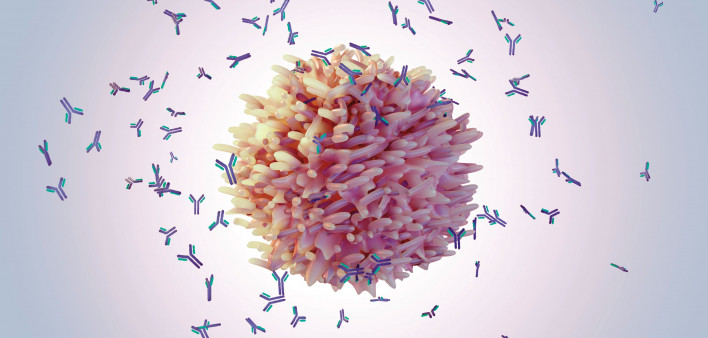
After several traditional HIV prevention vaccine candidates have failed, researchers have turned to more sophisticated approaches, such as training the immune system to produce broadly neutralizing antibodies (bnAbs). Only a small proportion of individuals with HIV naturally produce bnAbs, but most people possess rare immature B cells that have the potential to do so. An approach known as germline targeting uses a series of vaccines in a stepwise manner to encourage the development of these specialized B cells and train them to produce bnAbs.
Participants in the IAVI G002 trial, conducted in North America, received a messenger RNA vaccine based on an engineered immunogen dubbed eOD-GT8 60mer (mRNA-1644) with or without a slightly different booster. All 17 people who received both the primer and booster developed encouraging antibody responses. In the IAVI G003 study, 18 people in Rwanda and South Africa received the primer vaccine alone; all but one showed relevant antibody responses.
“We’ve now shown in humans that we can initiate the desired immune response with one shot and then drive the response further forward with a different second shot,” says senior study author William Schief, PhD, of Scripps Research Institute.
These findings are promising, but they are just early steps in a long process leading up to large clinical trials to test whether the vaccines can prevent HIV in the real world. Unfortunately, further research is in jeopardy as the National Institutes of Health has cut funding for HIV vaccine efforts, focusing instead on “currently available approaches” to eliminate HIV.




Comments
Comments