

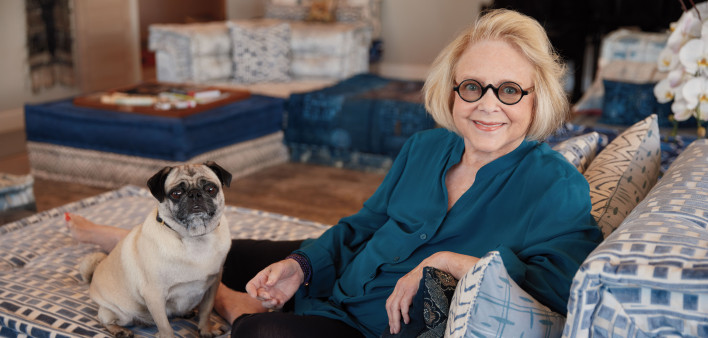
For more than 30 years, Mary Fisher has been a beacon of courage and compassion. The long-term survivor—of HIV and breast cancer—kicked off her advocacy journey onstage at the 1992 Republican National Convention with her powerful speech, “A Whisper of AIDS.” Fisher, a former aide to President Gerald Ford, came from a prominent political family. She was diagnosed with HIV in 1991. Speaking as a mother with two young boys, she urged her fellow Republicans and Americans to “set aside prejudice and politics to make room for compassion and sound policy” regarding HIV and AIDS.
Fisher continued speaking out against the injustices faced by those living with the virus and became a passionate advocate for the HIV community. Focusing on combating stigma and promoting compassionate, science-based public policy, her advocacy work has propelled her around the globe.
Fisher is also an accomplished visual artist and writer who uses her creative talents to support humanitarian causes. Her latest book, Uneasy Silence, is a call to listen, to understand and to act. The collection of essays challenges readers to confront society’s uncomfortable truths and to find the courage to condemn injustice. Her words encourage us to break the silence that often surrounds the suffering of others.
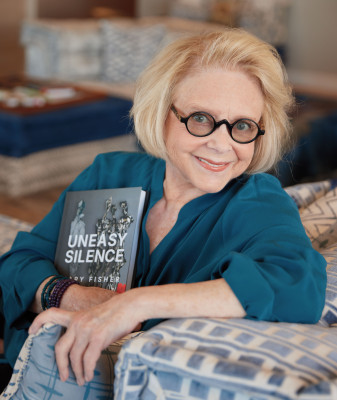
Mary FisherAri Michelson
Uneasy Silence is a testament to the power of one voice to effect change. Through personal recollections and reflections, the 77-year-old Fisher invites us to examine our silence and find our voice in the face of adversity. She reminds us that though silence may be comfortable, it is often in speaking out that we become our true selves. The following is a lightly edited excerpt from her book.
*****
It was an accident. I never intended to be an activist. I was working on being a contented artist when I was found by a tiny virus that changed my life.
When I think of activists, I think of Ida B. Wells (anti-lynching), Malala Yousafzai (girls’ education), Opal Lee (“Grandmother of Juneteenth”), or Gloria Steinem (women’s rights). Interestingly, none of the activists that come to mind are elected leaders. They don’t have lofty titles or huge armies. What they have in common is a strong conviction that something in society needs to change, and change now.
My friend Larry Kramer released Reports from the Holocaust: The Making of an AIDS Activist in 1989. I didn’t put his book on my reading list. But by the time we met four years later, I knew he was leading a campaign for change in how America responded to the burgeoning AIDS epidemic. I was a quiet mother from Florida who spoke softly in public. He was my screaming colleague, my model of what an activist should be.
I thought of activists as the organizers of marches, authors of diatribes, and firebrand community spokespersons. Larry fit the mold. I clearly did not. But between our first meeting in 1993 and Larry’s passing in 2020, I came to see myself as engaged in my own campaign for change.
I had become an activist.
Bearing Witness
My campaign for change centers on the truth about AIDS and how America responded, and still responds, to this disease. As best I can, I try to tell the truth without exaggeration. I prefer not to take cheap shots at those with whom I disagree, in part because I want their support. If someone is clearly opposed to the truth, I’m willing to call them out. But overall, I won’t achieve much by irritating those I want to convert.
The United States has never had an official policy of extermination for those hosting the AIDS virus. But the epidemic flourished in the ’80s and early ’90s owing in part to the intentional inaction on the part of political leadership. Those with the power of the purse strings chose to look the other way while hospices filled with dying young men. Then came Republican President George W. Bush.
In his January 28, 2003, State of the Union Address he announced the launch of PEPFAR (the President’s Emergency Plan for AIDS Relief), marshaling private and public funding to slow, and eventually eradicate, HIV in Africa and elsewhere. In its first 20 years, more than $100 billion have been invested in PEPFAR’s goals, saving no less than 25 million lives. Note: That’s 25,000,000 men, women and children. It’s no wonder that when I visit Rwanda or Zambia or any AIDS-battered nation, George Bush is seen as heroic, and Bill Clinton is remembered for “talking a good game.”
Bearing witness to these truths has its own power. When Jewish survivors of Dachau bore witness, they told the truth about the cruelties and deaths that permeated the [concentration] camp. They established on the record the brutality of individuals, some of whom were subsequently prosecuted for their crimes. Without the witnesses who told their own stories, conviction of evildoers would have been improbable. It was the truth, recounted by witnesses, that offered the power of justice.
A new crop of Holocaust deniers has recently sprouted, popularized in right-wing media and aimed at dismissing the truth of 6 million victims of fascism. Fascism isn’t really that awful, they claim. Tortures weren’t really severe, and malnutrition comes with war. Talk of a Holocaust is merely exaggeration by Jews and their sympathizers. Since the Holocaust didn’t happen, then we needn’t worry about the lies that resulted in the concentration camps: division of the races (Jewish and Aryan in Germany, Black and white in the U.S.), establishing that certain groups are not fully human (gypsies in Germany, Black slaves in the U.S.), and so forth. Denying history enables us to deny the impact of the patterns we see being repeated today.

Mary Fisher at the 1992 Republican National ConventionCourtesy of Mary Fisher
Tour the National Memorial for Peace and Justice (informally known as the National Lynching Memorial) in Montgomery, Alabama. Read the narratives describing the conditions of slavery and sanctions of Jim Crow. Stare at the photographs of Black bodies that have been dragged through the streets of rural Mississippi or slashed, branded, and hanged on a nearby sycamore. Come face-to-face with the realities of thousands—thousands!—of lynchings used to instill fear and assure obedience. The memorial bears witness. Powerful, shameful, unforgettable witness.
The state of Florida recently instituted a new educational curriculum in which it is noted that “some slaves developed highly specialized trades from which they benefited.” Claiming that slaves were helped by slavery is absurd. It can only be imagined to be true if we yield to the fallacy of “balanced reporting,” in which each of two sides are seen to be of equal importance, accuracy, and usefulness, whether or not they are equally true.
The media has fallen for the fallacy, and someone should quickly and consistently bear witness to the truth.
Cost of Isolation
The COVID-19 pandemic came without warning, a gloomy cloud of lonesomeness rolling into every American’s life.
I’d moved to California days before the pandemic’s alarms were being sounded. Twenty-five years earlier, I’d been an active citizen in the AIDS community, one among many, accepted and even valued. I was part of the informal team, the woman who was called to speak the truth to power. I had a role in the community, and I knew how to fulfill that role. I was a messenger, and I was grateful for it. Subsequently, other communities—an international quilting community, for example—welcomed me in.
But as the years rolled by, age and illness took a personal toll on my social interactions. I circled the world a few more times, meeting with government leaders and women with AIDS. But calls for me to speak to a live audience or worship community slowed. I’d paid my own way when giving speeches, contributing any honoraria to charity because I could. I was grateful for every opportunity and every audience because speaking had been my primary mode of bearing witness to the devastation of the American AIDS community, my way of keeping alive those we lost and preserving the truth about brutalities we endured. When invitations to speak slowed almost to a halt, I felt diminished and my sense of purpose wilted.
What I need to do is speak clearly using my story to bear witness to the truth that I know.
Then came the pandemic. It shut down social interactions of nearly every kind, from worship to parades, shopping to funerals. If requests for speeches had previously slowed, now they stopped. Recognizing that speeches were no longer a way to make a difference, I tried publishing essays on various online platforms, including Medium and Substack. My pieces were warmly received. But by the time 75 or 80 essays were circulating, I knew how keenly I missed face-to-face connection with a live audience.
It was 2022. By almost any measure, I did not have a bad life. I had survived COVID-19. I wasn’t impoverished. I had grandchildren to wear me out. But my life wasn’t satisfying. My interaction with the world was mostly as a spectator, seeing troubling events and noisy people through a television screen. I occupied the sofa. I felt old. Finished. Done.
Moving Into the Community
During the press of the COVID-19 pandemic, Project Angel Food’s director of philanthropy, Mark McBride, visited me with a request for support. I promised to keep helping.
Weeks later, an acquaintance called to ask if I’d join her at Project Angel Food for a chef’s dinner. We’d tour the place, she explained, then meet a volunteer or two, listen to a staff member explain the challenges, and go home. Frankly, I was still fearful of the COVID-19 virus, but I heard myself offer my caller a reluctant OK.
On a cool December evening in 2022, I was one of perhaps a dozen guests at Project Angel Food. As promised, we toured the kitchen—immaculate!—and the offices. We heard stories from staff and volunteers. If my mind wandered it was because I was remembering food brought to me in communities that had no food to spare. I recalled meals of nshima [a thick porridge made from maize flour] while sitting around charcoal fires in Zambia with women who had AIDS. I heard [Project Angel Food cofounder and my friend] David Kessler saying, “Our first act of love in this world is feeding someone, our child.” I remembered other evenings around meals in other places where the gay community and the AIDS community were one, embracing me.

Mary FisherAri Michelson
When I refocused on what was actually being said in that room, I offered to volunteer my time in the kitchen or wherever I could be useful. Being a donor is fine; it’s also solitary. I wanted to become a member of the crew volunteering to serve. These were my people.
If they’d let me in—and they have!—this is my community.
Joy in Service
I live with an uneasy silence when I think of all the troubles that scar this world. Raped women dare not speak out; someone needs to speak for them. Why not me? Why not now? Abused children are gagged by their abusers. Political “leaders” in Texas and Arizona say they’re “in prayer” for survivors of mass shootings and migrants who were stuffed into a hellishly hot truck and died at the border. And the ghoulish list goes on. I can paralyze myself with the desire to represent every cause and cure every evil. It doesn’t work.
According to David Kessler, the first day we met, I said to him, “I’d like you to help me die.” It told the truth about how I was feeling.
I’ve changed. The depressive moods have lifted, in part because David helped me see that I wasn’t so much “depressed” as “grieving” and that I could live with the grief while finding avenues to joy.
What I need to do is speak clearly using my story to bear witness to the truth that I know. That’s all. Stop. Now I need to get off the sofa and into serving others if I want to retain some semblance of a grandma’s mental health. There’s plenty of science that proves helping others helps us. Even without the science, my experience says it’s true.
For me, my engagements with Project Angel Food were at least mood-shifting and perhaps life-changing. It’s a special joy to belong in a crowd of people happily meeting the needs of others. Peeling an onion isn’t saving the world, but it may add savor to a meal that would otherwise be bland. Such are the hopes amid the kitchen volunteers, including me. There are tens of thousands of places where you could volunteer. Step up and join the community!
One of my important heroes is Mother Pollard, whose life of service was famous [she participated in the 1955–1956 Montgomery bus boycott]. “For untold decades she had cared for the sick and raised the orphans, Black and white alike,” wrote historian Taylor Branch. Like Mother Pollard, my feet are often weary, but my soul is rested. Martin Luther King Jr., two months before he was assassinated, said that he hoped to be remembered as one who “tried to give his life serving others.” One by one the people I admire have given testimony not only to the power of service but also to the satisfaction that serving others brings us.
I’ve long lived with gratitude for my sons, serving them as a mother does. Now I live with the staggering joy of grandchildren, a gift I never imagined I would live to enjoy. They call me to report their important preschool projects. They explain why they’re afraid, or why they’re ecstatic, using tears and giggles to express it all. They bring light to the darkest day, joy to the hardest moments. They’re noisy, busy, and bundles of love.
I feel no sorrow at the recognition that by the time my grandchildren read this book (if ever), I will likely have transitioned to another world. I hope those I love will miss me but not too severely. I trust that one of you will take up the role of bearing witness for justice. Another might say that I learned joy through service. I hope you’ll be willing to speak for those who are unheard in our society because “when you don’t have a voice you can’t stand up for yourself” [from Seven Sins, by Arti Manani].
My hope is that we will, all of us, grandchildren and grandmother included, stand up courageously because:
“a man dies when he refuses to stand up for that which is right. A man dies when he refuses to stand up for justice. A man dies when he refuses to take a stand for that which is true.” [From a sermon by Martin Luther King Jr. the day after Civil Rights protesters were beaten on the Edmund Pettus Bridge.]
Take my hand; let me pull. I want to stand up. n
Excerpt from Uneasy Silence by Mary Fisher. Copyright © 2025. Reprinted with permission from Mary Fisher. All rights reserved. Visit maryfisher.com to purchase a copy of the book or to learn more about her work.




Comments
Comments