

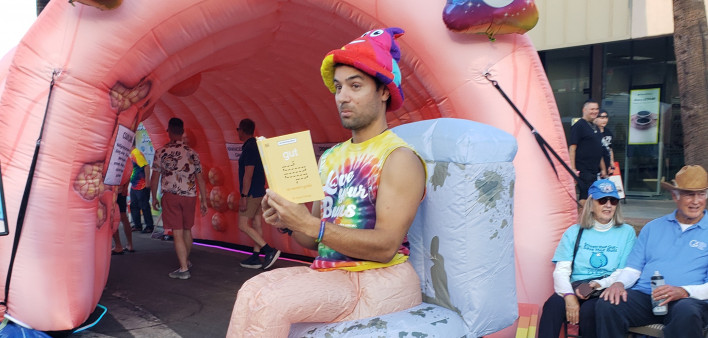
About a year ago, Tucson’s John Reed, 71, who has been living with HIV since the 1980s, heard from a friend of his about a new nonprofit, Cheeky Charity (CC), meant to support largely LGBTQ people living with — or hoping to avoid — colorectal and anal cancer. Reed learned that CC had regular online support groups for queer folks undergoing treatment for those cancers. That came as good news to Reed, who has been fighting colorectal cancer since 2019. Chemotherapy and surgery initially vanquished it, but it came back and is now being treated with radiation.
“My quality of life has been really up and down,” Reed says. “Thank goodness my husband has been by my side through all of this.”
Reed says that CC’s support groups have made a real difference. “Before them, I didn’t have a place where I was actually talking to other people who were going through what I was. I’ve been a member of Alcoholics Anonymous now for like 40 years, so I liken CC’s groups to that because they give me hope and make me feel connected.”
That kind of benefit is just what CC’s gay creator, David Russo, 40, hoped to hear when he launched the group. An engineer and entrepreneur, Russo, at 32, began having blood in his stool and stomach pain. He says that his health providers told him that, because he was a sexually active gay man, the symptoms were probably caused by hemorrhoids or an anal fissure.
But Russo worried that he might have cancer, or at least precancer. He had to fight to get a colonoscopy at his young age, he says—but when he finally had one, it found precancerous polyps that, thankfully, were treated. When Russo told his family, he says, he learned only then that there was a family history of both colorectal cancer and of precancerous polyps.
Around the same time, Russo learned that rates of colorectal cancer in people below age 50 had nearly doubled in the United States since the 1990s. He also started learning more about anal cancer, which is linked to the common sexually transmitted virus HPV. He learned that it disproportionately affects people with HIV, men who have sex with men and transgender people, and that screening for anal precancer, which is easily treated to prevent cancer, lacked both sufficient awareness and trained treatment facilities nationwide. Last year, the federal government released long-awaited guidelines for anal precancer screening in people with HIV. Please read them and share them with your primary health provider.
That, says Russo, is “when the lightbulb went off. I thought, ‘Well, I’m connected to this now and I don’t really see anyone talking about it, especially in the queer community — no LGBTQ-tailored awareness campaigns.’”
At the time, he says, he was visiting a national park, from which he was sending friends pics of his bare-butted self, “to make them laugh.” He started an Instagram page on which he posted the butt pics along with information about colorectal cancer.
Once the account amassed 4,000 followers, Russo started the “March Your Butt” challenge, asking LGBTQ folks to post a photo of their butt. “We had more than 500 people participate in our first year,” he says, including RuPaul’s Drag Race queens Honey Davenport and Jackie Cox. A central message of the challenge: People should start having colonoscopies at 45 instead of 50, per the recommendation of the American Cancer Society, regardless of whether they have symptoms.
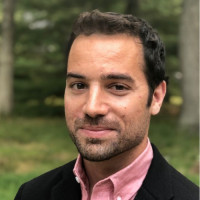
David RussoCourtesy of David Russo
After that, Russo renamed the effort Cheeky Charity and applied for nonprofit status. A boost came when he got a $25,000 grant from the Prevent Cancer Foundation, which led to CC partnering with DAP Health (formerly Desert AIDS Project) in Palm Springs on an in-person awareness event in which around 2,000 people participated. Around this time, he says, he began incorporating anal cancer into CC’s messaging. Then he got a $225,000 five-year grant with the New York State Department of Health to do awareness in LGBTQ communities. A $50,000 grant from the American Cancer Society followed.
Despite all that financial support, says Russo, “After three years, I only started paying myself a salary six months ago.” He says he desperately needs more funding. “We hired two new employees but don’t have the funds to keep them on for more than a few more months.” He says he’s hired a development director to try to help raise money.
Those challenges notwithstanding, CC has been able to offer twice-monthly online support groups (sign up here) for gay men, lesbians and pansexuals, and is trying to start a transgender group as well.
CC will also help people anywhere find their nearest provider of LGBTQ-competent colorectal or anal cancer screening, preventive treatments or treatment. (Contact CC here and they’ll get back to you.) Recently, says Russo, CC connected a New Yorker with symptoms of either anal or colorectal cancer into New York’s Cancer Services Program, which provides free screening and diagnosis of breast, cervical and colorectal cancers for uninsured people. CC is also working with the program to help them expand LGBTQ-affirming screening and diagnostic sites statewide.
In addition to seeking funding, Russo says, CC is also seeking LGBTQ people with a colorectal or anal cancer history, including currently on treatment, as well as their caregivers, to become CC “ambassadors” and help spread the word. CC is also seeking Pride events that would like to have a CC presence, such as a booth. For both matters, please email david@cheekycharity.org.
With the anti-LGBTQ, anti-diversity Trump 2.0 administration currently scrubbing any mention of LGBTQ people from governmental health web pages, Russo says he knows this isn’t the ideal time to be getting federal government support on the queer-specific goals of CC. As well, he says, “private funding is going to be cut into smaller slivers.”
That’s why he’s trying to find what he calls “capitalistic means” of raising money for CC—such as trying to develop a new douche to prepare for anal sex, which he sees of interest to both cisgender women as well as gay men and trans women. “More straight women than gay men have anal sex just because of the greater quantity of women,” he says.
Despite all these challenges, Russo says that building CC right now is “the most exciting time of my life — I feel like my most authentic self.”
John Reed is grateful for CC as well. “Doctors never bring up anything like” the need for people to be able to connect with one another, he says. CC’s support groups have left him feeling not so alone in what’s been an often-difficult journey, he says. “The emotional support I get there is huge.”
Click here to read a feature story about Daniel G. Garza, the director of anal cancer, HIV and hepatitis C advocacy for Cheeky Charity.


Comments
Comments