

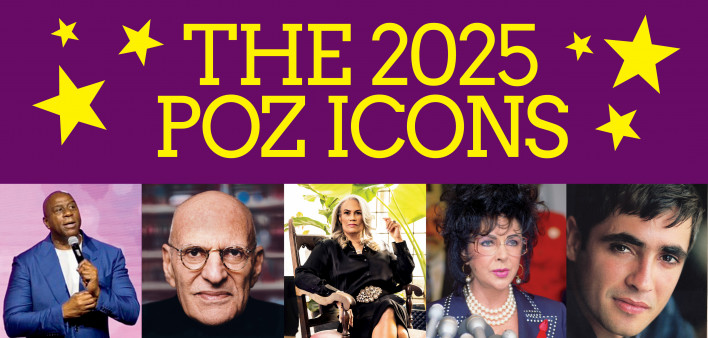
In the early days of the AIDS epidemic, silence was deafening and denial was deadly, but a few bold voices emerged to cut through the fear. This year’s POZ Icons—Earvin “Magic” Johnson, Larry Kramer, Rae Lewis-Thornton, Elizabeth Taylor and Pedro Zamora —all had the courage to speak out about HIV and got the world to pay attention. They opened their hearts and our eyes on behalf of every person silenced and erased by a disease many in the world tried to ignore.
Magic Johnson shocked the world in 1991 by announcing he was living with HIV, shattering stigma and calling for compassion instead of fear and misinformation. Larry Kramer, furious and unflinching, sparked a movement and galvanized AIDS activists into action. Rae Lewis-Thornton bravely graced the cover of Essence magazine, helping to change the conversation about Black women and HIV. Elizabeth Taylor, with her conviction and star power, leveraged Hollywood’s spotlight to push for HIV resources and advance research. Pedro Zamora showed the world that living openly with HIV could be a powerful act of education, proving that visibility and vulnerability can change hearts and minds.
To honor them is not just to remember what they faced but also to carry forward their legacy: that truth-telling and courage can change the world. Today, we draw from the power of their voices to confront the current attacks on the progress made in the fight against HIV and to fiercely advocate for those living with or at risk for the virus. These are the icons we need.

Earvin “Magic” Johnson
An advocate for care and compassion
By Harold Phillips, MRP
On November 7, 1991, NBA star Earvin “Magic” Johnson stunned the world when he announced that he was HIV positive. At the time, HIV was widely misunderstood and stigmatized, often seen as a death sentence and wrongly associated only with certain communities. Johnson’s courage to speak publicly—at the height of his basketball career—shattered stereotypes and changed the global conversation around HIV.
Since that historic press conference, Magic Johnson has become one of the most visible and impactful advocates for HIV awareness, prevention and treatment. His openness helped normalize HIV testing and inspired millions to seek care. He used his platform to educate the public, especially communities of color, about the importance of safe sex, regular testing and the power of early treatment. More than three decades later, Johnson continues to lead by example.
At the 2025 United States Conference on HIV/AIDS in September, after it was announced that I was NMAC’s CEO-elect, I had the privilege—especially as a person also living with HIV—to introduce Magic Johnson to our community. He delivered a powerful keynote address on aging, surviving and thriving with HIV. His message was clear: Living with HIV is not just possible—it’s also a testament to strength, discipline and community support. He honored those who came before him, acknowledged the challenges of aging with HIV and called for renewed investment in care and dignity for long-term survivors.
Johnson’s journey is more than a personal triumph—it’s a public legacy. He transformed fear into hope, stigma into strength and silence into advocacy. Today, he stands not only as a sports legend but also as a beacon for millions living with HIV. His life reminds us that with compassion, access to care and unwavering resolve, we can all thrive.
And that’s the real magic.
Harold Phillips, MRP, is the CEO of NMAC, a national HIV organization that aims to end the HIV epidemic among the communities most impacted in the United States.
KEY MOMENTS
1991 – Magic announces that he is living with HIV and retires from the NBA.
1991 – He establishes the Magic Johnson AIDS Foundation to combat HIV through awareness, education and prevention programs.
1992 – Magic is appointed to the National Commission on AIDS but leaves eight months later, stating the Bush administration had “dropped the ball” on AIDS.
1992 – Magic competes as part of the United States “Dream Team” in the Barcelona 1992 Summer Olympics, inspiring people living with HIV.
1992 – Magic discusses HIV and AIDS with kids in a Nickelodeon special titled A Conversation with Magic.
1992 – Magic publishes his autobiography, My Life, in which he reflects on his journey on and off the court.
2006 – Magic launches the “I Stand With Magic” campaign to promote testing, treatment and education among African Americans.
2006 – Magic appears on The Oprah Winfrey Show to discuss the rising rate of HIV among Black women.
2012 – Magic and the AIDS Healthcare Foundation announce plans to open HIV clinics in three cities.
2022 – They Call Me Magic, a documentary that chronicles his life, airs on Apple TV+.
2025 – Magic gives a speech at the United States Conference on HIV/AIDS in Washington, DC.
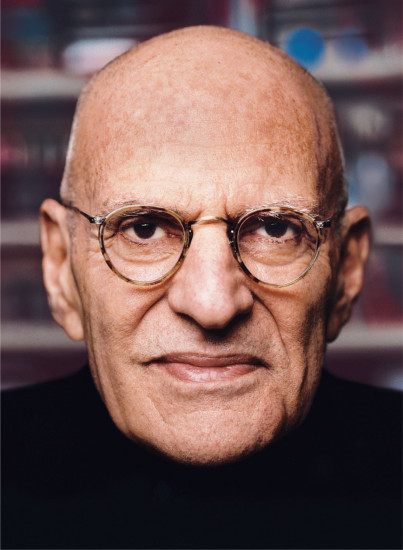
Larry Kramer in 2007Ethan Hill
Larry Kramer
An activist who sparked a movement
By Peter Staley
I was just a kid when I walked into my first meeting of ACT UP (AIDS Coalition to Unleash Power) in 1987. It was just weeks after Larry Kramer’s legendary speech at the Lesbian and Gay Community Center in New York City, which had led to the founding of ACT UP. I didn’t even know who he was—but I would soon learn. That year, Larry’s life became part of the steep learning curve I desperately climbed.
ACT UP members were mostly young and angry; Larry called us “my kids.” After meetings, we’d gather at Woody’s—dissecting strategy, debating our future, trading gossip and soaking up his fire. Those moments were the happiest I’ve ever seen him. He was surrounded by the kind of community he had long dreamed of—energized, radical and fiercely committed.
Larry became a father figure to many of us, asking about our lives and setting us up on dates. He genuinely cared about our struggles and fears.
ACT UP was born six years into a deadly silence. America and its president ignored AIDS as the virus slaughtered a community they despised. Larry told us to fight back. And we did. By 1990, the National Institute of Health’s AIDS budget hit $1 billion. It was the AIDS activist movement that caused that shift, and Larry was its spark.
Our relationship was stormy. He accused me of destroying ACT UP when TAG [Treatment Action Group] split off in 1992 and for not being angry enough in the years since; I accused him of being sex negative and out of touch (his early opposition to PrEP [pre-exposure prophylaxis] was symbolic of this). But we shared too much to ever fully turn away from one another. Under the anger lived profound mutual respect.
Larry was flawed—but he was also fearless. He was our community’s greatest advocate. He constantly told straight America that his gay brothers and sisters were the most beautiful people on earth. He pushed back against the hate directed at us like no other. Larry loved gay people and spent his entire life fighting for us.
Those ACT UP meetings gave me the only hope I could find back then. Larry Kramer founded a movement, and I’m alive because of that. Millions more can say the same. All of his faults fade away in the wake of our thanks.
Peter Staley is an AIDS and LGBTQ rights activist who cofounded the Treatment Action Group and PrEP4All.
KEY MOMENTS
1957 – Larry graduates from Yale with a bachelor’s degree in English.
1969 – Larry earns an Academy Award nomination for the screenplay adaptation of Women in Love.
1978 – Larry publishes Faggots, a satirical portrayal of gay men and their relationships in New York in the 1970s.
1981 – Larry cofounds Gay Men’s Health Crisis (GMHC), one of the first organizations dedicated to AIDS services and awareness.
1985 – Larry’s play, The Normal Heart, which depicts the early years of the AIDS epidemic, premieres at The Public Theater.
1987 – Larry gives a speech focused on using political action to fight AIDS, which leads to the formation of the advocacy group ACT UP.
1988 – Larry learns he has HIV.
2001 – Larry undergoes a liver transplant after fighting for the right to receive one as a person living with HIV.
2013 – Larry marries architect David Webster in a ceremony in the intensive care unit of NYU Langone Medical Center while recovering from abdominal surgery.
2015 – Larry publishes The American People: Volume 1. The second volume is published in 2020.
2020 – Larry dies of pneumonia at age 84.
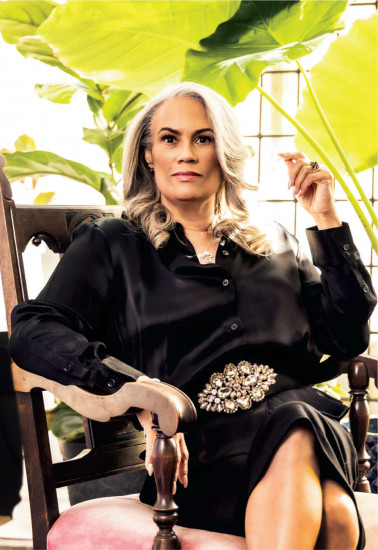
Rae Lewis-Thornton in 2022Kirsten Miccoli
Rae Lewis-Thornton
A pioneering diva living with AIDS
By Olivia Ford
Whether she’s holding your gaze from a photo or commanding a stage facing a rapt audience of thousands, the word that comes to mind when beholding Rae Lewis-Thornton is poised. With her silver hair impeccably coiffed, this renowned speaker and gifted writer is always dressed to the nines, just as she was on the December 1994 cover of Essence magazine where she proclaimed to all the world, and specifically to Black women, “I’m young, I’m educated, I’m drug-free, and I’m dying of AIDS.” She was 32 and had already been silently living with her HIV diagnosis for nine years as she worked for historic Democratic campaigns and amassed a roster of influential associates, building a career as a political strategist from which her health eventually forced her to retire.
That Essence piece made Lewis-Thornton a household name, leading to decades of media appearances, speaking engagements and awards, and helped establish her as an enduring voice and brand grounded in faith, affirming of sexuality and focused on leaning into pleasure to cope with crushing circumstances. In her long-running blog, Diva Living With AIDS (which was syndicated on TheBody.com during the 2010s when I was an editor there), she described her struggles with the effects of advanced HIV on her body, finances and mental health with unflinching candor, just as she reveled in descriptions of how a hot bath, a delicious cup of tea, a fresh outfit or spending time on an activity she loved could be a balm. Openly discussing the physical, emotional and sexual abuse she survived as a child—experiences a staggering proportion of women living with HIV share—Lewis-Thornton was an early voice framing HIV as a condition not simply of individual behavior but of trauma, years before that stark reality was validated by study findings.
An ordained minister, pioneer in social media advocacy and accomplished author of three books and numerous articles sharing personal narratives as well as subject-matter expertise on menopause, the impact of childhood trauma and more—not to mention tea connoisseur, jewelry designer and loving mom to several generations of toy poodles—Lewis-Thornton continues to make a thriving garden of the life she once assumed would end before she reached 50. At every step, she has demonstrated through her work and example that becoming our full selves is a journey—and what a gift to witness hers.
Olivia Ford is the editorial director of The Well Project, which prioritizes the advancement of women in all aspects of HIV prevention, treatment and cure research and policy.
KEY MOMENTS
1987 – Rae learns she is living with HIV after donating blood at a blood drive. She believes she acquired HIV in 1983.
1988 – Rae serves as the national youth director for the Reverend Jesse Jackson’s presidential campaign.
1992 – Rae is diagnosed with AIDS, which drives her to begin publicly sharing her story.
1994 – Rae appears on the cover of Essence magazine and announces she is living with AIDS.
1995 – Rae wins a Chicago/Midwest Emmy Award for an eight-part television series titled Living With AIDS.
1996 – “Rae’s Story” is an episode of Ted Koppel’s Nightline.
2000 – Rae becomes ordained as a licensed Baptist minister.
2006 – Rae obtains a master of divinity degree from McCormick Theological Seminary.
2010 – Rae launches the blog Diva Living With AIDS, which discusses the realities of living with the virus.
2015 – Rae takes part in “Doing It,” a testing campaign from the Centers for Disease Control and Prevention.
2022 – Rae releases her memoir, Unprotected.
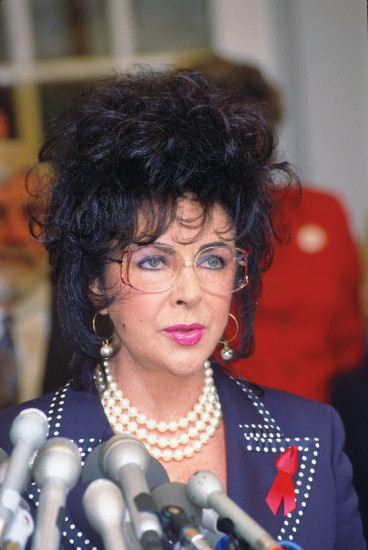
Elizabeth TaylorMark Reinstein/Shutterstock.com
Elizabeth Taylor
A legacy of justice and courage
By Robert Suttle
Elizabeth Taylor, who founded The Elizabeth Taylor AIDS Foundation (ETAF) in 1991, was one of the first globally recognized advocates to stand with people living with HIV and AIDS during a time when silence and stigma prevailed. She refused to let misguided fear dictate the response to the epidemic and instead called for compassion, courage and action. By framing HIV as a human rights issue, she shifted the focus of the global conversation and demanded that the world recognize the dignity of those most affected.
Her advocacy, however, went beyond speaking out. At a time when few dared to address HIV publicly, she established ETAF to ensure that care and resources reached those who needed them most. The foundation remains a vital force, funding lifesaving services, supporting vulnerable communities and confronting HIV-related stigma and discrimination. Long before celebrity advocacy was common, Taylor risked her reputation to raise awareness, influence policy and fight for justice. She understood that ending the epidemic required not only effective medication but also the dismantling of inequity and fear.
That legacy is more than history—it continues to shape lives like mine. Years after an HIV criminalization prosecution changed my life, I now serve as chair of ETAF’s Council of Justice Leaders. In this role, I work with other survivors of criminalization to promote the values she championed: amplifying the voices of people living with HIV, dismantling unjust laws and promoting policies grounded in science and compassion. In 2024, I had the privilege of presenting the Elizabeth Taylor Human Rights Award, which reminded me of the enduring and powerful influence she continues to have in the field.
Taylor’s unwavering advocacy continues through the efforts of many leaders, advocates and organizations inspired by her example. She demonstrated that courage and compassion can change hearts, influence laws and open doors that were once closed. Her spirit inspires our fight for justice, reminding us that the journey to ending the HIV epidemic, which includes decriminalizing HIV, must be grounded in human rights.
Robert Suttle is a New York City–based advocacy consultant and movement leader in the global HIV community with expertise in decriminalization, human rights and the intersection between equity and social justice.
KEY MOMENTS
1985 – Elizabeth organizes the first celebrity AIDS benefit, which raises $1.3 million for AIDS Project Los Angeles.
1985 – Elizabeth and Rock Hudson’s doctor, Michael Gottlieb, partner with Mathilde Krim, PhD, to establish the American Foundation for AIDS Research (amfAR).
1986 – Elizabeth testifies before the Senate on behalf of the Ryan White CARE Act to push for increased funding for AIDS emergency care.
1987 - Elizabeth becomes the first patron for the AIDS Crisis Trust in London.
1991 – Elizabeth establishes ETAF to support direct services for people living with HIV and AIDS.
1996 – Elizabeth appears in four prime-time CBS sitcoms (The Nanny, Can’t Hurry Love, Murphy Brown and High Society) in a single night and donates her earnings to ETAF.
2000 – Elizabeth is named a Dame Commander of the Order of the British Empire by Queen Elizabeth for her acting work and for her role in the fight against AIDS.
2001 – Elizabeth is awarded the Presidential Citizens Medal by President Bill Clinton for her humanitarian work and her HIV and AIDS advocacy.
2011 – Elizabeth dies at age 79. Her jewelry is auctioned by Christie’s and raises nearly $116 million for ETAF.
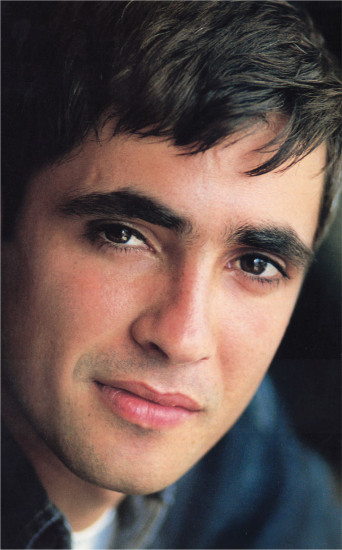
Pedro Zamora in 1994Ken Probst
Pedro Zamora
An AIDS educator who won our hearts
By John Cunningham
At 17, Pedro Zamora learned he was living with HIV. Rather than let the diagnosis define him, he chose to dedicate his life to raising awareness about HIV and AIDS and the broader health and social injustices affecting those impacted.
This dedication took him all the way to Congress, where he spoke fervently about the need for greater government efforts to promote HIV and AIDS awareness. “There is not one second of my day that I am not aware that I am HIV positive. I don’t want to forget that I have AIDS, and I don’t want you to forget that I have AIDS. You have to understand AIDS is part of my life. It’s my reality. It’s who I am,” he said in congressional testimony.
Pedro took his activism to mainstream pop culture via television, where he captivated the nation with his openness, compassion, vitality and charisma when he appeared on MTV’s reality TV show The Real World: San Francisco and spoke openly about his sexuality, status and activism. Throughout his time on The Real World, Pedro highlighted his relationship with Sean Sasser, another man of color living with HIV, and, in another historical first, the two pledged their love in a commitment ceremony on the show, nearly 20 years before such marriages became legal.
Pedro’s incredible life and work were tragically cut short when he died of an AIDS-related illness in 1994, the morning after the final episode of The Real World aired.
Pedro’s legacy lives on through those he inspired and through the efforts of those fighting to ensure that his story is never forgotten. In memory of his inspirational efforts and with major funding from Gilead Sciences, the National AIDS Memorial established the Pedro Zamora Young Leaders Scholarship. The scholarship spotlights and supports young leaders who carry the torch of activists like Pedro and speak out against health and social injustices in their communities—in ways inspired by their own passions, insights, originality and conviction. Today, this program supports young people doing the same work to bring about positive change that Pedro did.
John Cunningham is the CEO of the National AIDS Memorial, which ensures that the story of AIDS and the AIDS movement is never forgotten. The organization uplifts today’s health and social justice issues to help the nation heal, remember, thrive and continue to work for a just and equitable future.
KEY MOMENTS
1989 – Pedro learns he has HIV after attempting to donate blood during his junior year of high school.
1990 – Pedro joins Body Positive, a Miami-based HIV resource center and begins to raise awareness about HIV in his community.
1991 – Pedro gains attention as an HIV educator when a front-page article about his work is published in The Wall Street Journal. He gains more attention after interviews with Phil Donahue, Oprah Winfrey and Geraldo Rivera.
1992 – Pedro is appointed to Florida’s Red Ribbon Pannel on AIDS, which makes education and prevention recommendations to the state legislature.
1993 – Pedro testifies before Congress and advocates for comprehensive and explicit HIV educational programs for youth.
1993 – Pedro attends the 1993 Lesbian and Gay March on Washington and meets fellow AIDS educator Sean Sasser, who later becomes his partner.
1994 – Pedro joins the cast of the third season of MTV’s The Real World: San Francisco. He educates his housemates and millions of viewers about HIV and AIDS.
1994 – He appears on the August/September cover of POZ.
1994 – Pedro dies of AIDS-related complications at age 22.




Comments
Comments