


For years, The Well Project has been leading efforts to advocate for and create awareness around the importance of language among healthcare providers, researchers, media, conference organizers, and community members. This advocacy has been based on decades of anecdotal experiences reported by women who have been negatively impacted by stigmatizing language in healthcare settings.
To understand the extent and impact of experiences of stigmatizing language on women and nonbinary individuals living with HIV in the US, The Well Project, together with a group of expert advisors, developed “Words Matter: The Impact of Language on Healthcare Experiences.” This web-based survey was circulated in the fall of 2025 and resulted in a recent report titled Stigmatizing Language in Healthcare Settings: Results from The Well Project’s Research Among Women and Nonbinary Adults Living with HIV.
Survey results included 182 respondents self-identifying as cisgender women (93%), transgender women (4%), and nonbinary adults (3%) living with HIV. The sample was diverse across race/ethnicity, sexual orientation, age, type of health insurance used, and number of years living with HIV. Geographically, the greatest percentage of respondents were located in the Southeast US, with the remaining respondents spread fairly equally throughout other regions of the US.
In total, 131 (72%) respondents reported experiencing stigmatizing language in healthcare settings from various healthcare providers and staff.
- Nearly three quarters (71%) of respondents who indicated that they had experienced stigmatizing language from a medical doctor, reported experiencing stigmatizing language from their primary care provider
- Nearly half of respondents also reported experiencing stigmatizing language from their HIV clinician (47%) and/or obstetrician/gynecologist (44%)
"I often hear outdated and fear-based terminology, like ’AIDS victim’ or ’clean’ used to describe someone who is HIV-negative, which is deeply othering." – survey participant
Among the 131 respondents who reported on the impact of stigmatizing language:
- 65% reported that the use of stigmatizing language from a healthcare provider impacted their self-esteem and mental health
- 54% reported delaying, avoiding, or missing healthcare appointments
- 52% reported effects on their overall well-being or quality of life
- 39% reported finding it difficult to take antiretroviral medication
“HIV infected woman is stigmatizing; the word infected changes everything vs. woman living with.” – survey participant
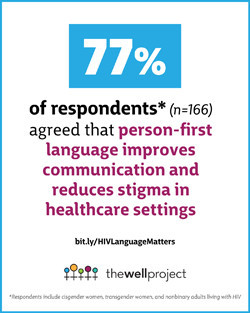
Person-first language puts the person before the illness or label and describes who they are, not what they have been diagnosed with. Person-first language helps eliminate prejudice and removes value judgments. When asked if person-first language improves communication and reduces stigma, out of 166 respondents, 130 (77%) agreed.
"[Person-first language] makes me feel like a whole person, not just defined by HIV. Saying a woman living with HIV acknowledges my humanity and dignity." -survey participant
The Well Project undertook this research to build upon anecdotal evidence with quantifiable data that will ultimately help raise awareness of the impact of language (which historically has been poorly understood). This research underscores the clear need for improved education and training around person-first language for healthcare professionals, which has the potential to positively affect the lives of women living with HIV and their engagements with care settings.
Read the full survey report: Stigmatizing Language in Healthcare Settings: Results from The Well Project’s Research Among Women and Nonbinary Adults Living with HIV
Media inquiries: Jenna Conley at jconley@thewellproject.org
The Well Project is a non-profit organization whose mission is to change the course of the HIV/AIDS pandemic through a unique and comprehensive focus on women and girls across the gender spectrum. Visit their website, www.thewellproject.org, to access fact sheets (English and Spanish), blogs, and advocacy tools, and to join a global community of women living with HIV.
Comments
Comments