



As we gear up for IAS 2025, the 13th IAS Conference on HIV Science, in Kigali, Rwanda, and virtually from 13 to 17 July, we want to take a moment to reflect on the key insights from AIDS 2024, the 25th International AIDS Conference. You will find all of that in the AIDS 2024 Conference report. If you haven’t read it yet, here are some key features.
Reflecting on AIDS 2024
AIDS 2024 took place in Munich, Germany, and virtually on 22-26 July 2024, with over 10,000 participants.
A total of 8% of attendees benefitted from a scholarship.
AIDS 2024 attracted diverse participation, with the strongest contingent (26%) coming from the continent of Africa:
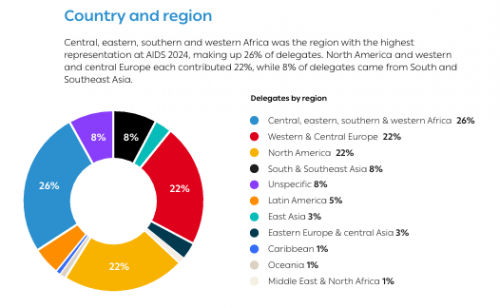
AIDS 2024 delegates by country and region
Some key themes from AIDS 2024:
Long-acting technologies: Delegates heard that six-monthly injections of lenacapavir gave 100% protection against HIV acquisition in cisgender women in the PURPOSE-1 study. Delegates gave the study team a standing ovation, celebrating a major advance in HIV prevention.
Cure: Three people known to have been cured of HIV shared their stories to inspire continued research. The conference learnt of the “next Berlin patient”, the seventh person known to have been cured of HIV; this 60-year-old man has been in HIV remission for over five years after a stem cell transplant. His donor had a single CCR5-delta32 mutation, which could offer insights for future HIV cure strategies using gene therapy.
Leadership, policy and funding: German Chancellor Olaf Scholz reaffirmed Germany’s commitment to the HIV response, joining a global initiative to eliminate HIV-related stigma. And the host city, Munich, became a Fast Track City. Also, over 370 MPs from 45 countries united to strengthen political support for ending HIV transmissions through the Global Parliamentary Platform on HIV and AIDS.
DoxyPrEP and DoxyPEP: AIDS 2024 saw the term, “DoxyPrEP” (doxycycline pre-exposure prophylaxis to describe taking the antibiotic before sex), make its debut to join the better-known “DoxyPEP” (doxycycline post-exposure prophylaxis). Two studies demonstrated that DoxyPrEP was feasible and associated with reductions in STIs in men who have sex with men and female sex workers.
Stigma, discrimination and criminalization: These major obstacles to progress in the HIV response are not abating. Analysis of data from 842,169 people, including 70,109 people living with HIV, across 33 African countries links stigma with reduced engagement at every stage of HIV care.
For detailed insights, explore the conference report.
Download the AIDS 2024 conference report
Looking ahead to IAS 2025
IAS 2025, the 13th IAS Conference on HIV Science, in Kigali, Rwanda, is taking place on the continent of Africa and virtually when our collective efforts are more critical than ever. The US funding crisis has halted lifesaving treatment and prevention programmes, affecting millions of people across the continent and beyond.
IAS 2025 is a vital opportunity to chart a way forward together. Join us.



Comments
Comments