


POZ readers were first introduced to Texas State Representative Venton Jones (D–Dallas) in January 2015 as the subject of the magazine’s Heroes page. Back then, he was a 31-year-old HIV advocate working in Washington, DC, seeking to make a difference for Black gay men through public policy.
Eleven years later, a lot has changed for Jones. But one thing remains the same: He never forgets where he came from as he looks ahead to where he’s going.
“I want people to know that I’m also a person too,” Jones says. “It’s sometimes easy to see what you see now. But that came from years and years of struggle and finding myself.”
Jones’s story of resilience, courage and triumph has inspired many people nationwide.
Public service work always felt right to Jones, whose family boasts numerous career nurses. That’s why, as a student at Texas A&M University, he set his sights on community health.
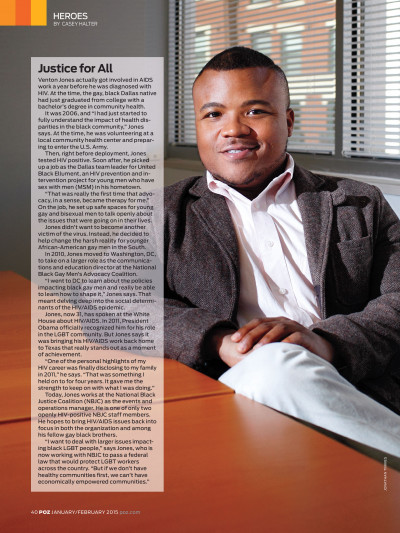
Jones was a POZ Hero in 2015.
“A lot of my interest came in helping people be well versus helping them not be ill,” says Jones, now 41, who grew up in Dallas and graduated from college in 2006.
As a Black gay man living in the South, Jones felt called to HIV work. He recalls a professor once asking students to choose a health disparity to address for a project.
“People were working on hypertension, heart disease and cancer,” Jones says. “But from a professional standpoint, no one was really talking about the HIV epidemic. That was problematic to me.”
It spurred Jones to take action to save his life as well as the lives of other Black gay men. But getting a job in health care post-9/11 wasn’t easy, so Jones thought he’d join the military and become a nurse in the U.S. Army.
In 2007, Jones enlisted. While preparing for basic training, he received a letter stating that he needed to speak with the Army medical team. Jones went for an HIV test first. The test came back positive.
“At that point, I knew I couldn’t go to the Army,” he says.
Jones didn’t beat himself up about his diagnosis for too long.
“I had to forgive myself,” he says. “I was a young Black gay man not doing anything different from what others like me would be doing at that age. I had a virus that was deeply impacting a community.”
His diagnosis only further propelled him to help people living with and at risk for HIV.
To that end, he earned a master’s degree in health care administration from the University of Texas at Arlington in 2009.
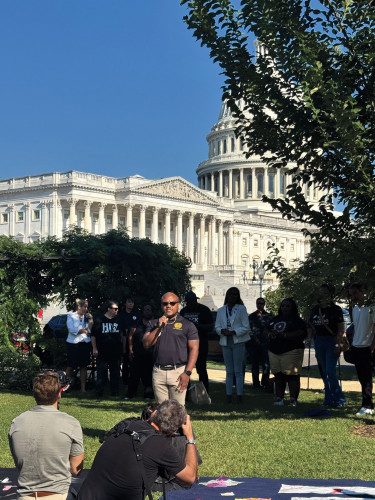
Venton Jones at the U.S. CapitolJennifer Morton
Using his health background and personal experience, Jones pursued work that centered on engaging young Black gay and bisexual men through targeted programs and HIV messaging that would reach them.
“I was also navigating my own positive status,” Jones says. “That set my HIV work into a higher gear because I really understood HIV not only from the medical testing standpoint but also from the need for support.”
In 2010, Jones relocated to DC to learn more about how policy drives health care services.
He started out as the communications and education manager at the National Black Gay Men’s Advocacy Coalition, where he was responsible for managing strategic operations and day-to-day communications for the coalition of over 50 organizations.
“I was also able to start the Young Black Gay Men’s Leadership Initiative, which helped to mobilize and engage young Black gay voices to take action in policy spaces and advocate,” he says.
By late 2013, Jones had moved on to the National Black Justice Coalition (NBJC), a civil rights organization dedicated to empowering LGBTQ people.
“I started one of their first health and wellness initiatives that centered addressing HIV in the Black family and raised the resources to put HIV back into the social justice conversation,” Jones says.
NBJC worked in such policy spaces as the White House, the Department of Health and Human Services and the Centers for Disease Control and Prevention. “It was great to be a part of that work and helping to navigate the needed conversations and raising the visibility of addressing the HIV epidemic through multiple lenses,” Jones says.
In 2017, Jones left NBJC to join AIDS United. His tenure at the national group was short because he had greater ambitions: He wanted to start his own organization.
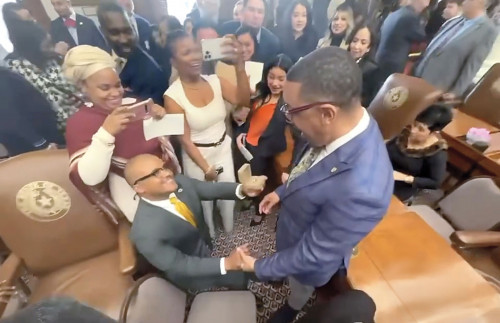
Venton Jones (kneeling) proposes to his partner at the Texas Capitol.@ventonjonestx/Instagram
In July 2018, Jones formed the Southern Black Policy and Advocacy Network (SBPAN), which was born of his desire to help improve health, social and economic conditions for Black communities in the South.
At the time, Jones was still living in DC and working as an Uber driver starting at 4 a.m. every day. He would set up office hours for himself to create the organization’s business plan.
But Jones always planned to return to Dallas. “I knew that DC wasn’t my endpoint,” he says. “Being able to return back home and bring that work back home was what I always wanted to do.”
Before his move back to Texas in 2019, SBPAN received its first grant. Jones used the money to create a video project that highlighted HIV and policies needed in the South to help marginalized communities.
SBPAN has worked to engage and empower Southern Black leaders and communities via training, education and mobilization with the goal of improving public health policy.
At its peak, SBPAN had five full-time staffers and additional part-time staff. But last January, the organization lost almost $1 million in funding as a result of federal budget cuts, leading SBPAN to greatly reduce staff and programming.
“We lost projects,” Jones says. “We’re back in a place of having to do aggressive fundraising and getting back to a place where we could operate.”
The Dallas Jones had known and loved was different from the city he remembered when he’d last lived there.
“You saw a city that had a lot of changes and growth,” he says. “But in areas like mine, they were not getting the needed services. Health disparities were increasing, and economic opportunities were decreasing.”
So Jones decided to get involved in local politics. First, he became a precinct chair (a local representative of the Democratic Party and its candidates in a voting precinct). He was also an election judge, or polling site overseer.
I’m fortunate to live a life that I feel honors my ancestors, who could not do this.
In 2021, Jones decided to run for the Texas House of Representatives. He wanted to represent the constituents of House District 100, which serves parts of the Dallas area where Jones grew up. In November 2022, Jones won, becoming one of the first Black LGBTQ people in the Texas State House. Jones also made history as the first Black state lawmaker in the country openly living with HIV.
“Even though I’d never been an elected official, and I just became a state representative, there were so many lessons that the HIV movement taught me around the importance of visibility, raising your voice and so many other things,” Jones says.
He is proud that his success has inspired others to become involved in politics in their own communities and beyond.
“It’s important that we own that power of our ability to make change,” he says. “Sometimes it’s easy or comfortable to wait for somebody to come and save us. But nobody’s coming to save us, especially right now.”
Jones is currently in his second term as state representative after winning reelection in 2024. He hasn’t forgotten what got him where he is today—his commitment to addressing and ending the HIV and AIDS epidemic.
“I’ve been a part of legislation that is really changing how HIV is funded and how services are provided in the state of Texas,” he says.
The Texas Legislature convenes for 140 days every other year. Within that time, the legislative body must review bills, calculate the state budget and address other concerns. On occasion, the governor will reconvene members for a special session.
Jones has fought through two legislative sessions for passage of a bill that would help increase routine HIV testing, but the bill never made it off the House floor.
“No bill just kind of comes in, and you’re going to get it through, especially when you’re working in the minority,” Jones explains. Democrats hold only 62 out of 150 seats in the Texas House of Representatives.
Jones adds, “I’m learning how to navigate and move this legislation while also creating the important conversations that need to be had, because I get to be a voice of people living with HIV in that body.”
But Jones and his colleagues managed to score one notable success during the 2025 legislative session: They secured $600,000 in funding to add long-acting injectables to the Texas HIV Medication Program’s drug formulary for the first time.
In August 2025, Jones and dozens of Texas House Democrats fled the state. Their goal was to block the passage of a new redistricting map that would create five new Republican seats in the U.S. House of Representatives.
“I had to leave the state with my Democratic colleagues to break quorum and not allow the president and the governor to steal congressional seats from Black and brown members in this state and try to steal even more power,” Jones says.
The Texas Democrats returned to the state two weeks later, following calls for their arrest by the governor. They also received death threats, including a bomb threat at their hotel in Illinois. “That must’ve been the first time I’ve been genuinely scared to travel the country,” Jones says.
Fearing that they’d flee again, the governor and Republican lawmakers required that the Democratic lawmakers be surveilled by police. Three escorts would sit in front of Jones’s house and go wherever he did. So Jones and a colleague led the escorts to a local gay bar for a meeting.
“If they wanted to follow me that bad, they were going to follow me into community and spend money,” he says. “But when I got out of that car to go into that meeting, they chose to stay in their vehicles. I guess that was their limit.”
Jones wants people to remember that there is a real person behind this work. He is a son, brother, grandson and loving fiancé. He works a full-time job to earn a living.
After health insurance and everything else, Jones takes home only about $400 a month as a state representative.
But, Jones says, “I’m fortunate to be able to live a life that I feel honors my ancestors, who could not do this.”

Venton JonesDavid Loi
In January 2025, after being sworn in for his second term, Jones proposed to his longtime partner on the House floor in the Texas Capitol. He knew he wanted to start his legislative session with a bright moment he’d always remember.
“I love having a partner that I can share life with—not just my elected official seat,” Jones says. “That’s one of the most valuable and rewarding things that I got going right now.”
Jones says he knew he had to bring every aspect of his identity to the table and hopes his story can serve as an example to other people living with HIV about the power of representation and raising one’s voice.
“I want the person navigating day one of their HIV diagnosis to see there’s a Venton Jones who exists that people love and support and was elected,” he says. “Not because I’m living with HIV but because I was living authentically, and HIV was part of that story.”
He adds, “I didn’t run for office to be the first anything,” Jones says. “I ran to serve my people and my community.”




2 Comments
2 Comments