

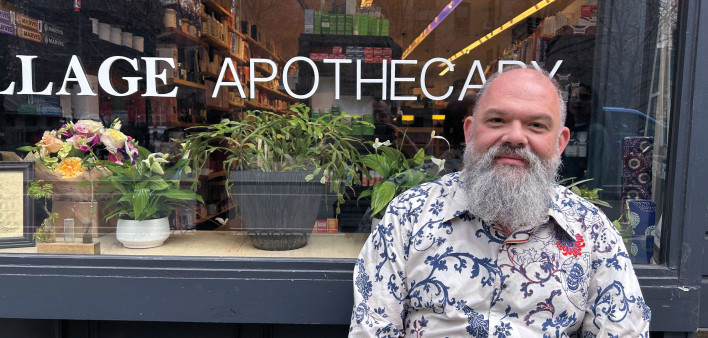
As a longtime nurse for Paul Bellman, MD, the pioneering HIV doctor who retired a few years ago, Tyrone is professionally very well-acquainted with New York City’s Village Apothecary (VA), located in Greenwich Village. When Tyrone, who asked to withhold his last name, started working for Bellman in the early 1990s, before the advent of effective antiretroviral treatment for the virus, it was common for VA to have a staffer rush over a prescription to Bellman’s office so that the patient there—often weak or even confused by dementia—wouldn’t have to walk to VA to pick up the medication himself.
Having lived with HIV for more than 35 years himself, Tyrone also has a personal relationship with VA. He’s a longtime client who says the beloved downtown NYC institution, which opened in January 1983, is special because it continues to provide mom-and-pop personal service. And this is despite both the extreme gentrification of the neighborhood it has long called home and the ongoing corporatization of the pharmacy landscape that serves to squeeze out independent shops, replacing them with brick-and-mortar chain stores, like CVS and Walgreens, as well as mail-order pharmacies.
“Despite the battles against the chains and mail order, VA has said to its customers, ‘We’ll continue to stand with you and give you quality, friendly care,’’’ says Tyrone. “You don’t get that comfort and compassion with the big chains. It just makes sense to go to VA, where you go in and no one is judging you but instead is speaking to you with respect. There’s nothing more important than that.”
Recently, says Tyrone, when he called VA about some of his prescriptions, John Kaliabakos, a VA pharmacist since 1994, noted that Tyrone’s voice sounded scratchy. When Tyrone’s order from VA arrived at his house—yes, the pharmacy delivers all over town, including to hospitals and doctor’s offices—he found complimentary cough drops among his meds. “It’s small things like that that make a big difference,” says Tyrone.
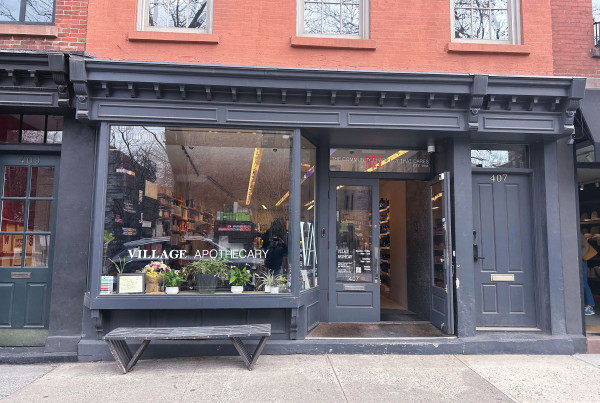
Village Apothecary (VA), located in Greenwich Village.Tim Murphy
Talk to even just a handful of VA’s longtime clients—many of whom survived the worst days of AIDS with VA’s help—and you’ll hear countless such stories. The ones about how Kaliabakos and the other pharmacists would go over especially complex orders with customers in the pharmacy’s private back area to protect their privacy, even though many customers with AIDS said they never worried about others in the store learning their status because it was such a loving sanctuary for people with HIV. The ones about how VA’s longest-serving delivery guy, Eric Lora, who started as a teen and still works there, would often walk or wheel home customers who couldn’t make their way on their own. And, of course, the ones about how the store would take a hit out of its own pocket to make sure all its customers had access to AZT or whatever other med offered the greatest promise of keeping people alive at any given moment.
Longtime survivor and activist Richard Berkowitz, who cowrote the seminal tract How to Have Sex in an Epidemic in 1983, the same year VA opened, recalls breaking his ankle about a decade ago and subsequently getting himself to VA in a wheelchair to buy a cane, only to realize he’d left his wallet at home. “They not only gave me the cane but had one of their guys wheel me home,” he says. “It’s like a family there. Try to get that at a CVS.”
New York City may be famous for its Greek diners, but the story of VA is the story of a Greek pharmacy. It was started by Michael Konnon (an abbreviation of Kazantzakis), an openly gay Greek American entrepreneur who owned a pharmacy in Harlem and then in the 1970s got into the nightclub business before semiretiring and moving to the Village. Over time, he became bored and, just as a strange new disease started affecting his friends, found a storefront at 346 Bleecker, on the corner of West 10th Street, that had once been a butcher shop. He decided to convert it into a pharmacy.
In the final months of 1982, Konnon enlisted the help of his entire family, including his nephew, George Manos, to prepare the space. Manos was so inspired by the work that he ended up going to pharmacy school himself, becoming a VA pharmacist and buying the business from Konnon in 1995. In 2012, he sold the business to its current owner, pharmacist entrepreneur Vijay Desai, who has kept the store’s family-style atmosphere intact.
“We all went in and stocked the shelves for the opening—me, my mom, my dad,” recalls Manos.
Even though the syndrome that would come to be known as AIDS was being seen in a relatively small number of gay men and drug users in the early 1980s, it wasn’t until VA gained traction in the middle of the decade that the epidemic revealed its terrifying scope amid NYC’s gay neighborhoods, including the Village. “Friends of my uncle were coming into the store panicked, this dreaded look on their face, telling my uncle privately in the back that they had AIDS,” says Manos. “And often, as soon as six months later, they were dead.”
Yet amid this atmosphere of fear, confusion and stigma, VA staff exuded warmth and compassion, says Berkowitz. “It was a safe place for people with AIDS, many of whom were dying. The staff was so sensitive and welcoming.” Even early on, he says, “they understood that you couldn’t get AIDS by touching someone or breathing the same air.”
When we get feedback that we helped someone, it makes everything worthwhile.
In constant consultation with Bellman and other early local AIDS doctors, including the late Joseph Sonnabend, MD, VA would prescribe its customers with AIDS everything and anything under the sun that might prevent or fight the myriad infections and other complications caused by the illness, including antibiotics, antifungals, steroids and Chinese herbs. When it became known that the antibiotic Bactrim could prevent Pneumocystis pneumonia, one of the most common causes of death related to AIDS, VA pharmacists would compound the drug themselves to start customers on a low dose before increasing it to prevent the extreme allergic reaction to an instant full dose that many takers experienced. “We would dilute it into 20 different bottles for people to start microdosing it,” recalls Kaliabakos.
In 1987, the Food and Drug Administration (FDA) approved AZT, the first anti-HIV drug. It was priced at the then-unbelievable sum of $10,000 a year per patient, putting it out of reach of many who needed it. This was three years before Congress would pass the Ryan White CARE Act, which covered HIV and related medications for people with no other coverage. (This was also years before the Affordable Care Act and expanded Medicaid.)
Whereas other pharmacies would buy AZT at $1,000 a bottle and mark it up as high as $3,000 for customers, “Michael said, ‘I can’t make money that way—it’s not right,’” recalls Manos. He says Konnon priced it just about $100 above the wholesale price and would arrange payment plans for customers so they could access it.
Whereas other pharmacies might order only as much AZT as was asked for, “Michael said he always wanted 100 bottles in stock,” says Manos, so people who needed it could start right away. “We probably lost about $100,000 a year,” he recalls.
In turn, he says, as VA’s reputation as a business that sometimes behaved like a nonprofit grew, wealthy locals and even celebrities, such as Bruce Springsteen, started popping in and buying over-the-counter luxuries, like fragrances and candles, in order to support the store. Even Mother Teresa, on a celebrated 1987 visit to New York, stopped by the store, Manos says, and blessed the staff.
When the Ryan White CARE Act was passed, it included the AIDS Drug Assistance Program (ADAP)—which is still the payer of last resort for countless people living with HIV and AIDS. According to Norman Saban, a pharmacist at VA from 1985 until his recent retirement, VA was one of the first pharmacies to sign up with the New York office of ADAP, consulting with ADAP workers day in and day out to get VA customers’ meds covered. Saban became such good friends with ADAP staffers over the years that he wound up attending some of their children’s weddings.
Then, in 1996, the FDA approved the protease inhibitor Crixivan (indinavir)—the first drug that when taken with older meds like AZT often brought viral loads down to undetectable, making it the first step in the lifesaving HIV treatment revolution to occur over the following years.
“Many of our customers got a second wind,” says Manos, estimating that in the ensuing years, the proportion of VA customers lost to AIDS plunged from as high as 90% to 5%. VA was also among those entities that ultimately successfully pressured the drugmaker Merck to expand distribution of Crixivan to pharmacies other than Stadtlanders, to which it initially gave a dispensing monopoly.
Even after effective treatment arrived, customers too far gone from AIDS complications or who had developed too much resistance to the first HIV meds, died. But overall, as HIV treatment improved, VA customers began not only to survive but also to thrive with HIV. “It was amazing to see,” says Saban, “almost like a weight had been lifted, because suddenly there was a lot less death.”
In the first 25 years of the 21st century, VA has seen its share of changes. Not only did Desai become the owner in 2012—“It’s hard in retail pharmacy to find quality businesses that have a connection with the community,” he says of why he bought it—but in 2024, the store moved to 407 Bleecker Street.
One thing hasn’t changed: its fiercely loyal customer base. It seems almost every VA customer living with HIV has a story to tell about the store’s kindness and generosity. Joseph Guerrero, 50, who lives at the nearby longtime HIV residence Bailey House, says that the store has many times gifted him over-the-counter items, including mouthwash and an electric toothbrush. “They said to me, ‘No, just take it, you’re a good customer,’” he says.
Willie, age 60, who asked to withhold his last name, shares that he once took a friend with AIDS—an undocumented bartender—to the store, where the staff connected him to counseling as well as to ADAP to access his meds. “The people who work there have such humanity,” he says. “They’re not just there to make money.”
Mark de Solla Price, a former POZ staffer, remembers when his late husband, Vinnie, had such a complicated med schedule that Price told VA he couldn’t keep track of it. The store, he says, sorted Vinnie’s meds into timed packages with labels, including his over-the-counter vitamins. “It made such a difference,” says Price, adding that years later when he needed to take opioids for pain but worried he would take too much and become addicted, VA arranged for him to come in every morning for his day’s supply.
“They were like my nanny,” he says, “taking care of me in a way that I know CVS would not.”
Longtime treatment activist Jules Levin says that as his meds require more and more prior authorizations, the VA staff is always there to call his doctor or his insurance provider and sort things out for him. “It’s a very welcoming environment there for people with HIV,” he says.
And one longtime client who prefers to be identified by his drag name, Ruby Rims, says that even though he now lives dozens of blocks uptown from VA, he still goes there for his meds “because it’s a fun atmosphere.” He remembers one Christmas when VA delivered him a surprise package filled with his favorite cologne and other items. “It’s a mom-and-pop store,” he says. “They care about you.”
Of course, says Desai, like many independent pharmacies, VA must struggle against so-called pharmacy benefit managers (PBMs), corporate middlemen who require people on many insurance plans to fill their prescriptions at affiliated pharmacies—usually CVS or Walgreens—or via mail order. When PBMs do allow independent pharmacies to fill scripts, they often reimburse them at far lower rates than they do their affiliated corporate partners.
“Year after year, we have no choice but to take these losses,” Desai says, adding that VA is part of a coalition of indie pharmacies advocating for PBM reform in New York state. Says Kaliabakos, “We’d have twice as many customers if it weren’t for mail order and PBMs.”
But overall, remarkably, the store has hung in there for more than 40 years—thanks in part to loyal customers who include not only people living with HIV or AIDS but also the increasingly wealthy and famous residents of 21st century Greenwich Village, whose handsome 19th-century brownstones are now valued in the multimillions. “You’ll have an Oscar winner waiting in line behind a kooky old lady who’s yelling about something,” says Kaliabakos. With a typical pharmacist’s discretion, he declines to name the Oscar winner in question.
Another reason for the store’s longevity? Its staff loves to work there and tends not to leave for decades. “Most pharmacists are probably not as happy with the day-to-day as we are,” says Kaliabakos. “When we get feedback that we helped someone, it makes everything worthwhile.”
Manos and Saban back him up. “We know we’re doing good, contributing to the neighborhood, and I’ll take that feeling over being the richest person any day,” says Manos. “We know a lot of people are alive today because of what we did.”
Says Saban, “Even though I’m retired, I still talk on the phone or email with a few customers. We never turned anyone away. I feel like I did something good with my life.”




2 Comments
2 Comments