

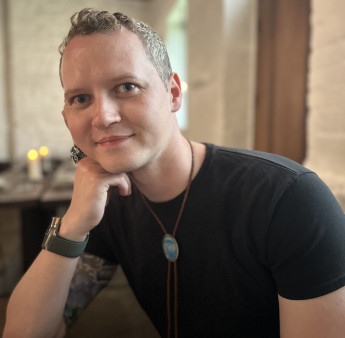
It’s not the physical similarities between my father and my uncle that strike you—they are brothers, after all—but the differences. Whereas my uncle Kenneth has a fleshy, filled-in quality to his appearance and smile lines emanating outward from the corners of his eyes, my dad, Wendell, retains an almost gaunt countenance, sunken in the eyes, his cheekbones harsh, his lips perpetually cracked, his hair flaxen but thinning. He looked so much like an old man at almost 40. I’m 34 now; in a few years, I will surpass him in age, frozen as he is in time.
I last spoke with Kenneth in 2012, when, as a broke college student teetering on the edge of joining the military, I rang him up and asked for help. For a pittance, really—perhaps something remained of what money had been left him by my father for services rendered? “I’m sorry, buddy,” he’d told me. That was that, but what he withheld in money, he attempted to give in information: When I asked him whether he had helped my dad pass some blood tests well over a decade ago, he grew quiet, before answering, “I’d say you hit the nail on the head there.” It might as well have been an admission. And it fit snug into the gap in the history I’d been reconstructing and am reconstructing still.
***
My earliest memory is of being asked to sit down next to my brothers on the living room floor in our home in Charleston, West Virginia, and being told by our mother, Kathie, through blearing eyes that Wendell was sick—that he had a “bug”. I’m unsure whether Kathie told us then or later that my father was gay, but she did tell us early on. Thus, my initial impressions of my parents would be bundled together as a bunch of understandings: My parents are divorced. My mother is upset. My father is gay. My father is sick because there is a bug inside his body. I’m supposed to be careful around him.
In short time, these understandings were straightened out and clarified. This bug, which I previously imagined as wriggling and crawling beneath my dad’s skin, actually swam in his blood, so my brothers and I were instructed to beware that blood, the breaks in dad’s skin. Don’t let him change your Band-Aid. Keep him at a loving distance.
It wasn’t until around 1997, as the custody battle was waning, that I finally got to know my dad a little better. I can’t recall him working then. I mean, he must have worked, as evidenced by his ability to pay rent and buy groceries, to buy us the spare toy or video game.
Still, there came a day when, without a doubt, Wendell ceased working any mere jobs and devoted himself to the harder work of just getting through the day. His energy levels plummeted; he was assailed by chronic diarrhea and urges to vomit. I had no idea how to comfort him in his distress, so I stayed away, waited it out. I numbed myself to his pain.
Yet it was also during this period of his final unemployment, around the summer of 2000, that Wendell purchased his first home, a two-story cottage-style brickwork house in Kanawha City. Then, he bought an Escalade. Then, he took me and my brothers on a cruise to Jamaica.
And then, in the fall of 2003, he passed away. In keeping with the theme of paternal obscurity, I was in school when he died (of pneumonia, I learned later), and I never got to see his face again. He was cremated rapidly, just as his relatives (Kenneth included) descended upon his personal effects and cremated his legal documents and other notes in a bonfire. Who really knows what they consigned to oblivion? What knowledge about my dad they robbed from me and my brothers? What evidence?
***
There was a kerfuffle among my family over who should receive Wendell’s remaining estate: me and my brothers, or Kenneth and his two sisters? Mediators were brought in by the bank, and we all ended up in court several times, with the final result being that the estate was divided among us, amounting to a comparably small sum to be split between me and my brothers. It was enough to help me with rent and car maintenance for the first few years of college, and then it was gone before I turned 21. With the last penny having been spent, there went Wendell.
A few years later, almost off-handedly, during a car ride, Kathie told me that she suspected that Kenneth had offered his arm in place of Wendell’s and had given his blood so that Wendell might secure some life insurance policies. That’s why on that final phone call to Kenneth, I’d asked him as much. He didn’t outright admit it, but he definitely didn’t deny it either.
***
When someone enters into a viatical agreement with a third party, one can expect the settlement to conform to a general structure: The viator (Wendell, in this case) names as the beneficiary of their life insurance policy a viatical settlement provider, who then pays a percentage of that policy amount to the viator while they are alive using capital provided by investors; the provider also pays the premiums on the account to keep it from lapsing. When the viator dies, the viatical settlement company will receive the life insurance payout and use that to pay back their investors.
But what if the viatical settlement provider is a Ponzi scheme?
Less than a year after Wendell’s death, his viatical settlement provider, Mutual Benefits Corporation, or MBC, was shut down by regulators for racketeering and fraud. They had been using new investors’ money to pay back old investors and to continue paying the premiums on their viators’ life insurance accounts. They did this for 10 years, from 1994 to 2004, and the defendants in the subsequent trials would ultimately be convicted and sentenced to decades in prison.
I share all this as context. A few years ago, two decades since Wendell’s death, spurred by a curiosity about how exactly he got his money while still alive, I Googled my dad’s name and discovered some online court documents naming MBC as a defendant in a case and containing Wendell’s name therein—not as a codefendant but as an example of someone who, alongside four other men, had submitted potentially fraudulent insurance applications. This one document, not even being about Wendell specifically, has nonetheless come to be a sort of source of truth regarding my father, a codex spelling out in bare facts many of the details of his life which for so long had remained unknown or ambiguous to me. The document seems to confirm that Kenneth, or rather someone, took a blood test in Wendell’s place. It alleges that MBC actually helped forge documents for Wendell in his attempt to obtain life insurance. And it provides dates and places whereby I can track, however broadly, the movement of my dad’s life from the 1990s to his death at 39 years old.
I don’t get on well with Kathie or many of my other family members these days—as a matter of fact, that’s underselling it. I was kicked out of my home a few days after I turned 18, and I’ve not had normal familial relationships since (apart from a brief attempt at reconciliation in my early 20s). Yet one of the important latent functions of a family, it seems to me today, is that a family facilitates the persistence and integrity of memories—perhaps not necessarily of true memories, but of memories nonetheless. A family constructs memories together and attempts to keep the dead alive with some fidelity. I’m not sure that will make sense to you. But I ask that you reckon that I feel it’s true. And when I read over these court documents, particularly those few paragraphs concerning my father, I can’t help but feel they fulfill a function left wanting.
***
It wasn’t until this spring, after having watched Matt Nadel’s Cashing Out documentary, that I realized just how ordinary Wendell’s situation was. For years, I had assumed that he had cleverly exploited a loophole in the system and gotten his bag while he was still alive. I know now that that isn’t the case, that he was actually treading a ground well-trod before his ever having passed through there. Just as MBC was the beneficiary of his life insurance policies, just as I was the beneficiary of a part of his estate, so was Wendell the beneficiary of the many thousands who came before him and who established the means whereby he might be able to live with some comfort in his last days.
Ten days into Pride Month, I wonder what this all means. I know that I miss my dad, or the idea of him. I know that it guts me (too often) to think that I never got to know him as a man and that our relationship is irrecoverable, lodged in a deep stratum of my life like a fossil. I know that I feel awfully lonely sometimes.
>But it occurs to me too, that it isn’t just family or online court documents that keep something of Wendell’s memory alive. Rather, there is this greater community, comprising lovers, parents, brothers, sisters, friends and children who share this experience—not of having lost someone to AIDS but of having gained something because of it. By “gained” I don’t mean just money—money isn’t nothing or else viatical settlements would never have become such an important facet of the ’ 80s and ’ 90s. So what do I mean by “gained”?
I think I mean that I’ve gained the feeling that I’m not so alone. That this major loss I experienced as a kid was not an isolated event but a strand in a human continuum stretching back decades and reaching out across the country, around the globe. That what so many of us felt we endured alone in our hearts and minds, we unknowingly endured together. That there is a bond between so many of us, of which we may remain ignorant for years but which persists nonetheless. That there is a quilt into which our lives are stitched together. That there is a permission to mourn not separately but as a community. And that there is an opportunity to shore together these fragments from our past and to celebrate the lives of the people we knew or barely knew or wish deeply we could have ever known.
What three adjectives best describe you?
Compassionate. Justice-oriented. Hopeful.
What is your greatest achievement?
Having finally forged strong, lasting, intimate relationships in which I have been able to develop secure attachments and trust.
What is your greatest regret?
Not having gotten to know my father better before his passing in 2003.
What keeps you up at night?
The thought of: How can I have a positive impact on the world when so much seems to be crashing around me in this country? And how can I balance the need for both justice and joy within myself?
If you could change one thing about living with HIV, what would it be?
I’m HIV negative so I’m not sure that I am qualified to answer this. But I suppose I wish that the stigma thereof would diminish to nothingness.
What is the best advice you ever received?
You may only ever be able to change your corner of the world, but it is up to you to decide how small or large that corner is.
What person in the HIV community do you most admire?
My father. He was the person with HIV whom I knew best, and today, I cannot help but admire what lengths he went to to try and make his life (and my own) a little more comfortable before his passing.
What drives you to do what you do?
I desperately want to believe that I can leave this world a little better than it was when I entered it.
What is your motto?
Everything is impermanent.
If you had to evacuate your house immediately, what is the one thing you would grab on the way out?
My dog, Juniper (aka Junebug, June, Goon, Juniper Berry, June Berrymore, etc.).
If you could be any animal, what would you be? And why?
A brown bear. What more majestic way is there to enjoy the great outdoors? What would I fear? What could ever stop me?

Comments
Comments