

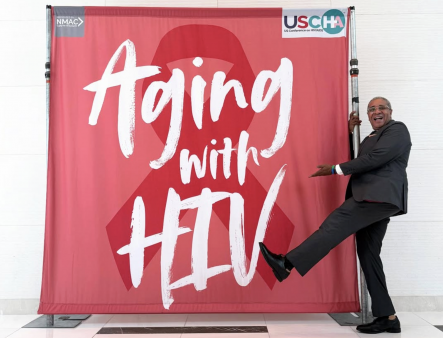
The U.S. Conference on HIV/AIDS (USCHA) takes place annually in rotating cities across the nation, but the 2025 return to Washington, DC, seems to capture this specific moment in history. Congress members, freshly returned from summer break, are about to vote on a proposed budget that guts HIV funding and erases decades of progress. Health Secretary Robert F. Kennedy Jr., who has been dismantling federal health institutions and lifesaving policies, is being grilled by lawmakers. HIV organizations are scrambling to survive in a brave new world in which federal grants will definitely not go to populations that need support the most. And oh, yes, National Guard troops and militarized ICE (U.S. Immigration and Customs Enforcement) agents roam the streets to intimidate and terrorize citizens at the whim of President Trump.
At least the weather is gorgeous.
Perfect for a protest.
View this post on Instagram
And inside the Marriott Marquis’s convention center, thousands of HIV community members gather. Advocates, allies, elected officials, health care providers, pharma reps, researchers and, of course, all manner of folks living with the virus—everyone has come together in a display of resilience and strength, to educate, uplift, protest and, yes, to have a joyous good time.
View this post on Instagram
POZ is here—stop by booth 601 in the Exhibition Hall and say hi!—and to help capture the vibe of USCHA 2025, we’re embedding a collection of social media posts throughout this article on the event’s kickoff.
The @pozmagazine.bsky.social team is ready to greet you at #2025USCHA! #USCHA
— Liz Highleyman (@lizhighleyman.bsky.social) September 4, 2025 at 5:37 PM
[image or embed]
The conference runs Thursday to Sunday, and this year’s theme is “Aging With HIV.” Thursday’s luncheon plenary was titled “Beyond Belief.” Presented by drugmaker ViiV Healthcare, it featured five memorable speakers who shared their unique journeys aging with the virus: Grissel Granados (she was born with HIV—a group referred to as dandelions—and is now a mom about to turn 40), Louis Ortiz-Fonseca, Jeff Berry, Keith Green and Rae Lewis-Thornton (she tested positive in 1987 when she was 24; folks like her are referred to as long-term survivors).
View this post on Instagram
View this post on Instagram
Also on the plenary conference stage was Harold Phillips, making his debut as the incoming CEO of NMAC (formerly the National Minority AIDS Council), the organization that spearheads USCHA. For the occasion, Phillips rocked an “I [Heart] CDC” T-shirt, one of the many nods throughout the conference to federal workers at the Centers for Disease Control and Prevention and the National Institutes of Health who have been fired or degraded by Trump despite their dedication to public health.
In the upside-down world that is 2025, many federal workers—even those employed in HIV-serving programs—were forbidden from attending USCHA. That’s because the Trump administration refuses funding and support of programs that promote diversity, equity and inclusion (DEI). Considering that HIV disproportionately affects Black, brown and LGBTQ communities and that effective HIV programs center the needs of these people, well, you can see the dire need for this conference at this moment.
View this post on Instagram
Every morning and afternoon of USCHA, conference-goers can attend any number of break-out sessions. In fact, one Thursday morning session focused on “DEI Whiplash” and ways to secure financial stability for your organization as federal funding dries up. (Hint: Tweak your grant proposals to ensure they include favorable buzzwords.) Other sessions covered “HIV and the Law,” “Exploring Reproductive Aging in Women Living with HIV,” “HIV and Medicare: What You Need to Know,” “Forever Undetectable: Harnessing U=U for Older Adults” and many other topics.
U=U stands for Undetectable Equals Untransmittable, meaning that people with an undetectable viral load don’t transmit HIV to others through sex. What’s more, people with HIV who achieve and maintain viral suppression experience slower disease progression, are less likely to develop opportunistic illnesses and are able to enjoy better overall health.
The kickoff of USCHA also coincided with the launch of the “Choose U” initiative by HIV pharma giant Gilead Sciences. Complementing USCHA’s Aging with HIV theme, this initiative spotlights people living a long life with HIV treatment and encourages them to prioritize self-care and wellness, especially considering that treatment is a lifelong commitment.
View this post on Instagram
“Treatment is bigger than just, I’m going to the doctor. It’s a lifestyle. It’s having a holistic view,” says Kim, who identifies as a dandelion, in one of the campaign videos. “An HIV diagnosis does not define who someone is or their future self. Choose U features individuals telling their authentic stories to empower others living with HIV to participate in a dialogue regarding their treatment and care.” Learn more and watch the videos at ChooseUHIV.com.
Of course, much community building during USCHA (aka: wining, dining, making friends and generally having a great time) occurs outside the conference walls.
The HIV media dinner held during the 2025 US Conference on HIV/AIDS. With apologies to DaVinci. Front: Olivia Ford (The...
Posted by Mark S. King on Friday, September 5, 2025
View this post on Instagram
At this year’s USCHA, a number of protests are scheduled on Capitol Hill throughout the week. For related stories, see “Celebrities and a #CutsKill Quilt Join AIDS Advocates in DC to #SafeHIVFunding” and “HIV Activists Protest the Latest Blockage of Funds for Global HIV Program PEPFAR.”
Check back with POZ for more coverage on #USCHA.



Comments
Comments