

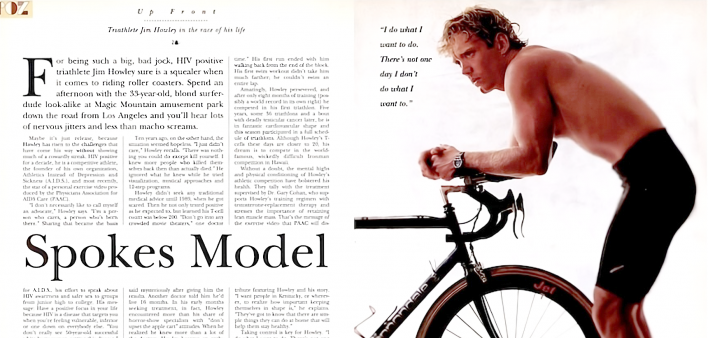
Endurance athlete Jim Howley, who “shocked the world in 1996 when, with AIDS, he finished the Ironman,” died July 29, 2025, of cancer. He was 65.
Howley is remembered as “an incredibly kind and compassionate man who went out of his way to help others. A man who left his imprint on many people’s souls and hearts. A jokester, a traveler, a lover, a farmer, a fighter, a chef, an athlete, a patient advocate and so much more. A man who knew what he wanted and fought for what you wanted equally,” recalled Ben Hurst in a Facebook tribute on Howley’s page.
Howley had told friends he had an incurable cancer as a result of radiation for testicular cancer in the ’90s.

Despite AIDS and cancer, Jim Howley became a triumphant endurance triathlete in the 1990s. He died July 2025 at 65.Facebook.com/jim.howley.98
Although he didn’t set out to be an HIV advocate, Howley became a well-known and triumphant face of the epidemic because he spoke openly about living with AIDS while enjoying a healthy lifestyle and competing in endurance sports.
When he learned he had HIV in 1989, his T-cell count was below 200. This was about seven years before effective treatment became available, when a diagnosis was considered a death sentence.
Howley wasn’t surprised to have tested HIV positive, he told POZ in a 1994 profile “Spokes Model.” But learning he had developed AIDS marked a turning point. Before that diagnosis, he had tried to cope with his physical and mental health issues via partying and cocaine, which played a part in his contracting the virus. But faced with AIDS, he became determined to get in shape and fight for his life. Motivated to challenge himself further, Howley competed in marathons, swims, bike rides and other endurance athletics—including several Ironman races. In 1994 when the POZ article was published, he had already completed 37 triathlons. To inspire and educate others, Howley shared his love of exercise—and his journey with HIV.
Howley recounted to POZ the personal story he often shared with others: “I know the day I got this disease,” he would tell people. “I know exactly when it was, who it was. And I also know that I knew about HIV at that time—even though it was back in the early ’80s. But I didn’t have the guts to make that person do what I should have—because I felt one down. With athletics I never feel down anymore.”
He shared information about safer sex and mental health, often speaking with students. He urged people to cultivate a healthy focus in their lives because without it, he believed, they could be prone to feeling inferior and depressed—which is when a disease like HIV can target you.
Howley founded his own organization, Athletics Instead of Depression and Sickness (A.I.D.S.) and starred in a personal exercise video produced by the Physicians Association for AIDS Care.
POZ interviewed him again in 1997 for the profile “Medal Man,” in which he discussed HIV drug trials, mental health and exercise.
He was also featured in the 1996 coffee-table book 25 Years of the Ironman Triathlon World Championship by fellow endurance athlete Bob Babbit. Writing on Babbittville.com, Babbitt paid tribute to Howley by reprinting the piece from the book. It reads in part:
“Howley does what no AIDS patient has done before. Each week, he runs 35 miles, cycles 150 and swims five to six miles. He takes 60 pills a day to help combat the ravages of AIDS.…
“One of the pills he takes, Marinol, is a marijuana pill designed to give him the munchies so that he can eat enough to keep his weight up. At the moment, he is a robust 193 pounds.
“When he … found out that he had AIDS, he thought it was all over. ‘[Doctors] told me not to even go into a crowded movie theater,’ he recalls. ‘That’s how bad it was. I freaked out. I went home and decided that before I die, I want to do a triathlon. I went to a pool that day and wasn’t able to swim to the other side.’
“Jim Howley was told that the type of training he would need to do for the Ironman would kill someone with AIDS. He proved them all wrong when he completed the toughest day in sport. Jim shocked the world in 1996 when, with AIDS, he finished the Ironman in 14:47:22. To prove it wasn’t a fluke, he came back in 1997 and went 13:14:55, over an hour and a half faster.”




1 Comment
1 Comment