

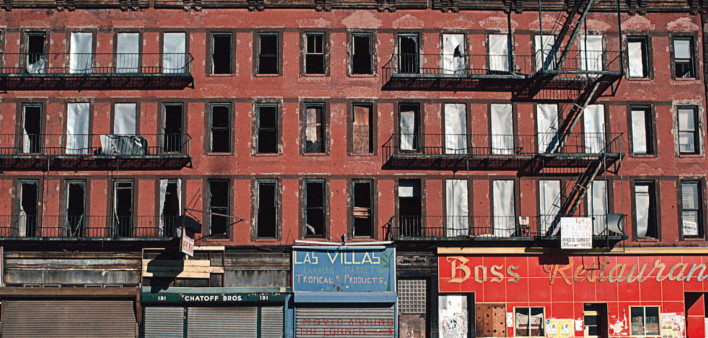
Eric Sawyer, 71, a New Yorker living with HIV, is well known in the HIV and AIDS community for having been a principal player in ACT UP and then cofounding Health GAP, which helped get the first wave of effective HIV meds to low-income countries in the late 1990s and early 2000s.
But he is perhaps less known for having cofounded, in 1990, the ACT UP spin-off Housing Works to create secure, stable, medically appropriate shelter for people with AIDS who were homeless. Housing Works has since grown into a multipronged, multimillion-dollar New York City services agency.
Sawyer was interviewed by POZ contributing writer Tim Murphy for the Caftan Chronicles Substack series of interviews with notable older gay men. In this condensed and edited version of the Q&A, Sawyer discusses AIDS housing history.
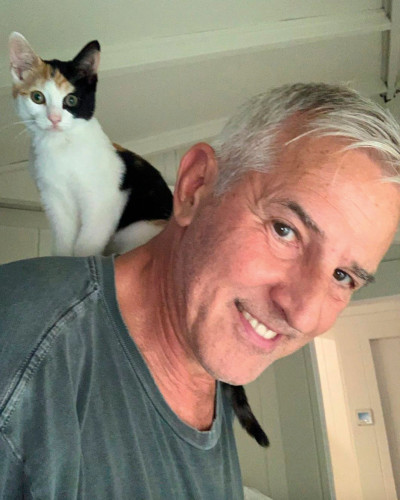
Eric SawyerCourtesy of Eric Sawyer
You were raised an upstate New York farm boy. After graduate school in Colorado, you arrived in New York City in 1980.
I got an apartment on 22nd Street between 9th and 10th Avenues in Chelsea. It was run-down and becoming a gay offshoot of the West Village, the main gay neighborhood.
In Denver, I had co-bought and renovated a two-family home and sold my interest in it. But it had given me the renovation bug, so I kept looking for a building in NYC to buy. I’d become friends by then with Larry Kramer, and in 1981, he and I and my boss at American Standard [a manufacturing company], where I was working by then, were trying to buy two brownstones for a total of $225,000 on 100th Street between West End and Broadway. But the deal fell apart. I’d heard that people were starting to renovate brownstones in Harlem, so I biked there.
I’d seen a house there listed for $26,000—a four-story brownstone with several squatters in it. So with money I borrowed from a friend of my father and the manager at the restaurant I worked at, I bought it. Then I moved in with my new boyfriend. There was no heat or hot water or gas—only electricity and cold water. There were water leaks everywhere and rooms filled with garbage as high as the refrigerator.
What was the neighborhood like?
My brownstone was one of only three on the block that was occupied. We were the only white people for 15 blocks. We’d get off the subway and people would yell and sometimes throw bottles at us. So I adopted a 95-pound German shepherd to walk around the neighborhood with.
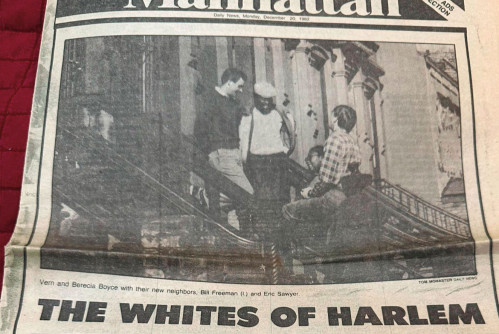
New York City newspaper headline spotlighting Eric Sawyer meeting his new Harlem neighbors, 1982Courtesy of Eric Sawyer
What was the renovation like?
I renovated it with my own hands. I hired people for the electricity and the plumbing, but I did all the demolition, framing, Sheetrocking, insulation and flooring myself. It took me until about 1988 to finish the whole thing. We had a working kitchen sink on the ground floor, a bathtub on the third floor and a toilet on the top floor, and we’d have to go between them.
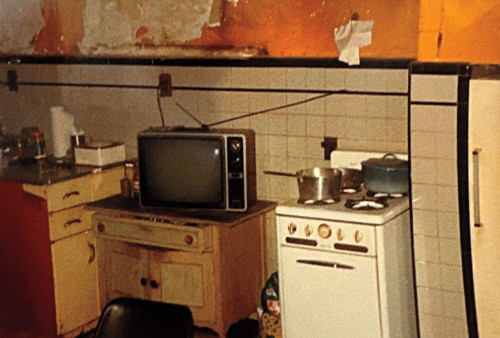
Brownstone kitchen before renovationCourtesy of Eric Sawyer
How much did all of this cost and how did you pay for it?
I think the whole thing cost about $150,000, which I paid for either through tax refunds or money I’d saved or credit cards. That’s why it took me so long. Even after I started working at American Standard, I kept working at the restaurant three nights a week and double shifts on the weekends.
Then I was sold the building next door by a guy who would go and find buildings in foreclosure, buy the deed for pocket change, pay the back taxes on it to the city and then flip it. Then in 1985, I bought a building on West 123rd Street for $25,000 and never renovated it but sold it a year later for $85,000. And then I bought another adjacent building on Manhattan Avenue from a sealed bid Housing Preservation and Development auction. And then I bought a building on West 119th Street with a friend for $100,000 and sold it a couple years later for $125,000. By that point, my boyfriend had died of AIDS, and we’d started ACT UP, so—
Yes, amid all this, AIDS comes into the picture.
I knew about AIDS pretty much from 1981, when Larry Kramer started writing about it in The New York Native, but by 1982, I was symptomatic, and by 1984, my boyfriend, Scott, had Kaposi sarcoma, an AIDS-linked cancer. I was only lightly symptomatic. One of the first things I got was recurring shingles. Also swollen lymph nodes. It wasn’t really until 1983 or 1984 that I understood these as AIDS symptoms.
Fast-forward to 1987, the founding of ACT UP.
I called Larry Kramer, whom I hadn’t talked with much the year my boyfriend was dying of AIDS. I told Larry that Scott had died and that a lot of guys with AIDS were becoming homeless when they lost their jobs and got evicted. And also that a lot of homeless people were coming down with AIDS via injection drugs. I told him that I wanted to use my housing development skills to create housing for people with AIDS and could he introduce me to some of the right people.
And Larry said certainly and that he was speaking at the LGBT Community Center the following week to call for the creation of an AIDS civil disobedience organization [which would become ACT UP].
I went to the speech with my boyfriend at the time, Frank Jump, and we both volunteered to help plan the first demonstration, and then we were both elected to ACT UP’s first coordinating committee.
A bit after that, this guy in ACT UP, Rich Jackman, an architect, came to me and said, “Let’s start an ACT UP Housing Committee.” So we did that and started doing lots of demos. One big demo we did was dumping a ton of garbage we’d collected—furniture, toilets, ovens—in front of the HPD building to block traffic. We demanded that the city create a $25 million capital fund to build AIDS housing. That got so much publicity that the city ended up announcing the fund, and a few weeks later the state matched it.
At that point, we’d been trying to get GMHC [the first U.S. AIDS services organization, founded in 1982 by Kramer and others] to develop AIDS housing, and nobody there was willing. So we incorporated our own 501(c)(3) [nonprofit] and started Housing Works in 1990.
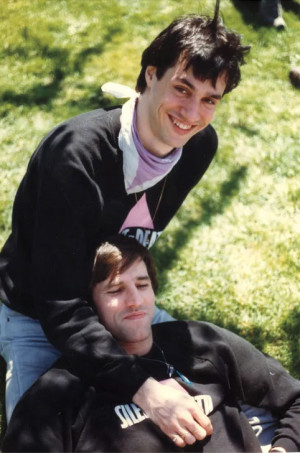
Eric Sawyer with his former boyfriend Frank Jump (top)Fadingad.com
How did that go?
A lot of our early work was facilitated by Joe Allen and his wife, Rhonda Shearer, who allowed us to use her loft space as Housing Works’ first offices. Cofounder Charles King was the first employee, then Ginny Shubert and [Charles’s boyfriend] Keith Cylar [who died in 2004].
Our first program was procuring and providing scattered-site housing. We did a lot of bar and club benefits to pay for our expenses. And eventually, when the Ryan White CARE Act [to provide AIDS funding] was passed in 1990, we applied to it for a whole bunch of grants. We provided up to maybe 80 scattered-site units as well as social services to help care for the people living there. The actor Rosario Dawson’s mother was the head of maintenance.
And we kept growing with other contracts and eventually started developing the first building of our own, Cylar House, which opened on East 9th Street in 1997.
I stayed involved with all this until about 1996, when I started working exclusively on access in the developing world to the new, highly effective HIV drugs that had come online in the late ’90s and beyond.
What do you want to prioritize with the rest of your life?
Trying to document the work I was involved in during my life. I’ve never written a book about it, so I think I will soon.




Comments
Comments