

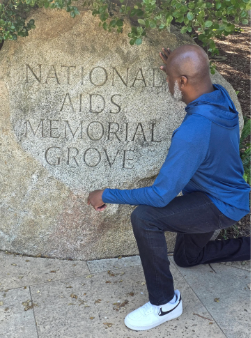
Yesterday I visited the National AIDS Memorial in San Francisco for the first time. As someone who has been living with HIV since October 1988, I can say without hesitation that the experience felt like a pilgrimage.
It was not tourism. It was not simply visiting a place I had heard about. It was something deeper. It was the kind of journey that calls you not only across miles, but across time. I went there carrying more than memory. I carried over 30 years of survival. I carried grief, silence, stigma and endurance. I carried the weight of having lived through 15 years of HIV criminalization. And I carried the ache of knowing that, for much of my life, I had been far from the places where the early HIV movement took shape and found its voice.
Living in Idaho meant living at a distance from that history. Growing up in Boise in the 1970s and 1980s, I already knew something about isolation, even before I had language for it. There is a particular kind of loneliness that comes from being far from the cultural centers where movements are born, where resistance becomes visible, where people find one another and say, “You are not alone.” In Boise, and later in Idaho more broadly, the early HIV movement did not feel close enough to touch. It felt like something happening somewhere else, to other people, in other cities, with other resources, other communities and other kinds of permission to be seen.
So for me, this visit was not just about arriving at a memorial. It was about arriving at a history I had long felt connected to, but separated from. It was about standing in a place that holds the pain, courage, love and defiance of so many lives shaped by this epidemic. It was about finally stepping into sacred ground that, for years, I had only known from afar. And standing there, I felt the distance between “then” and “now” collapse.
I thought about the men and women who did not live long enough to see what I have seen. I thought about those who fought to be treated with dignity while the world looked away. I thought about those who died before the language of “U=U,” before better treatments, before even the smallest measure of justice. I thought about how many people were lost not only to the virus, but to shame, abandonment and fear. I thought about how many of us survived, but not untouched. Because survival is not simple. Survival is not neat. It is not just a medical fact. It is emotional. It is political. It is spiritual.
To live with HIV for more than three decades is one thing. To also survive 15 years of incarceration for living with HIV is another. That kind of survival leaves marks. It changes how you move through the world. It teaches you that stigma can be written not only into people’s attitudes, but into laws, systems and sentences. It teaches you what it means to be treated as a symbol of fear rather than a human being.
That is part of why this experience felt like a pilgrimage. I was not only honoring those who came before me. I was also honoring the parts of myself that had to fight to stay alive. The newly diagnosed man in October 1988. The man forced to endure criminalization. The man who kept going anyway. The man who found purpose in advocacy, in truth-telling, and in refusing to disappear.
At the memorial, I did not feel disconnected. I felt gathered in. I felt, maybe for the first time in that particular way, that my story belonged to a larger story. Not separate from the movement, but part of it. Not too late, not too far away, not too outside. Part of it.
For someone from Idaho, someone who came of age far from the epicenters of the early epidemic, that mattered deeply. It reminded me that geography may shape our access to community, but it does not erase our place in history. It reminded me that even if I was distant from the early movement, I was never outside its reach. I have been carrying its echoes all along.
Yesterday gave me a chance to stand still long enough to feel that truth.
What I found there was not closure. HIV does not offer neat closure. Criminalization does not offer neat closure. But I did find reverence. I found memory. I found grief that did not have to hide. And I found a quiet, powerful sense that making that visit was an act of witness — to those we lost, to those who survived, and to the long road that brought me there.
Some journeys are about seeing a place. Others are about finally letting a place see you.
Yesterday, I believe, was both.
Kerry S. Thomas (he/him) is a Public Engagement & Narrative Advocacy Strategist with the Sero Project, working at the intersection of HIV decriminalization, restorative justice, and public health reform. A long-term survivor of HIV, HIV criminalization survivor, and returning citizen, he brings lived expertise to advancing policy change and shifting public narratives. Kerry is Editor-in-Chief of Turn It Up! Staying Strong Inside and co-host of The Mic Is Ours podcast, where he amplifies the voices of people impacted by incarceration and HIV. He serves on the Aging Advisory Council for the Center for HIV Law and Policy and is actively engaged in national and state-level HIV advocacy efforts.
Click here to subscribe to him on Substack.



Comments
Comments