

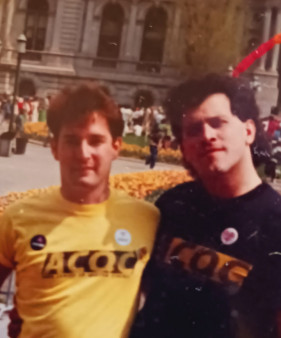
Over 30 years have passed since I was diagnosed with AIDS. In 1991, I was shocked to learn via an article in Newsday that my former dentist, whom I had also dated in the 1980s, had passed away from AIDS-related Pneumocystis pneumonia. The article mentioned his patients were getting tested for HIV. I went to get tested as soon as possible, and the test came back positive. For me, the news was catastrophic. I was only 26 years old.
In the early 1980s, the disease was referred to as GRID (gay-related immune deficiency). In 1982, it was renamed AIDS (acquired immune deficiency syndrome). AZT was the only drug available at that time. The COVID-19 pandemic hysteria reminded me how it felt being diagnosed with a fatal disease. The beginning of the AIDS epidemic was a really scary time in history. There was confusion, panic and much misinformation regarding transmission and treatment of HIV. Many people were living in fear and worried about when they would become sick. I had to keep my diagnosis a secret. It was sheer agony not to be able to tell anyone about my condition. AIDS was known as the “silent battle,” and it truly was.
When I was younger, I was bullied for being different. I was gay. Then, in my formative years, from early childhood into adolescence, I was abused—sexually, physically and mentally—by a family friend. As a young adult, I struggled with hate, bigotry and stigma.
Many people viewed gay men and women as perverse people who went to sleazy bars and met in back alleyways. Being gay was not as accepted as it is now. Perhaps my being bullied and sexually abused in my early years prepared me for the battle that was yet to come. The phrase “in the closet” can have many meanings. Most commonly, it refers to being gay and hiding one’s identity. Many long-term survivors of HIV/AIDS, homophobia and childhood sexual abuse have lived their lives in silence.
I was no stranger to keeping secrets. I was afraid to tell my family about the trauma I suffered. The abuse was yet another secret that I kept for over a decade. A beautiful thing about young children is that they move through the world without questioning who they are or who they should be.
I came out as gay when I was in my early teens, and I dared to be honest about my sexuality. I disclosed it to my family, minister and some trusted friends. I also shared the truth about my sexual abuse and rape. I had suppressed the trauma and abuse for so long. Having the courage to tell my story was a double-edged sword. For my family, it was extremely painful to watch friends and other family members walk away from us. It was like I had done something unspeakably wrong. It was something I could not control or even fully understand. For me, my parents and my siblings, it was an emotional roller coaster. My immediate family stood by me and loved me no matter what.
Survival is universal—that’s what we’re all here for. We need not experience our feelings and reactions in isolation. We can reach out to others for support by owning who we are and by relating to our experiences. We no longer need to pretend to be something we’re not solely because other people may feel threatened by our thoughts and feelings.
Self-acceptance leads to change and growth. We do not have to prove ourselves to anyone. Always be yourself.
What three adjectives best describe you?
Resilient, fastidious and persistent.
What is your greatest achievement?
Long-term survivor of HIV/AIDS since 1988.
What is your greatest regret?
Not having enough time to do all the things I need to do in this life.
What keeps you up at night?
All the hurt that the new Trump administration is causing will keep anybody up at night.
If you could change one thing about living with HIV, what would it be?
I would change the stigma related to HIV and AIDS. The LGBTQ+ community is so marginalized, and there is so much hate. I would like to be able to bring more light to this subject.
What is the best advice you ever received?
To always be myself/to thine own self be true.
What drives you to do what you do?
A desire and determination to help others—especially those who have HIV/AIDS, those in the gay community and survivors of sexual abuse and emotional abuse.
What is your motto?
Talk to my ass; my head’s had enough.
If you had to evacuate your house immediately, what is the one thing you would grab on the way out?
My little kitty, Beatrice. She’s my little fur baby.
If you could be any animal, what would you be? And why?
A cat, specifically a puma. They are worshiped and mysterious creatures.




Comments
Comments