

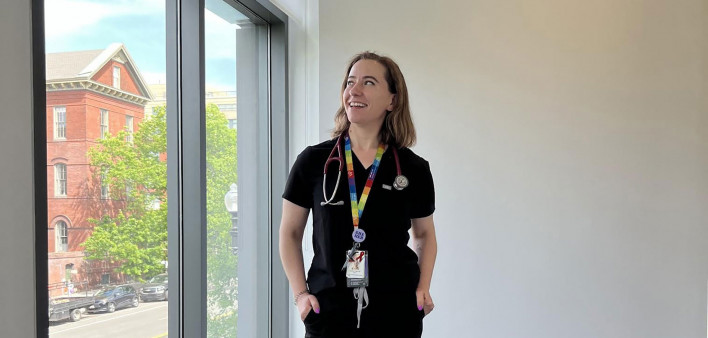
The HIV community lost one of its own with the death of our beloved Amanda Cary on April 8, 2026. She was 42. Amanda was a nurse, an HIV provider and a clinician who set a standard for care that many aspire to and too few are supported to sustain. Her loss is profound—felt by those who loved her and across the patient and provider communities she served.
Amanda believed in showing up. And that she did.
She built her career around that idea long before she ever held a clinical title. She studied international health at Simmons College and traveled to South Africa, where she first saw how structural inequality shapes health outcomes. That experience stayed with her. It pushed her toward human rights work at Physicians for Human Rights and later policy advocacy at American Jewish World Service, where she focused on women, girls and LGBTQ communities affected by HIV.
Eventually, she did what great providers often do—she moved closer to the patient.
She was educated as a nurse practitioner, specializing in HIV care and community health. She worked on inpatient HIV units, then at Whitman-Walker Health in Washington, DC, and later as a clinical leader at Callen- Lorde Community Health Center in New York City.
At Whitman-Walker, Amanda helped lead one of the most important transformations in its clinical services in recent years, evolving the sexual health clinic from a volunteer-run model into a full-time accessible program that could serve more patients, accept insurance and remain grounded in its commitment to equity and inclusion.
During the COVID-19 pandemic, Amanda helped rework how sexual health services were delivered, almost overnight. With in-person visits sharply limited, she stood up new approaches —like at-home HIV and STI [sexually transmitted infection] testing—to keep patients connected to care. At a time when many systems stalled, she made sure this one didn’t. When mpox [also known as monkeypox] hit DC, she stepped in as one of the city’s central clinical leaders, caring for patients at scale during a period of uncertainty and fear.
Amanda didn’t see patients as cases or visits. She saw people navigating systems that often failed them. She spent time. She followed up. She brought people back into care when they dropped out. She worked across HIV, sexual health, substance use and gender-affirming care because she understood that real life doesn’t fit into clinical categories or executive orders. She was a dedicated advocate who stepped forward again and again to lead the way in providing nonjudgmental, high-quality care for all.
And the impact showed up in people’s lives. Patients stayed in care because of her. People trusted the system because she was in it. Colleagues relied on her judgment, her steadiness and her refusal to accept anything less than dignity for the people she served.
Amanda managed a level of responsibility that most systems quietly depend on but rarely acknowledge.
She understood what it means to hold complexity—to care for others while managing your own struggles at the same time. And like many providers, especially nurses, she also carried the emotional weight of the work itself. HIV care asks providers to sit with stigma, loss and uncertainty and to do it consistently over time.
The system relies on that kind of presence. But it doesn’t always support it—and rarely builds structures that sustain it.
We don’t talk enough about the HIV provider pipeline or how underappreciated nurses are within it. Fewer clinicians are choosing this field. Training programs are shrinking. Incentives push people elsewhere. On paper, HIV is manageable. In practice, it still depends on providers who are willing to stay engaged over years and build real relationships with patients.
If we are serious about ending HIV as a public health threat, we need to be serious about supporting the provider workforce. That means investing in education, supporting nursing pathways, fixing reimbursement and valuing the time it takes to actually care for someone—and treating mental health as fundamental to care for everyone, not an afterthought.




Comments
Comments