

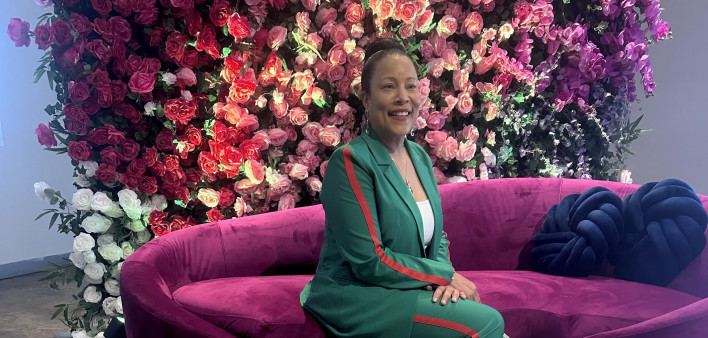
When Kim Moon’s physician, also a Black woman, invited Moon to speak to her church congregation in the spring of 2014, she hesitated. She had never spoken to a group of people about her HIV status, let alone shared intimate details of her life with HIV. But her doctor encouraged her to stand up and speak.
“I was like, ‘I can’t do that!’” Moon says. “She said, ‘Yes you can. I believe you can.’”
Moon doesn’t recall exactly what she said that night. She does remember crying throughout the whole speech, though. Snot ran out of her nose and down her face. She had whipped herself up into an emotional frenzy walking through memories and talking about how far she had come.
The emotions she experienced during her speech recalled the feelings that would sometimes overtake her when she faced taking her daily medication. For some time after her diagnosis, the prospect of swallowing a pill triggered a flood of memories of how she wound up contracting HIV: The 58-year-old Atlanta resident was diagnosed with the virus in 2001 after experiencing a sexual assault.
“I remember crying because it brought back memories,” she said. For a time, even just going to the doctor’s office could provoke unpleasant reminders of why she was there.
Despite the psychological toll, she took her meds without fail. The only time she struggled with adherence was was when her job at a contact lens company switched health insurance providers and she had to have her pills delivered via a mail-order pharmacy. Whether or not she got her meds suddenly depended on a host of systems: her insurance company, the mail-order pharmacy and the postal service. If she didn’t receive her medication on time, she was often unsure where in the supply chain the system had broken down. She would phone the pharmacy in tears.
“I used to call them crying like, ‘I don’t have my medication. I’m going to die. Y’all are killing me,’” she says. “I was scared. I still wasn’t educated.”
Though she now understands that she wouldn’t have quickly died without her pills, Moon was still at risk of developing a potential resistance, which could’ve complicated her treatment options down the line. Thankfully, that never came to pass. Still, Moon was left with a deep distrust for any process that potentially messes with her meds.
“Even to this day, I hate those mail-order pharmacies,” she said. “I hate them with a passion.”
That’s why when Moon first heard about long-acting injectables and learned that she could possibly—with just a few trips to her doctor’s office per year—remain undetectable, she knew she wanted to try them.
“I just wanted the injection because, heck, who doesn’t want to take something once every other month, rather than every day?” she said. “Choosing the injection has given me freedom from the daily pill reminder of my diagnosis. Now, I only think about HIV once every other month, not every single day. It’s a game changer.”
To get the injection, she had to practice self-advocacy. When her insurance initially denied her, she didn’t press. But when she got a new doctor, she persisted, saying she wanted to be on long-acting treatment. Now, self-advocacy is something she stresses when talking to other women, especially other Black women.
“I couldn’t advocate for myself because I didn’t know how. All I knew to do was what the doctor said, or I was going to die. I now know that wasn’t right. But that’s what I thought,” she said. “For me, it starts with education and self-care. That’s how you find your voice and the only way to speak up for yourself and be heard.”
Despite some pain and burning at the injection site, she has no other side effects from the injections; even if she did, she says, she doesn’t see herself going off them.
“I wouldn’t trade it for anything,” she says. “The only thing I would trade it for is if they came up with another injection that I have to take less. That’s the only thing better.”
Prior to taking her first injection, she had never known another Black woman who had taken the shot. That is partly why she speaks so openly about it now, especially with friends. Moon remembers vividly what it was like during the first 10 years after her diagnosis when she didn’t know a single other person who was openly HIV positive. She was isolated and lonely.
That changed when a peer educator at her doctor’s clinic, a Black woman, came to speak to her one day. “That’s when I stopped all that crying,” she said. “I was like, ‘Fool, you’re not dead yet.’ I woke up literally every day wondering if today was the day that HIV would kill me? I thought it was a death sentence. I didn’t know any better, and I didn’t know anyone who was living with HIV.”
Now, she wants to be that friend to other people considering the switch to long-acting treatment.
“Educate yourself. Things are changing quickly: If you’re not educated, you’re left behind,” she says, as though talking to a friend. “I refuse to pay a doctor, allow my insurance to pay said doctor and then settle for less than the best of care. Subpar is not an option because the key to all of that is I pay them; therefore, they work for me.”
She now regularly speaks in front of other people living with HIV. And when she does, she displays a relic from her former life as a daily pill taker: the daily alarm she set on her phone for 10 p.m. with a note reading: “Live life every day.”
“That was my reminder,” she said. “I am taking this so I can live.”
Now, on a long-acting injectable, she no longer needs the daily nudge. She doesn’t have to think about HIV daily or the circumstances that led to her diagnosis. With the pills are in her past, she doesn’t need the daily reminder to embrace life. She is just free to live it.




Comments
Comments