

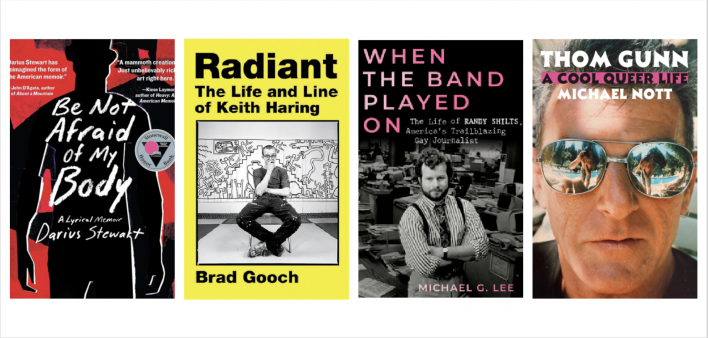
Each year, the Lammy Awards highlight outstanding contributions in LGBTQ literature. Spearheaded by Lambda Literary, the 2025 ceremony was held October 4 at Charlie’s Queer Books in Seattle. Several books featuring HIV storylines were nominated, notably in the category of Gay Memoir/Biography, in which the winning title was Brad Gooch’s Radiant: The Life and Line of Keith Haring.
The other titles nominated in that category include:
- Be Not Afraid of My Body: A Lyrical Memoir by Darius Stewart, a gay Black Southern man living with HIV;
- Thom Gunn: A Cool Queer Life by Michael Nott, about the poet who remained HIV negative but wrote a collection of poems, The Man with Night Sweats, about the loss of many friends during the epidemic in the 1980s;
- When the Band Played On by Michael G. Lee about journalist Randy Shilts, who died of AIDS-related illness in 1994 and is best known for his 1987 nonfiction work, And the Band Played On: Politics, People, and the AIDS Epidemic; and
- Manboobs: A Memoir of Musicals, Visas, Hope, and Cake by Komail Aijazuddin, a gay Pakistani.
Biographers Lee and Gooch have been highlighted in POZ magazine. The June 2024 issue included a Q&A with Gooch titled “Keith’s World” and a feature titled “Radiant Activist” that included an excerpt from his book on the life of the pop artist.
The book traces Haring’s path from Kutztown, Pennsylvania, to New York City, where his graffiti-inspired art made him a superstar of the 1980s art scene and catapulted him to global fame before he died of AIDS-related complications on February 16, 1990, when he was just 31. Haring often used his artwork and fame to raise awareness for social issues, including HIV. The excerpt in POZ tells of Haring’s choice to go public about his HIV status in a fundraising letter for the AIDS activist group ACT UP.
Gooch, who has also written biographies of poet Frank O’Hara and author Flannery O’Connor, said he had much in common with Haring. “There were a lot of things about [writing about] Keith that came naturally to me. We were living in New York City at the same time. Both of us were born in the 1950s,” he told POZ. “His parents didn’t want him to be an artist, and my parents didn’t want me to be a poet. Both our parents were Republicans. Keith’s mother said to me, ‘Keith never said the words gay or AIDS to us,’ and I completely understood that. I don’t think I ever said the word gay to my parents, but when my lover, Howard Brookner, had AIDS, he’d come home with me in his wheelchair, and my parents accepted all of this, but we never said, ‘We are lovers, and one of us has AIDS.’”
Having also lived through the darkest days of the epidemic, Gooch recalled, “I also have a kind of PTSD from having lived through AIDS and the loss of Howard. In the ’90s, a numbness set in for me emotionally and sexually. One reason I’m glad to have this book about Keith out there is that it tells the story of AIDS at that moment, because I don’t think young queer people know it.”
In our June 2025 issue, Shilts biographer Lee also shared how he related to his subject matter. “Being a child of the ’80s, And the Band Played On was ubiquitous. I was 10 years old when that book came out. From that time forward, I was aware of the book as it’s related to the AIDS epidemic because that was a frightening part of the coming-out experience for people in my generation.” When researching AIDS organizations and advocacy, Lee realized there wasn’t a proper biography on Shilts and decided to make that his project (including the controversy regarding Shilts’s portrayal of Canadian flight attendant Gaetan Dugas as the infamous Patient Zero, a main vector of the spread of HIV across the United States).
For fellow Lammy nominee Stewart, HIV is much more personal: He is currently living with the virus, which is one of the topics covered in his memoir, Be Not Afraid of My Body. In an interview with the literary website Full Stop, Stewart explained whom he envisioned as the primary audience for his memoir:
“I would have thought the audience were folks like me—specifically, Black, gay, Southern men who are HIV-positive. But the book could be for anyone in a marginalized circumstance because it’s about the physical body and how it can be ravaged by illness, dependency, substance misuse, and all that. There’s a lot in the book about being a racialized subject that I think is important, and for the most part, I haven’t heard people discuss a lot (e.g., queer, Black, HIV-positive men). But the easy thing to say is that it’s for anyone who can appreciate what I’m writing—that’s who I am writing this for.”
Although renowned queer poet Gunn remained HIV negative (he died at age 74 in 2004), one of his most enduring works is the 1992 collection The Man with Night Sweats, a meditation on mortality as well as a tribute to the many friends he lost to the pandemic. (For a detailed breakdown of the titular poem, check out this essay by Poetry Prof.)
In addition to memoirs and biographies, the Lammy Awards also celebrated LGBTQ fiction, nonfiction, romance and poetry. For a complete list of the 2025 nominees and winners, visit LambdaLiterary.org.


Comments
Comments