

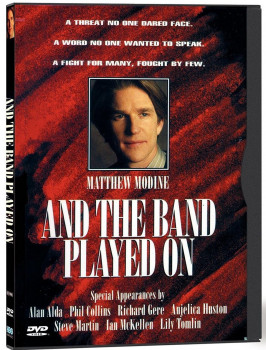
The late journalist Randy Shilts is probably best known for his 1987 masterpiece, And the Band Played On: Politics, People, and the AIDS Epidemic, a staggering piece of reportage that unearthed the particular ways that neglect, apathy and incompetence combined to cause the AIDS epidemic as much as HIV itself.
While many people know Band as a book or the 1993 TV movie that followed, fewer know about the life of the man who produced the work and who died of AIDS-related illness in 1994 at age 42.
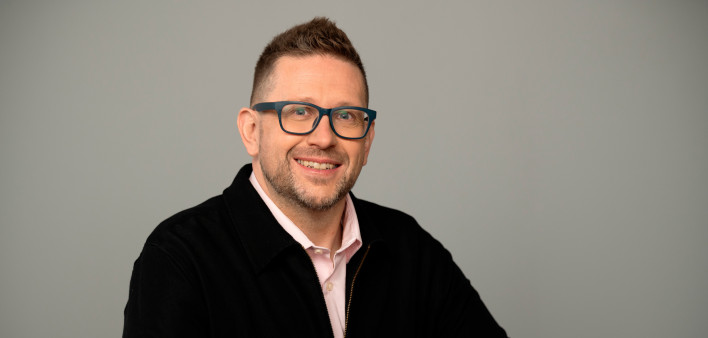
In a new biography titled When the Band Played On: The Life of Randy Shilts, America’s Trailblazing Gay Journalist by writer, researcher and educator Michael G. Lee, PhD, Shilts himself becomes the story.
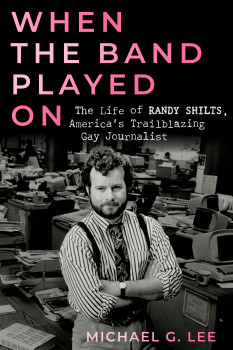
“And The Band Palyed On, The Life of Randy Shilts, America’s Trailblazing Gay Journalist”Amazon.com
Here, Lee discusses not only the rich past he mined to write When the Band Played On but also how Shilts’s work as well as Lee’s own can help people navigate the newest unfolding chapter in the AIDS crisis.
How did you first encounter Randy Shilts?
Being a child of the ’80s, And the Band Played On was ubiquitous. I was 10 years old when that book came out. From that time forward, I was aware of the book as it’s related to the AIDS epidemic because that was a frightening part of the coming-out experience for people in my generation.
In terms of Randy himself, by the time I got to my PhD program, I’d read And the Band Played On a couple of times. I’d also read The Mayor of Castro Street [a 1982 biography of Harvey Milk by Shilts]. The impetus for the project really came from the research I was doing as a doctoral student at the University of Minnesota, where I had the opportunity to do historical research. I wanted to look at the history of gay and lesbian community services before the AIDS epidemic in 1981 because I’d worked in AIDS organizations for several years.
People at those groups had talked about And the Band Played On and how much it helped to explain the political nature of human services and outreach and education. But there wasn’t a lot documented about how the gay activist tradition had informed the creation of AIDS groups in the ’80s. I wanted to look at what was happening between Stonewall [in 1969] and the advent of AIDS that would have informed their creation.
I was looking at back issues of The Advocate from the 1970s. They were producing some of the most in-depth and well-sourced articles on pandemic-level conditions in urban gay communities, especially around alcoholism, drug abuse, sexually transmitted diseases, social isolation, loneliness: everything that we later recognized as the comorbidities around AIDS. And it was Randy writing about these as a freelancer.
I wanted to find out more about how he came to recognize these conditions, and I wondered what his biography said, and at the time, I couldn’t find one. Andrew Stoner, PhD, was doing an academic biography of Randy based on his dissertation. He published his academic biography of Randy in 2019 and unfortunately passed away in 2022. But the larger life story of Randy, the more intimate story, the one that would connect the details of his intimate personal life, his developmental milestones, his intimate relationships had not been done yet. In 2012, I decided to make that my project after I finished my dissertation, and then it became the next 10 years of my life.
I went in not particularly pro-Randy or anti-Randy, and I’m well aware there are plenty of people out there who are strongly critical of him. I just wanted to understand what it was in his background that led him to be sounding the alarm on these conditions half a decade before we realized there was this new epidemic.
Can you talk about this as a biography of a famous reporter but also as someone who was living with HIV?
It’s a very important part of his lived experience, without a doubt. I think it was important for me to be in touch with the influence of trauma on his life, both before and after contracting HIV, in the period when he was writing And the Band Played On, knowing that he had been tested [for the virus] but waited to receive the results until he finished the manuscript. That’s an enormous amount of pressure.
There’s a famous criticism of And the Band Played On, highlighted in the 2017 book Patient Zero and the Making of the AIDS Epidemic by historian Richard A. McKay. It centers on the depiction of Canadian flight attendant Gaetan Dugas as the main vector of HIV transmission in America. How did that stain on Randy’s legacy inform your work?
I wanted to go back to the beginning and see where that story started for Randy and trace his path to see how it became what it became. What I found was that he first learned of Gaetan out of his interviews with Selma Dritz, MD, MPH, who was the then-retired director of epidemiology for the San Francisco Department of Public Health.
And it came about, as I followed in his notes, her describing her frustration and exhaustion and remembering all of the gay male patients that she had met who had since died. Out of that came her frustration with what Randy first describes in his notes as “Montreal.” What that evolved into was Dritz sharing some of her published research that labeled Gaetan as the so-called Patient Zero of that one study.
Randy took an interest in it and shared with his editor, Michael Denneny, that all of a sudden he started hearing across the country from his sources of more and more people who had known and been connected to this mysterious figure. Denneny bears some responsibility for this too.
Denneny saw Gaetan as a representational figure, like a gay everyman of the ’70s, liberated by his sexuality and struggling to change in the face of this new reality. And with Denneny’s encouragement, Randy built up this story around Gaetan that allowed him to be this larger-than-life figure. Denneny said to me, point-blank, “Blame me, not Randy for that.”
What do you think both And the Band Played On and your book have to tell us about where we are currently in the HIV epidemic?
His books collectively offer some important lessons about the power that marginalized communities can claim for themselves, especially in working in collaboration, especially in speaking truth to power against major systems.
With And the Band Played On, when I was working on my research and writing during the COVID-19 lockdown, it felt like the band was playing again, only faster. With respect to public health information and misinformation, it shows how easily the systems that we created can be abused by partisan political forces.
With respect to my book, it’s an important reminder on all these pieces. It adds in some important pieces around the enduring influence of trauma both at the individual and the community levels. It even shows some of the dangers of any one of us thinking that we can be the “hero” of our movement. We have to take care of ourselves. We have to recognize our own limitations, ask for help and work across our differences to try to regain the power that we’ve lost.
We’re in a perilous moment. The CDC [Centers for Disease Control and Prevention] has removed important information from its websites. Those archives still exist, but at the same time, we’re in this age of information. We’re going to have to learn how to create new communication channels that, unfortunately, leave our federal government on the sideline, because it’s trying to impose its own ideology on the rest of us. They can’t stop us from talking to each other.
Hopefully, putting out the book at this time is a reminder of the power that we can claim for ourselves.


Comments
Comments