

I discovered How We Named the Stars by Andrés N. Ordorica last year. I chose the novel on a whim, picking it because it was written by a queer Latiné writer, and I’m a queer Latiné writer.
I didn’t expect this beautiful book to affect me the way it did. How We Named the Stars touched a part of me that I thought had long died. It was as though Ordorica reached into my soul to light a hopeful candle, reminding me of true love, the hope that it brings and the power of family.
The novel is a portrait of Daniel, a Mexican American college student from an immigrant family, who moves cross-country to attend an elite East Coast university. He meets his roommate, an all-American golden boy named Sam, and, after some awkward interactions, the two fall in love. The book ties together themes of first love, coming of age, family and connections to history.
Ordorica also introduces AIDS into the story in a beautiful way. The character of Daniel is named after Daniel’s deceased uncle in the novel, who was very active in AIDS causes during the 1980s and ’90s.
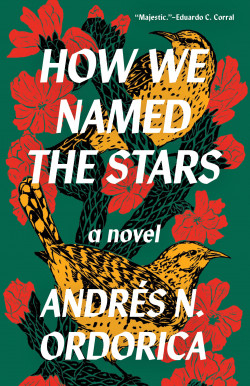
“How We Named the Stars” by Andrés N. Ordorica
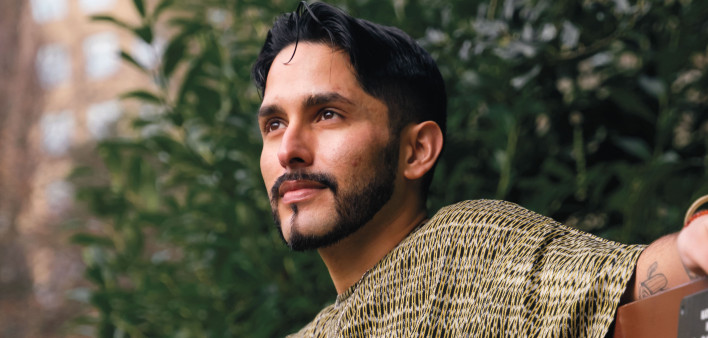
POZ caught up with the 36-year-old writer, who lives in the United Kingdom with his husband of 11 years, to learn more about the poet and novelist.
Where did you grow up?
I am a third-culture kid, having spent the majority of my life outside of the United States. I grew up between Europe, the Middle East and Asia due to my father’s career.
Where do you live now?
I have been living in Edinburgh for the past seven years; in total, I have lived in the United Kingdom for 13 years of my adult life and am now a dual citizen. I still have remnants of a Californian accent, which was shaped by my parents while growing up overseas, but beyond that, most of my life has been lived away from the United States. I guess that is why I have chosen to build a life here in Scotland.
Family is such an important part of the book. Tell me about yours.
I am one of four children. My parents were very young parents, which was always funny, especially when I entered university and many of my friends’ parents were nearer to my grandparents’ age. My parents were, and still are, very loving parents who supported my precocious ambitions.
What was it like to travel so much as a kid?
I have many happy childhood memories. I was a very bookish child and interested in reading, art and history. Growing up as I did was a lovely experience and truly unique. Often, I would be studying something in world history that was very much related to the place I called home at the time, be it Roman ruins in the English countryside or preserved Byzantine mosaic floors in a Turkish village’s central plaza. From an early age, I sensed there was a story alive and well all around me.
When did you know you wanted to be a writer?
I have been deeply in love with storytelling from a young age, so there was never an aha moment. I think it was more of working backward from the idea “I want to be a writer,” of figuring out what that means practically. From the age of 5, I knew I wanted to write, and over the next 30 years, it has been a matter of learning what that looks like.
I double majored in English and drama in my undergrad, and then, I immediately went to graduate school in London at the Royal Central School of Speech and Drama to study playwriting. While in my graduate studies, I began to freelance as a theater critic for a few online magazines, and that informed my understanding of writing efficiently and informatively. I began to write poetry in secret when I should have been working on plays. Nowadays, I would consider myself a poet and novelist, and I feel my practice holds space for both in equal measure.
The love story in How We Named the Stars is so beautiful. Would you consider yourself a romantic?
I wouldn’t say I am interested in romance in any grand sense. However, I do feel love and loss are central themes across all my writing. I think there is a difference between love and romance. Love is fraught, malleable and can evolve, whereas romance feels too much for show. I am more interested in the smaller moments, how one person might help the other handle an unexpected and life-changing moment, how two people greet the dawning of a new day.
What was the impetus for How We Named the Stars? How long did you work on it?
Daniel and Sam, in essence and texture, were very much the same from first draft to the final novel now out in the world. The impetus that led me to find them was a means of coming to terms that I was nearing my 30s and still processing the death of a friend who profoundly shaped my first few years of college life.
The structure and storytelling mechanisms shifted and reshaped themselves many times before landing on the narrative flow that felt best for their story, which was not mine. I wanted to inform the characters of my loss, but I did not want to write autofiction.
There was even a version in which Tío Daniel was much more present, and, in what is the first part of the novel, chapters were jumping between Chihuahua, Mexico, of the ’80 and ’90s and his nephew’s college experience—probably a means of moving from my own story. But it became unwieldy and was not serving the heart of the story, which ultimately is Daniel and Sam’s relationship changing from roommates to something deeper and richer.
However, I was able to leverage many of those chapters of Daniel’s uncle into the diary entries that open each chapter of How We Named the Stars. But all in, I would say it took nearly six years to work on this novel, not always continuous work, but still, it needed that time.
What has been the reaction?
On both sides of the pond, the reaction has been very generous, much more so than I could have imagined. It has had some beautiful write-ups in places I could never have dreamed of, such as The New York Times Review of Books, and was named one of the best top 10 debut novels by The Observer.
On a personal level, the reaction from readers who have championed Daniel and Sam has been unreal. I feel truly honored by every reader who has read it and shared it and shouted about it. Frequently, I receive private messages and emails in which readers have shared very generously their own experiences of loss, especially loss in early adulthood. To have written a story that elicits this type of response is not anything I could have ever planned for.
I felt very called to write about AIDS activism.
Family is such an important element in the book, not only Daniel’s but Sam’s family and even how Sam and Daniel become family for each other. How important is family to you?
For me, portraying family dynamics just feels an obvious task to take on. I am one of four children. My mom is one of five, my dad is one of seven, so I have a lot of cousins. I don’t think I could have written a novel that doesn’t explore family relationships in some way, and I think at the age Daniel and Sam are in the book, they’re using their families as reference points: How to fall in love, how to care for someone, how to articulate intense feelings.
I think in the first half, this is done while living away from their parents for the first time as freshmen in college, and then in México, Daniel’s grandfather and extended family help guide him through his first heartbreak before the onslaught of first loss comes rushing toward him. So family feels like an essential secondary and tertiary character.
How like you is Daniel?
I wouldn’t say I am like Daniel at all. For all his aloofness and doubts, Daniel is far more brave than I ever was at that age, and I did not have any great love in my undergraduate life. Daniel’s empathy and how much he values friendship are probably the closest traits he shares with me.
I love how Daniel discovers so much about himself through the story and his connection to his uncle. Why did you connect Daniel to his uncle?
So much of the novel is heavy, especially the latter half, and it felt vitally important for Daniel to have someone to turn to, even if that person was no longer here. His uncle’s life and subsequent diary entries become both a salve and compass for young Daniel. For me, that mentorship and guidance from a queer elder felt necessary given a story about navigating first love and first loss.
You handled HIV in the story so well. Why was it important to include HIV in the story?
This is such an interesting reading of Tío Daniel, because in all honesty, I do not mention HIV. The only thing the reader gets is that Tió Daniel became very active in local AIDS activism before his untimely death. So I don’t want to claim something that is not there for me as a writer, especially when there are other writers who tackle HIV and AIDS head-on, with such generosity and truth. But I felt very called to write about AIDS activism in Latin America, specifically in a Mexican context, because I grew up in a way of seeing it through a North American and British lens.
Much of the context that informed this subplot of the novel came from the amazing work which shaped the exhibition The Seropositive Files: Visualizing HIV in Mexico and its subsequent text written by Alejandro Brito Lemus, Oliver Debroise, Sol Henaro, Luis Matus, Alfonso Morcillo and Rosa María Roffiel (Museo Universitario Arte Contemporáneo, UNAM, 2020).
As a queer brown Mexican, it felt vitally important to me to highlight that AIDS activism was not solely a Western story and that work was occurring throughout the global majority, and thus the research of these scholars, artists and curators helped to inform my understanding of what activism looked like in México at the time Tío Daniel would have been alive.
Do you think it’s important for queer writers to include HIV in modern stories?
I think if it is relevant to the story or the world in which the writing exists, then yes. I am thinking of brilliant novels, like Edmund White’s The Married Man or Andrew Holleran’s Dancer from the Dance and one of my all-time favorite contemporary novels Rainbow Milk by Paul Mendez.
In these novels, it is either dealt with head-on or lingers in the background but is done so skillfully, without ever becoming polemic. With the advent of pre-exposure prophylaxis (PrEP), it is easy to forget how stigmatized HIV was and still can be. From a storytelling perspective, I think it is important that we remind young queer people of what it was to live through the AIDS crisis and how it fundamentally shaped the gay rights and larger queer liberation movement. Ultimately, it is our history and our stories to tell.
How does your own history inform At Least This I Know and the rest of your work?
At Least This I Know is my debut poetry collection, which was published in 2022. It has been described as a memoir in poetic form, which I think is a lovely assertion. It explores themes of faith, sexuality, race and concepts of home. I like to draw from life, and so I think my practice is always being informed by my own personal histories.
Tell me about Holy Boys, your most recent work.
My sophomore collection, Holy Boys, explores faith and masculinity and is much more experimental than my debut. For me, it is a collection that speaks in close communion with the work of other poets, including my all-time favorite poet, the great, late Edwin Morgan. He was one of the finest linguistic poets to be working in the 20th century, gay during a difficult time in Scottish history. His body of work is immense. “By the Fire” is the most beautiful poem that I have ever come across, and its closing couplet serves as the epigraph to Holy Boys.
What’s next for you?
Right now, I am not working on anything. I have been working straight through from 2018 to late spring of 2025 on major writing projects between poetry and prose, and I feel that I need to go and be in the world for a bit. If anything, I am working on my garden. That connection with the land and nature is helping me reconnect to my writing practice.
How We Named the Stars is available wherever you buy books. To learn more, visit andresadorica.com.



Comments
Comments