

Those who know me know that I’m obsessed with Keith Haring—his art, his activism and everything he represents culturally. He was more than a visionary artist; he was a truth-teller who made HIV visible through bold lines and public murals at a time when silence was deadly. With this year’s relentless attacks on science, LGBTQ rights and public health, I’ve often found myself wondering: What would Keith Haring draw right now? What would he say in this moment of crisis?
But I didn’t expect him to show up in Rwanda.
And yet, there he was in Kigali—his unmistakable imagery projected on screen during the opening plenary of IAS 2025, the International AIDS Society’s 13th IAS Conference on HIV Science, which took place in Kigali from July 13 to 17. Haring was invoked by the remarkable Dr. Linda-Gail Bekker, CEO of the Desmond Tutu Health Foundation and director of the Desmond Tutu HIV Centre. She wasn’t just referencing art. She was reigniting memory—calling back to an era when advocacy was raw, loud and often lifesaving. She reminded us that the HIV movement was forged in fire—in the United States and South Africa alike—and that very fire is burning again in 2025.
For me, that reference was a turning point. I traveled from Washington, DC, to IAS 2025 expecting to feel hopelessness and despair. The headlines leading in were bleak: budget cuts, rising stigma, stalled progress. But that moment—Keith Haring, advocacy, resilience—was the injection of hope and inspiration we all needed. It landed in the room like a jolt of electricity. We carried that energy through the rest of the week. And boy, did it feel good.
Advocacy Is Back—And It’s Multigenerational
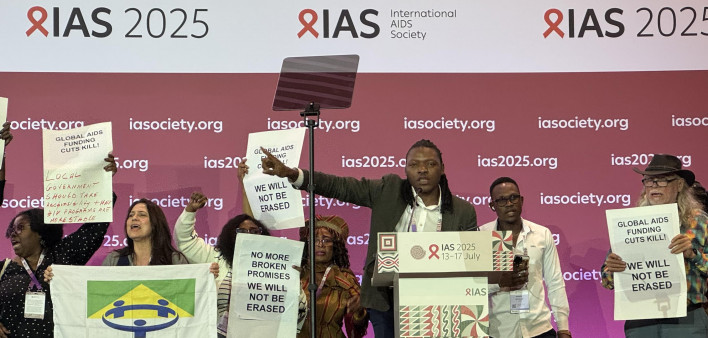
IAS 2025 wasn’t just about showcasing progress in the lab. It was about momentum in the streets. Veteran activists who helped launch the global HIV response are returning to the fight. And they’re linking arms with a new generation of advocates: young, global, unapologetic and digitally fluent. From Johannesburg to New York, Lagos to Oakland, the message is clear: We will not be erased. We will not go back.
Not back to invisibility. Not back to criminalization. Not back to fragmented responses that ignore the needs of the most marginalized.
This is a movement that has always known how to make itself seen and heard. And in 2025, that fire has been reignited in direct response to the Trump administration’s dangerous attempts to dismantle decades of progress. Activists have carried coffins to the State Department, staged die-ins and protests in the halls of Congress, and reignited the streets of South Africa—not for nostalgia, but for survival. That same uncompromising spirit pulsed through Kigali.
Sessions throughout the week uplifted voices too often left out of decision-making: sex workers, gay men, transgender leaders, people who use drugs, migrants and young people living with HIV. They weren’t just included—they were leading.
There were raw conversations about the fragility of progress, about how easy it is for global momentum to stall when politics, prejudice and poverty collide. But there was also urgency—and unity. From community-led research to self-care AI powered models tailored to key populations, the message was clear: communities are the frontline, not the afterthought.
Proof: Advocacy Is Delivering Wins
As activists gathered in Kigali, the U.S. Senate handed the HIV movement one of its biggest legislative wins of the year. Lawmakers removed the President’s Emergency Plan for AIDS Relief (PEPFAR) from the Trump administration’s proposed $9.4 billion rescission package—defying pressure to gut one of the world’s most successful global health program.
The $400 million in proposed cuts to PEPFAR wasn’t just another budget line. Its removal was a signal. Bipartisan support for HIV programs remains strong, even in a polarized political climate. And it reinforced what we already know: sustained advocacy—loud, strategic and unrelenting—can still change the course of policy.
More importantly, it signaled that despite deep divisions, Congress still draws a line when it comes to dismantling HIV and AIDS programs that save lives.
Science Is Moving
Alongside the political victories, the HIV science made headlines too:
- Merck’s announcement of a Phase III trial for its long-acting once-monthly HIV prevention pill marks a major milestone, answering years of community calls for expanded options beyond daily oral pre(PrEP).
- Gilead’s new supply agreement with the Global Fund offers promise that life-saving HIV treatment and prevention tools will hopefully reach more people, more affordably.
- ViiV Healthcare’s expanded voluntary licensing deal with the Medicines Patent Pool is a step toward broader access to long-acting cabotegravir in low- and middle-income countries.
- The World Health Organization released new guidance endorsing twice-yearly lenacapavir as an additional option within combination HIV prevention strategies, signaling growing momentum for long-acting tools in the global response.
None of these developments happened in a vacuum. They were catalyzed by advocates and scientists who showed up at congressional hearings, on panels, in protest and behind the scenes to insist that science without access is not progress.
Taken together, these announcements—and the collective energy behind them—made IAS 2025 a historic conference. I believe it belongs in the same breath as Vancouver 1996, when HIV treatment changed the course of survival; Durban 2000, which exposed global inequities in access and put Africa at the center of the response; and Vienna 2010, when PrEP emerged as a game-changing prevention tool. These were moments when science, policy and activism collided to change the trajectory of the HIV response—and Kigali now stands proudly among them.
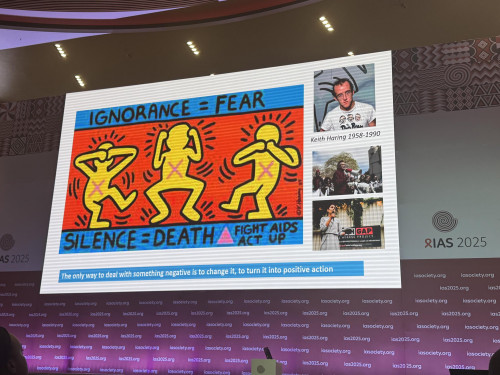
Keith Haring is invoked at IAS 2025 opening plenary.Jirair Ratevosian
And Then There Was Keith
Which brings me back to Keith Haring.
Keith never made it to an IAS conference. When he died in 1990 at the age of 31, there was no such conference as we know it today. There was no PrEP. No Undetectable Equals Untransmittable (U=U). No Global Fund. No PEPFAR. No long-acting injectable to prevent HIV with just two shots a year.
What was there? Stigma. Silence. And a whole lot of death.
And yet, Keith kept drawing.
Keith Haring’s art wasn’t just a response to crisis—it shaped the narrative of the AIDS era. At a time when political leaders ignored the epidemic and the media stigmatized those affected, Haring’s bold lines and radiant figures cut through the silence. He brought the realities of AIDS into the streets, subways and galleries, using accessible imagery to humanize the crisis and mobilize action. His work didn’t ask permission; it demanded attention.
So what would he be doing now?
Maybe he would be sketching vaccine syringes and PrEP pills on buildings in Los Angeles and Nairobi—transforming biomedical tools into bold symbols of hope. He’d be using public art to make complex science visible and human, cutting through stigma with color and clarity. And he’d be collaborating with young, queer, Black, brown and trans artists to amplify new voices and reimagine what access and equity in HIV prevention can look like.
More than anything, he’d be telling us: don’t look away.
The Work Continues
This year’s IAS Conference reminded us that advocacy is not a relic of the past—it’s our most powerful tool for the future. The movement is alive. The fire is burning. And from Kigali to Congress, from clinics to community centers, from art to action, the message is clear:
We’re still here.
We’re not going back.
And we’re not done yet.
Jirair Ratevosian, DrPH, is a Hock Fellow at the Duke Global Health Institute and a Non-Resident Global Health Policy Expert at the Center for Strategic and International Studies.


1 Comment
1 Comment