

March 17 through March 21, 2025, is the 23rd annual LGBTQ Health Awareness Week. This year’s theme is “Health Equity NOW!” It’s a call to improve health care access and outcomes for the LGBTQ community, notably regarding HIV and sexually transmitted infections (STIs).
“As policies and funding shift, threatening the health of some of our most vulnerable communities, unwavering commitment to protecting vital services and expanding inclusive care must remain a priority,” wrote the National Coalition for LGBTQ Health, which organized the awareness week. “This week is an opportunity to engage with organizations conducting crucial health equity work, to inform the public about the importance of LGBTQ+ health and to unite providers, LGBTQ+ communities and allies for the advancement of real solutions that remove barriers and improve health for us all.”
The 23rd National LGBTQ Health Awareness Week is now! Demand Health Equity NOW! For more info visit: healthlgbtq.org/awareness-week.#LGBTQHAW25
— Inland Oasis (@inlandoasis.bsky.social) March 18, 2025 at 12:20 PM
[image or embed]
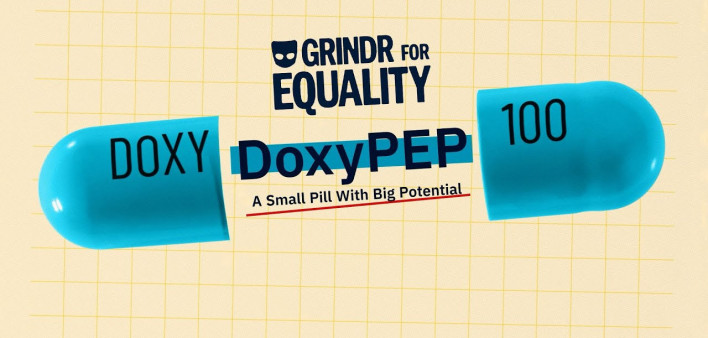
One such ally is gay dating and hookup app Grindr, which launched a new in-app feature to coincide with National LGBTQ Health Awareness Week that allows users to include profile tags to indicate that they use doxyPEP and/or condoms. What’s more, Grindr for Equality’s new video series, The Equality Spotlight, launched with the primer “DoxyPEP—A Small Pill With Big Potential.” (You can watch the video at the top of this article and on YouTube.)
DoxyPEP refers to the use of doxycycline, an antibiotic, as post-exposure prophylaxis after sex to prevent STIs. It involves taking a single dose within 72 hours after anal, vaginal or oral sex. For more, see DoxyPEP 101. Last summer, the Centers for Disease Control and Prevention issued clinical guidelines for using doxyPEP. At the time, POZ science editor Liz Highleyman wrote:
“The new guidelines are supported by findings from the doxyPEP trial, first presented at the 2022 International AIDS Conference. The study enrolled more than 500 men and transgender women who have sex with men at public health clinics in San Francisco and Seattle. About a third were living with HIV and the rest were taking PrEP [pre-exposure prophylaxis]. They were randomly assigned to receive a single dose of oral doxycycline within 72 hours after condomless sex or standard care, which is regular testing and treatment after an STI diagnosis.
“The study was halted ahead of schedule after an interim analysis showed that doxyPEP significantly reduced STI incidence. For people with HIV, doxycycline reduced the risk of acquiring gonorrhea by 57%, chlamydia by 74% and syphilis by 77%. For those taking PrEP, the risk reduction was 55%, 88% and 87%, respectively. The French IPERGAY and DoxyVAC studies also showed that doxycycline reduced the risk of chlamydia and syphilis, though the medication and a vaccine were less effective against gonorrhea. DoxyPEP failed to significantly reduce the risk of STIs in a study of cisgender women in Kenya. Although doxycycline appeared to reach adequate concentrations in vaginal and cervical tissue, many participants reported suboptimal adherence.
“Earlier this year, public health experts from San Francisco—which issued the first local doxyPEP guidelines in October 2022—reported that implementation has already contributed to a reduction in STIs in the real world.”
It should be noted that because doxycycline is an antibiotic, meaning it only fights bacteria, it is not effective against viral infections, including HIV, human papillomavirus (HPV), herpes simplex and mpox (formerly monkeypox).
This year’s National LGBTQ Health Awareness Week includes a Wednesday, March 19, webinar at 3:30 p.m. ET titled “Initial Findings From the Third Annual State of LGBTQ Health National Survey.”
At 1 p.m. ET Thursday, March 20, Kathleen A. McManus, MD, will host another webinar, titled “Improving Patient-Provider Relationships with LGBTQ Patients Living with HIV.”
Visit HealthLGBTQ.org for more details as well as a social media tool kit and graphics you can download and share to get the word out about LGBTQ Health Awareness Week.


Comments
Comments