

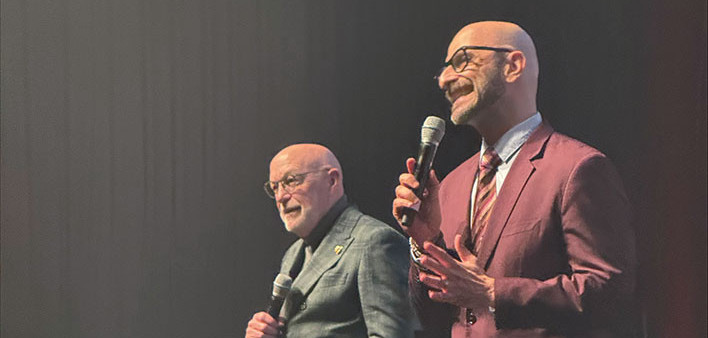
A leading national expert on HIV and LGBTQ health, Demetre Daskalakis, MD, MPH, has a new position as chief medical officer at Callen-Lorde Community Health Center in New York City. He is also serving on NYC Mayor Zohran Mamdani’s transition committee on health. Most recently Daskalakis was director of the National Center for Immunization and Respiratory Diseases at the Centers for Disease Control and Prevention (CDC), a position from which he resigned in protest last August after CDC director Susan Monarez, PhD, was ousted for clashing with Health Secretary Robert F. Kennedy Jr. over vaccine policy. “As I move on to the next phase of my career, I will continue to advocate for the values that have always driven my work—science, data and evidence-based solutions to public health challenges,” he wrote in his blistering resignation letter.
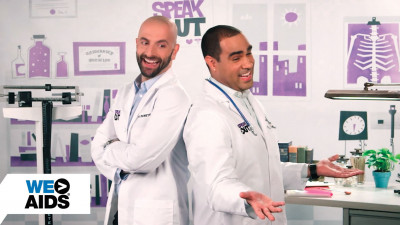
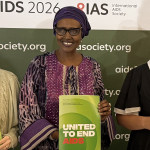
Demetre Daskalakis and David MalebrancheCourtesy of Greater Than AIDS
Daskalakis started his career in HIV as a frontline physician. In 2006, he founded the Men’s Sexual Health Project, which offered HIV and sexually transmitted infection testing at sex clubs and bathhouses. He was named deputy commissioner for the Division of Disease Control at the New York City Department of Health and Mental Hygiene in 2013, and he became the director of the Division of HIV/AIDS Prevention at the CDC’s National Center for HIV/AIDS, Viral Hepatitis, STD, and TB Prevention in 2020. Two years later, he was tapped to co-lead the White House response to the mpox outbreak.
Widely acclaimed for his intimate knowledge of and connection to the communities he serves, Daskalakis is not shy about putting his identity as a gay man front and center. He recently spoke with POZ about his new job and the ongoing national turmoil affecting public health.
Congratulations on your new position! Tell us a bit about what Callen-Lorde does and what the new job entails.
Callen-Lorde, at its core, is a community health center. They have three clinics, in Chelsea, Brooklyn and the Bronx. It’s very specifically focused on the LGBTQ+ community as well as the community of people living with and at risk for HIV. With a history dating back to the Stonewall uprising, it’s the nation’s preeminent LGBTQ health provider, and its approach is emulated in other places.
First, I’m seeing patients again. I did see patients while I was at the CDC in Atlanta, but, because my job was so crazy, I wasn’t able to do longitudinal care. At Callen-Lorde, my job is to supervise the entire medical team and work with CEO Patrick McGovern and others on key policy issues. It’s not just about HIV but about a bigger vision of LGBTQ health.
What are some of the advantages and drawbacks of returning to local work versus working at the national level?
I left the national work because I think that you can’t get anything done there. The way the current administration is treating its health agencies, there’s very little you can do to effect change. That’s where my grassroots gene kicked in and made me look at the opportunity at Callen-Lorde as a chance to go back to the front lines and be a better advocate for policy instead of toeing a line. I drew the line at toeing a line that I thought was unethical and immoral. A lot of the value I’ve added is understanding what happens at the front. I’m looking at this as a great opportunity to flex that muscle. I’m excited to be an advocate again and speak up in a different way than you can when you’re in government.
What does losing culturally competent health leadership at the national level mean, especially for the South?
We’ve learned that things that happen closer to the ground are more impactful and less easily destroyed. The disparity in the South is going to get worse before it gets better, but if they pull the plug on Ryan White, even cities like New York and San Francisco and Los Angeles are going to be in trouble. A lot of people with consequential voices are leaving national government, but the front line is going to hold it down and keep things going for when the time comes to reimagine what this all looks like. I think it’s going to feel a bit like the late ‘80s and early ‘90s, because we’re going to need some pretty loud activism.
While working on mpox and vaccine policy at the national level, you were criticized for your unapologetic presentation. Did that hamper your work?
There’s the avatar of what folks say about me, and then there’s the reality of what my everyday looks like. If I were worried about right-wing attacks, I’d be in the corner of my apartment crying, but I don’t care. Still, sometimes you need to know when you’re not the voice. In the HIV and LGBTQ space, I’m a trusted messenger. When I went to the White House to do mpox, my job was to actually use my identity to do good public health. But that voice may not always be me. When I was doing measles work with the Hasidic community in New York City, the Orthodox Jewish Women’s Medical Association and the Orthodox nurses became the voices—they just needed the support of public health to get the information and funding to do the work. Like Kenny Rogers says, “You got to know when to hold ‘em, know when to fold ‘em.”
What are your thoughts about the recent changes at the CDC?
There’s been an active effort to dismantle public health. At the CDC, they’ve created this Swiss cheese with gaps that have left us less prepared than we were during the COVID-19 pandemic. This administration has put everyone on notice that if you don’t agree with their policies, you’re at risk for losing your funding. They made a very clear statement by saying that CDC no longer supports harm reduction or “gender ideology” or DEI [diversity, equity and inclusion]. So much of public health—which is to make sure that everyone has the best shot at achieving their optimal health—is going to be harder to do. It’s like taking a giant leap backward.
How will the changes at the CDC and other federal health agencies affect efforts to end the HIV epidemic?
The president’s budget is, first and foremost, a moral document, and it communicates the priorities of the administration. We’re at a place where HIV intervention services, the dental program, AIDS education training centers, the entire CDC division of HIV prevention are potentially on the chopping block. We’re seeing historic cuts that mean that a lot of people living with HIV are not going to be able to use Medicaid services. We have all this technology and new interventions to end the HIV epidemic, but it’s really just been thrown in the garbage. Local health departments are in suspended animation. The administration is erasing whole swaths of at-risk populations, including transgender folks. Everybody has been working so hard to connect them to HIV services, and they’re being given signals that their health doesn’t really matter. It also means a talent and brain drain because people are leaving public health leadership. All of us doing work in the HIV and LGBTQ space are on the short list because someone is going to think it’s more important to get rid of wokeness than to end HIV.
At this stage in your career, what makes you hopeful for the future?
Back to Callen-Lorde, Michael Callen was one of the coauthors of the Denver Principles, which was all about “nothing about us without us.” Coming back to New York, I’m excited that the new administration seems very interested in leading with the key social factors that are so important in public health. I’m coming with a lot of experience, and I hope that I get to be a resource. Some pretty aggressive action is going to be needed to make sure that we don’t fail our community of people living with and at risk for HIV.
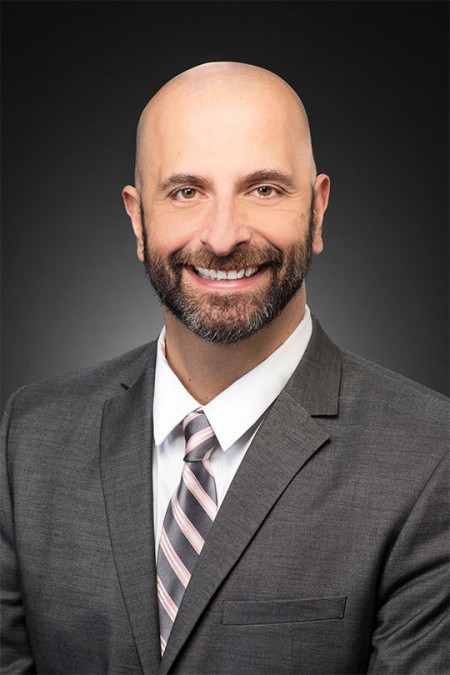
Demetre DaskalakisCourtesy of Demetre Daskalakis


Comments
Comments