

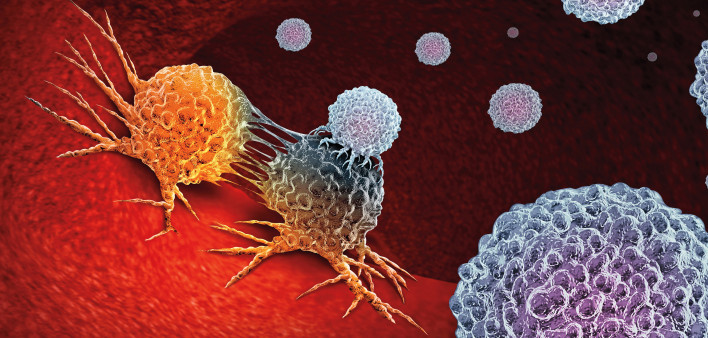
New studies add to the evidence that immune checkpoint inhibitors are safe and effective for people with HIV and cancer. What’s more, a growing body of research suggests that this type of immunotherapy could also play a role in a functional cure for HIV.
As people with HIV live longer thanks to effective antiretroviral treatment, cancer has become a leading cause of morbidity and mortality. HIV-positive people are at increased risk for certain cancers compared with the general population—even if their HIV is well controlled—but they have traditionally been excluded from clinical trials of new treatments.
Checkpoint inhibitors, the most widely used type of immunotherapy, are a breakthrough in treatment for several types of cancer. These monoclonal antibodies interfere with receptors on immune cells that regulate immune response. For example, drugs that block PD-1 or its binding partner, PD-L1—such as Keytruda (pembrolizumab)—can restore lost T-cell activity, while those that block CTLA-4—such as Yervoy (ipilimumab)—promote T-cell multiplication.
Prior studies of checkpoint inhibitors for people with have been encouraging, but more data are welcome. In one recent analysis, published in the journal AIDS, Anna Coghill, PhD, MPH, of Moffitt Cancer Center in Tampa, and colleagues compared the safety and effectiveness of immune checkpoint inhibitors in 24 people with HIV and 24 HIV-negative patients.
The overall response rate—indicating tumor shrinkage—was a bit lower for people with HIV relative to HIV-negative people (29% versus 38%), but the difference was not statistically significant, meaning it could have been due to chance. Overall survival rates were similar for HIV-positive and HIV-negative patients (63% and 67%, respectively). The frequency of adverse events also did not differ significantly by HIV status.
“These findings suggest that HIV status alone should not preclude use of immune checkpoint inhibitor therapy to improve prognosis among people with HIV and cancer,” the study authors concluded.
In a second study, published in The Oncologist, Florence Brunet Possenti, MD, PhD, of Hôpital Bichat-Claude-Bernard in Paris, and colleagues looked at real-world outcomes among 54 HIV-positive people with aggressive skin cancers who received checkpoint inhibitors. Overall response rates were 43% for people with melanoma, 58% for those with cutaneous squamous cell carcinoma and 75% for those with Kaposi sarcoma. Immune-related adverse events occurred in 43% of patients, rising to 65% for the 17 people treated with both Opdivo (nivolumab) and Yervoy.
“These findings support managing well-controlled people with HIV similarly to the general population and highlight the importance of including this population across all settings of skin cancer trials,” the authors concluded.
In a third study, published in MDPI Pharmaceuticals, Wedad Nageeb, of the University of Tabuk in Saudi Arabia, and colleagues performed a systematic review of outcomes among HIV-positive people with non-small-cell lung cancer (NSCLC) treated with PD-1 or PD-L1 checkpoint inhibitors. They searched PubMed and other databases through January 2025, identifying six relevant studies with a combined total of 762 patients, most of whom were on antiretroviral therapy with viral suppression. They were treated with Keytruda, Opdivo, Tecentriq (atezolizumab) or Imfinzi (durvalumab).
Progression-free survival and overall survival outcomes and adverse event rates varied widely across the included studies, but the researchers concluded that efficacy outcomes were “encouraging” and aligned with those seen in the general lung cancer population.
“These data indicate that, when appropriately selected, people with HIV with NSCLC may derive comparable survival benefits from immune checkpoint inhibitors as their HIV-negative counterparts,” they wrote. “While immunotherapy should not be withheld based solely on HIV status, better standardization in reporting HIV-related variables is needed to optimize patient selection and management.”
Likewise, Malte Benedikt Monin, MD, of the Centre for Integrated Oncology in Germany, reviewed medical literature on outcomes among HIV-positive NSCLC patients treated with checkpoint inhibitors, identifying five relevant studies. As described in HIV Medicine, response rates and survival outcomes were similar to those for HIV-negative people, and the risk of immune-related adverse events was also comparable. Importantly, no significant effects of checkpoint inhibitors on HIV viral load or CD4 count were reported.
One unusual case appears to confirm that checkpoint immunotherapy does not compromise control of HIV. California resident Loreen Willenberg, an exceptional elite controller, is thought to be cured of HIV without a bone marrow transplant, having maintained control of the virus for decades without antiretrovirals. (Read POZ’s profile in the March 2021 issue.) Despite recent treatment with Keytruda for lung and brain tumors, Willenberg still has no evidence of intact HIV, according to a report in Science.
In fact, checkpoint inhibitors may actually help promote control of HIV, and they are being studied as a potential HIV cure strategy. CD8 killer T cells fight HIV as well as cancer, and the PD-1 receptor is heavily expressed on exhausted T cells that have lost their functional ability. PD-1 is also expressed on CD4 helper T cells that harbor hidden HIV and may play a role in maintaining viral latency.
More and more studies are finding that drugs that block PD-1 may help reduce the viral reservoir and delay viral rebound after stopping antiretrovirals. In one small study, for example, six out of 11 people who received the investigational PD-1 inhibitor budigalimab experienced slower viral rebound during an analytical treatment interruption, including two who maintained viral suppression for more than a year.
Click here for more news about HIV and cancer.
Click here for more news about HIV cure research.



Comments
Comments