

The Supreme Court this week declined the Trump administration’s request to continue withholding billions in foreign aid funding, but the fight may continue in lower courts, according to CNN. The ruling notwithstanding, much damage to global HIV efforts has already been done. Meanwhile, advocates and health experts are scrambling to assess the fallout and protest the cuts.
The Supreme Court’s 5–4 ruling did not say when the money must be released, giving the White House the opportunity to dispute the decision in lower courts.
CNN Supreme Court analyst and Georgetown University Law Center professor Steve Vladeck, PhD, called the decision “extremely modest."
“The unsigned order does not actually require the Trump administration to immediately make up to $2 billion in foreign aid payments; it merely clears the way for the district court to compel those payments, presumably if it is more specific about the contracts that have to be honored,” Vladeck said. “The fact that four justices nevertheless dissented—vigorously—from such a decision is a sign that the Court is going to be divided, perhaps along these exact lines, in many of the more impactful Trump-related cases that are already on their way.”
In court filings, the Trump administration revealed that it is attempting to terminate more than 90% of foreign aid contracts established through the United States Agency for International Development (USAID), the group that provides civilian foreign assistance.
The United States has long been a global leader in the fight to end HIV with programs including the U.S. President’s Emergency Plan for AIDS Relief (PEPFAR), the largest commitment by any country, ever, to address a single disease. According to the health policy group KFF, about 60% of PEPFAR’s HIV work is made possible through USAID, so demolishing USAID will also destroy PEPFAR.
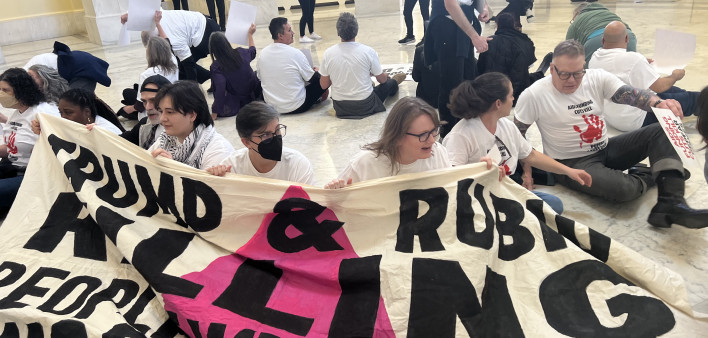
Last week, fired USAID employees and HIV advocates staged a die-in protest at the Capitol office building, according to The Guardian. Protesters wore white T-shirts that read “AIDS funding cuts kill” and chanted “Congress has blood on its hands, unfreeze aid now,” while about three dozen protesters lay down in the rotunda of the Cannon House office building.
About 20 demonstrators were arrested, according to Capitol police.
“It’s very hard to overstate what’s at stake regarding humanitarian assistance,” Asia Russell, executive director of Health Gap, a global advocacy group that fights HIV, said before the protest, according to The Guardian.
An early survey of global PEPFAR implementers found that the first week of the 90-day stop-work order resulted in a “severe” disruption to HIV service delivery for 87% of respondents, according to Global Black Gay Men Connect’s new report, “Frozen Out.” More than 90% of implementers surveyed reported canceling or reducing loss to vital services, including HIV testing, treatment, prevention, follow-up services and more.
View this post on Instagram
What’s more, within one week of the stop-work order, about two thirds of organizations surveyed had terminated staff contracts, and 29% had closed their clinics. The loss of access to these spaces could result in severe health risks and give rise to significant barriers to lifesaving care, especially for high-risk populations.
HIV services aren’t the only humanitarian efforts on the ropes. Leaked memos from USAID and federal workers detail the toll of disrupted U.S. foreign aid. As ProPublica and the New York Times reported, Trump’s USAID closure is expected to result in:
- Up to 18 million additional cases of malaria per year and as many as 166,000 additional deaths;
- 200,000 children paralyzed with polio annually and hundreds of millions of infections;
- 1 million children not treated for severe acute malnutrition, which is often fatal, each year;
- More than 28,000 new cases of such infectious diseases as Ebola and Marburg every year.
Join the fight
On Monday, March 10, the San Francisco AIDS Foundation is holding a Save Our Sciences Rally to Protect HIV Research to support HIV and other research programs facing the Trump’s administration’s attacks on federal funding. The protest aligns with the 2025 Conference on Retroviruses and Opportunistic Infections (CROI) taking place from March 9 to 12, which provides a forum for scientists and clinical investigators to present, discuss and critique their investigations.
View this post on Instagram
To learn more about the conference, go here.
PEPFAR works with partners across 55 countries and to date has saved 25 million lives and enabled 7.8 million babies to be born HIV-free. Since PEPFAR’s establishment in 2003, the U.S. government has invested over $110 billion in the global HIV response.
A fact sheet compiled by amfAR, the Foundation for AIDS Research, highlighted what could be lost each day during funding pauses and pointed out that each day PEPFAR provides:
- More than 222,000 people with HIV meds;
- More than 224,000 HIV tests, newly diagnosing 4,374 people with HIV—10% of whom are pregnant women attending antenatal clinic visits;
- Services for 17,695 orphans and vulnerable children impacted by HIV;
- 7,163 cervical cancer screenings, newly diagnosing 363 women with cervical cancer or precancerous lesions and treating 324 women with positive cervical cancer results;
- Care and support for 3,618 women experiencing gender-based violence, including 779 women who experienced sexual violence.
More than 20 million people around the world rely on the HIV services provided by PEPFAR. The stop work order puts millions of lives at risk. Learn more: www.amfar.org/press-releas...
— amfAR (@amfarofficial.bsky.social) January 27, 2025 at 3:45 PM
[image or embed]


Comments
Comments