

Recent research has consistently found a strong association between loneliness and accelerated or worse aging—whether or not you’re living with HIV. On the happier side, social connection appears to be strongly linked to optimal aging.
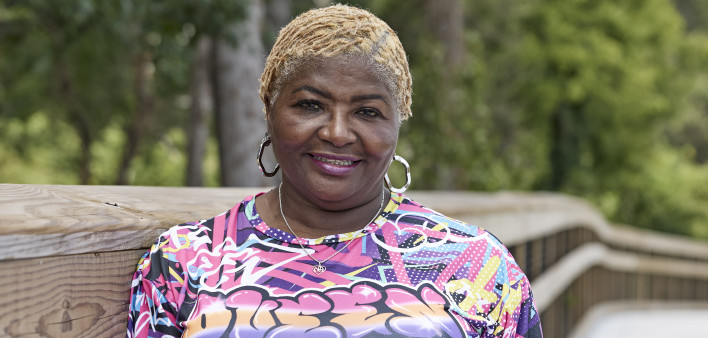
If that’s the case—as it well seems to be—then it appears that Janice Shirley, 61, of Charlotte, North Carolina, has vibrant years ahead of her. Drug-free since 2003 and diagnosed with HIV in 2006, Shirley not only attends daily 12-step meetings, where she has a circle of longtime friends, but she is also involved in countless local and national HIV initiatives. She’s cochair of her county’s Ryan White CARE Act advisory council, sits on NMAC’s National HIV/AIDS Advocacy Network, was a liaison for the Black AIDS Institute and has participated in Common Threads, a personal storytelling project for women living with HIV.
In other words, Shirley doesn’t have a lot of time to sit around moping because she’s constantly engaging with peers. “I hang out,” she says simply. “I like people. I didn’t always, but when I got clean, I saw that I needed to start trusting people.”
Once she started doing that, she says, people started trusting her. Speaking at a 12-step meeting about her journey with both HIV and sobriety, she titled her talk “From a Curse to a Blessing.” After she spoke, she tells POZ, a man in the room stood up and announced that Shirley’s openness had prompted him to say aloud, right there in a roomful of other people—and for the first time since his diagnosis 20 years ago—that he, too, was living with HIV.
But the centerpiece of the work that keeps her close to several of her communities is her role as director of Hope in the End, a nonprofit she founded in 2018. Hope in the End is anchored around a three-bedroom transitional home in Charlotte for single men with mental health or substance challenges who are often just getting out of prison or drug treatment. Remarkably, she pays the home’s $1,100 monthly rent out of her own salary as a peer specialist at a behavioral health provider. This means that when the home is not full, with all three men paying her just some rent, she eats the costs herself. [Editor’s note: After speaking with Shirley, POZ connected her to a major HIV services fundraiser that seems poised to offer her some additional financial support.]
Shirley says she was driven to start the home by a strong desire to “pay forward” the help she received when she went into recovery. During that time her grandmother took in two of her three kids and, later, several people helped her reclaim care of all three of them. “I asked God, ‘What can I do to be of service to you?’” she recalls. And then, the idea for the home came to her. “I had one man who was there for seven years, and sometimes he was the only client in the house,” she says.
Between work and all her volunteer projects, she says, she doesn’t even have time to think about aging—and she likes it that way. “My body reminds me of it, like when I have to sit on the side of the bed for a moment when I wake up so my body can adjust, like a Transformer,” she laughs. “But my brain tells me I’m 25—not 61.”
Shirley is also involved with the national network The Reunion Project (TRP), which was founded in 2013 by HIV long-term survivors Jeff Berry and Matt Sharp, as a way for Americans who’ve lived the longest with HIV—including those born with the virus—to bind together in community and share information.
Such positive-since-birth folks (known as lifetime survivors, or “dandelions”) are now mostly in their 30s. But according to Berry, the majority of TRP’s 3,000-plus members nationwide are over 50, and many of them are in their 60s and 70s. And that means that TRP is a group for both HIV long-term survivors and those who, along with people in general ages 50 and older, are facing both the challenges and joys of later life.
A hallmark of TRP’s offerings are the in-person town halls in cities across the country that the group’s four staff members, including Berry, organize throughout the year in partnership with folks in those areas. They’re a chance for attendees to learn the latest HIV science and policy from experts in the field, but they’re also an opportunity for HIV long-term survivors—as well as their HIV-negative allies and even people who are newly diagnosed—to enjoy one another’s company for a few days.
“If you aren’t out with your HIV status or know anyone else with HIV where you live, our town halls [as well as TRP’s numerous online summit options] are a chance to be enfolded in community with other folks living with HIV, which can be transformative,” says Chicago’s Berry, 66, who was diagnosed with HIV in 1989.
“HIV stigma or having nobody to disclose or talk about your status to are forms of isolation, which isn’t good for aging,” he says. “So TRP is a way to break that isolation that isn’t just a one-and-done but a network of peers you can be part of indefinitely.” Recent town halls have been held in Chicago, Baltimore, Houston, Birmingham, Alabama and Jackson, Mississippi—TRP prioritizes hosting town halls in the South, which is hard-hit by the epidemic—and have taken place multiple times in long-term survivor hubs, like San Francisco and Palm Springs in California.
Shirley played a major role planning the Charlotte town hall that took place in September 2023. There, says Shirley, attendees, in both large forums and more intimate breakout circles, discussed everything from housing to mental health. “It’s all about us learning from each other how to do this,” she says, meaning to live one’s best life with the virus.
She says that a hot topic in Charlotte was, not surprisingly, aging with HIV. It was a hot topic as well at a recent Denver TRP town hall that featured the University of Colorado’s Kristine Erlandson, MD, an expert on the subject. Many studies over the past decade or more have associated having HIV with earlier onset of conditions linked to aging, including cognitive decline, heart disease and frailty, even if those studies didn’t necessarily confirm HIV as the cause.
Of course, tests can help diagnose these conditions, which is why people with HIV should discuss them with their health providers. But, says Berry, the steps folks with HIV would take to mitigate those conditions—usually some combination of medication, including HIV treatment, and lifestyle changes like healthier eating, minimizing or giving up drinking or smoking, exercising and seeking out social connection and life purpose—are the same steps that anyone would take to age as well as possible.
That’s why, he says, most people in TRP town halls are more eager to hear about these solutions—such as how to eat better on a budget or how to go from being sedentary to incorporating walking and going to the gym into one’s life—than they are to quantify just how much worse off they are than their HIV-negative aging peers.
“I think most folks in TRP are more focused on how to live well day-to-day than they are in knowing how inflammaging is going to make them have additional issues.” (Inflammaging is the term for the chronic, low-grade overactivation of the immune system that increases with age.) And a big part of living well is to be connected in shared purpose with other human beings, which is at the core of what TRP provides.
Not that Berry doesn’t do everything he can to stay healthy as he ages. He takes medication to control his moderate high cholesterol and blood pressure. “I force myself to go to the gym even when I don’t feel like it, because I always feel better afterward,” he says. And when his hearing started dropping off recently, he got hearing aids. “Studies have found that hearing loss can lead to earlier onset of dementia,” he says, “so that really motivated me to do something about it.”
Still, he says that being at the center of TRP may be the single most protective thing he does for his own aging. He’s proud that some TRP members in Virginia are featured in Surviving Voices: HIV Lifetime & Long-Term Survivors, a recent short documentary from the National AIDS Memorial. He’s also proud that TRP recently launched the AWARE LTS Leadership Academy to help train the next generation of HIV long-term survivor (LTS) leadership.
“When I was first diagnosed with HIV, the organizations I found saved my life through camaraderie and connectedness,” he says. He wants TRP to serve that purpose for folks today entering their golden years with the virus. “It’ll help get you connected to people and programs that can make aging with HIV both easier and more joyous.”
Like Berry, Shirley exerts her best effort to live healthfully, especially now as she embarks on her 60s. She, too, takes blood pressure and cholesterol medication. She also drinks plenty of water, regularly uses her home exercise bike and rowing machine and works out up to three times a week at a gym, whose owner received a grant from the county health department that lets her train eligible folks for free. Shirley has also incorporated more fruits and salads and lean protein, like chicken, fish and eggs, into her diet.
“I was at 215 pounds two years ago, and now I’m at 186,” she says proudly. “Now I can bend over and tie my shoes without huffing and puffing.” She also stopped smoking cigarettes years ago when she gave up drugs and alcohol, so those are no longer issues in her life either.
Like many people, she has periodic episodes of depression and anxiety. “I know when I’m sinking into it because my house starts to look depressed,” she says. Shirley copes by permitting herself time alone—she doesn’t have to be there for everyone all the time, she reminds herself—and by talking with both her 12-step sponsor and a spiritual adviser.
“I’ll call them and say, ‘I’m feeling some kind of way,’” she says. “I don’t like feeling my feelings, but at least now, in recovery, I have people to go to, and I know how to do it.”
And that’s a good thing, because Shirley has plans for the years ahead. She wants to open yet another transitional home for women and their children and to grow Hope in the End and have her daughters take it over one day. “They help me out all the time.”
She definitely wants a nice trip to a South Carolina beach soon—and solo is fine with her. “I have a ball by myself,” she says.
And she simply wants more time to sit on her porch and watch the world go by. It helps her recharge before she gets back out there and connects with people. “Working on projects with others has enhanced my life a lot,” she says. “I enjoy being a part of things.”




Comments
Comments