

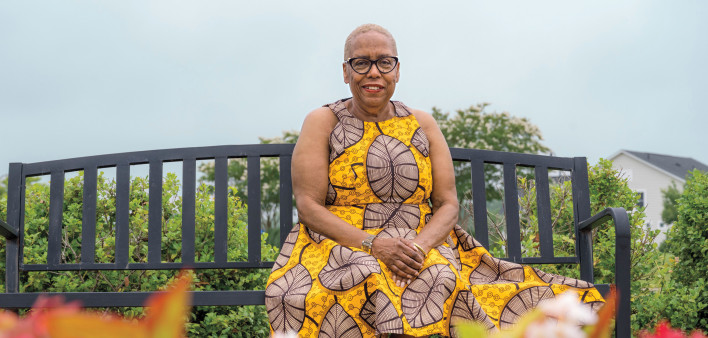
Aracelis Quinones, 60, of Queens, New York, who has been living with HIV since 1988, has been running a monthly Spanish-language support group for Latinos with HIV, Poder Latino, for the past 25 years. Thanks to 21st-century treatment, her HIV has long been well managed.
But in recent years, she has felt overwhelmed by an accumulation of other health conditions—high blood pressure, osteoporosis, spinal stenosis, atrial fibrillation, arthritis—not to mention anxiety associated with managing the many medications she must now take in addition to her HIV meds. It’s a common scenario for folks aging with HIV, who often experience the onset of typical aging-related conditions up to a decade earlier than those without the virus, as ample research has shown.
“I feel like I’m getting a new diagnosis all the time, having new pains, and sometimes it gets scary,” she says. “It’s not just the stigma of having HIV but of aging in general.” She adds, “If it wasn’t for the network I have through NMAC’s 50+ Strong and Healthy and its National HIV & Aging Advocacy Network [NHAAN], I don’t know what I’d do.”
Quinones is referring to two groups at the longtime nonprofit NMAC (formerly known as the National Minority AIDS Council). The first is an aging-with-HIV peer support and information-exchange group; the second focuses on advocacy actions for that cohort, including how members can become educators and trainers in their own communities as well as lobby for programs at the federal, state and local levels.
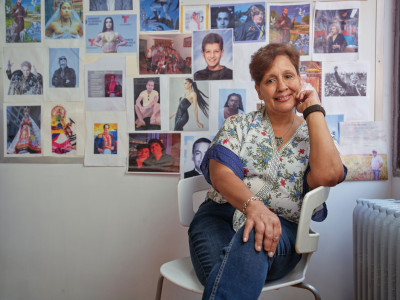
Aracelis QuinonesBill Wadman
Quinones says both groups empower folks aging with HIV to take action, because they enable them to meet others like them who’ve already done so. “You say to yourself, ‘Oh my goodness, if they’re doing it, I’m going to do it also,’” she says. “It motivates and inspires you because you feel safe and like you’re not the only one, especially at times when it feels like the world is ending.”
Since she became involved with the groups several years ago, Quinones has joined NHAAN’s executive committee, helping to organize quarterly Zoom meetings that draw, in her words, “huge attendance.” She’s also part of NHAAN’s subgroup for women—one of many groups within the group.
As part of NHAAN, she attended AIDSWatch, an annual meetup for people living with HIV in Washington, DC, organized by AIDS United that includes visits to Capitol Hill lawmakers to lobby for continued HIV funding (currently quite a challenge given a Trump-aligned GOP congressional majority’s ambition to slash social spending programs). She’s also a recipient of an NHAAN $2,500 mini grant, which she’s used to spark education and advocacy efforts around aging with HIV in her own community.
With the money, she’s been able to invite groups of up to 60 people aging with HIV to discussions at the Latino Commission on AIDS, where she works the front desk. “We had a lawyer talk to us about immigration laws, HIV criminalization laws and how to survive and thrive and not feel that this is the end of days.”
And she has glowing words for Moisés Agosto, NMAC’s longtime director of treatment. “He’s our leader and an inspiration,” she says. “He’s been doing this work for so many years now, since the early ACT UP days, and he also shares his own story of aging with HIV. Thank you, Moisés, for opening your heart and showing that we cannot only survive but achieve our goals.”
Agosto, 60, a Puerto Rican gay man who was diagnosed with HIV in 1986, has been an HIV advocate, especially for Latinos and communities of color, since ACT UP’s heyday in the late ’80s and early ’90s. (He was on the cover of POZ in 1997.) Agosto says starting both 50+ and NHAAN through his job at NMAC is one of his most important accomplishments ever.
In 2016, he says, “there was a lack of discussion of the issues facing older adults living with HIV and their visibility in the HIV community.” He notes that people living with HIV who are 50 and over are on track to make up 70% of all people living with HIV by 2030.
But the health systems that have been established for people with the virus, including via the Ryan White CARE Act (RWCA), were not designed to respond to the needs of older adults living with HIV. (For example, RWCA doesn’t necessarily cover visits to gerontologists, who can examine an aging patient in a holistic manner.)
He adds, “Research is showing that individuals with HIV often present with early and multiple comorbidities [health issues other than HIV], highlighting the need to build capacity in our health systems and increase health literacy and prevention efforts.”
Under Agosto’s leadership, the 50+ group made its public debut at the 2016 U.S. Conference on HIV and AIDS (USCHA, hosted annually by NMAC). “We made people over 50 very visible there and had them all come up onstage with their HIV 50+ Strong and Healthy T-shirts on,” he says. A few of them, like veteran activist Lillibeth Gonzalez of New York City, addressed the crowd.
After that, picking up the tab to get 50+ members to USCHA became a priority for the group. It then dispatched participants home with the aforementioned $2,500 grants to set up webinars and live events in their communities. The programs focused on issues related to diabetes, cardiovascular disease, mental health, polypharmacy [managing interactions among medications for many different conditions], HIV drug resistance, healthy living through exercise, diet and smoking cessation, and getting involved with federal, state and local advocacy for programs and funding.
NMAC also sends members of the 50+ and NHAAN cohort—which increases by roughly 50 new selected individuals every year—to different conferences throughout the year to deliver presentations. NHAAN was formed in 2019, says Agosto, because members of 50+ “thought that just building community wasn’t enough” and “there had to be some sort of a body to organize around policy and activism.” NHAAN now has close to 200 members, he says, and hosts quarterly online meetings. The group also holds a briefing day for AIDSWatch participants before they head to visit their representatives on Capitol Hill to bring them up to speed on the current status of key programs, including Medicaid, Medicare and RWCA.
Agosto says the NMAC aging programs are distinct from national networks like The Reunion Project and Let’s Kick ASS—AIDS Survivor Syndrome, which serve HIV long-term survivors (including those born with HIV) who are not necessarily 50 and over. True to NMAC’s founding mission, members of the 50+ group and NHAAN are mostly people of color, although the groups welcome white members as well. Agosto says those interested in applying to be a 50+ fellow should check the NMAC home page (nmac.org) at the beginning of every year—this is where NMAC posts a call for applicants. Those interested in joining NHAAN, which has no selection process, should email him at magosto@nmac.org or Audrianna “Dri” Marzette, the associate manager for NMAC’s treatment program, at amarzette@nmac.org.
Agosto says he’s proud that the 50+ group and NHAAN have meant that “people who weren’t very involved or visible have found a platform where they can develop themselves as leaders.” He acknowledges that the climate for HIV advocacy in Washington, DC, is currently challenging, which is one of the reasons that this year’s USCHA, taking place September 4 to 7 in DC, will center the theme of aging with HIV.
“The climate is hostile right now, but that doesn’t mean you stop pushing,” he says. That’s not an option, he adds, at a time when Medicaid, which covers health care for 40% of Americans with HIV, is on the chopping block—potentially leading to cuts that would crowd countless people with HIV onto Ryan White’s AIDS Drug Assistance Program, the payer of last resort.
Because federal support is fragile right now, says Agosto, “we’re currently developing a training manual for folks to be active with their local and state reps.” The manual was born in part from a session NHAAN held at this year’s AIDSWatch on exactly that topic.
Agosto admits that his own anxiety about aging with HIV around the time he turned 50 helped inspire him to form 50+ and NHAAN. “A year or two ago, I was diagnosed with both neuropathy and diabetes, and I’ve always had cardiovascular disease,” he says. “I’m controlling the diabetes now with a GLP-1 agonist [a weight loss drug], but it also required a big adjustment in my diet, eliminating empty carbs and sugar and adding more fiber, vegetables and lean protein, like chicken and fish.”
He says his recent health challenges have triggered memories of getting opportunistic infections back in the ’80s and ’90s, before his HIV was well controlled. “I’m not trying to sound like a victim, but it’s still a challenge. I thought that after getting my HIV under control years ago, I was going to have a break from health scares.”
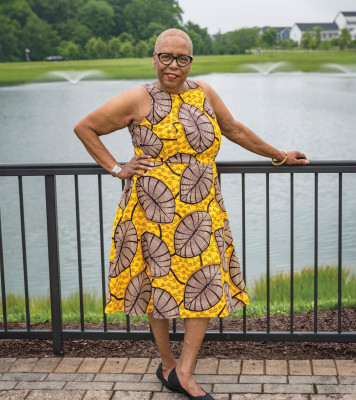
Denise DraytonLiz Roll
Denise Drayton, 75, a program associate at the nonprofit Ribbon—A Center of Excellence for Healthy Aging with HIV, where she supports initiatives concerning aging with HIV, is another member of the 50+ group and is part of NHAAN’s executive committee.
Diagnosed with HIV in 1993, Drayton moved a few years ago from her longtime Brooklyn home to the Maryland suburbs to be closer to her sister. She says the NMAC groups have “given me an opportunity to learn more about aging with HIV, so I can pass on that education in my day job.” (She’s also a member of the NHAAN Women of Color subgroup.)
The 50+ group has been particularly helpful for her, she says, because as a nondriver in the Maryland suburbs, where services are scattered, she’s had to rebuild an HIV and health support network for herself. Thanks in part to the 50+ group, she’s now connected with fellow long-term survivor Melanie Reese of Baltimore’s senior HIV network Older Women Embracing Life; she’ll also be joining her area’s RWCA Community Advisory Board.
Drayton also credits the 50+ group with helping her get and stay on the Mediterranean diet, which research has found to be healthiest for aging folks, whether or not they are living with HIV. (The Mediterranean diet emphasizes the consumption of lean protein, fruits and vegetables and olive oil.) “A family of like-minded people are here to support and help one another,” she says of the members of the 50+ group.
Another member of the 50+ group and NHAAN is Joey Pons, 57, of San Juan, who was diagnosed in 1988 and is a longtime fellow Puerto Rican friend of Agosto. Formerly the head of the Puerto Rico office of the federal program Housing Opportunities for Persons with AIDS (HOPWA), Pons says he has helped fine-tune some education components of the 50+ group and NHAAN.
For example, he says, “the financial stability module used to only say ‘You need to have accessible housing,’ but it lacked the ‘How do I get it?’” The module, he says, has since been upgraded with resources specific to every region.
He also helped the group record Spanish-language trainings on topics including diabetes, heart disease and advocacy—“like when a local or state budget is being negotiated, you can play a role in trying to expand services in rural areas.” The trainings will be released at USCHA in September.
Plus, he says, being in the 50+ group has helped him with some of his own aging issues, such as getting his drinking under control and dealing with depression from his own perception that he is not as desirable as he was in his youth.
“All of us are living under stress with this administration,” he says, so the 50+ group “is a way for us to socialize, vent and feel supported.”
Yet another 50+ and NHAAN member is Jeffery Haskins, 70, of Philadelphia, who was diagnosed with HIV in 1993. A major aging issue for him is exhaustion, even as he continues to work part-time for the clinical education division of the longtime HIV care and advocacy group Philadelphia FIGHT. “I emceed a program [recently], and I’m just wiped out now,” he says.
He says the 50+ group “has given me a purpose and centered me. And it has helped me deal with my own issues around aging because I’m in contact with so many people dealing with the same situations I have.”
According to Agosto, that’s exactly why he started 50+ Strong & Healthy in the first place. “If I hadn’t found community as a gay man living with AIDS a long time ago, I wouldn’t be here—honestly,” he says. “That’s how much I value community, because it helps us figure out ways to support one another, including those local referrals.”
He adds, “Community can give you many things—it all depends on what you need.”

Comments
Comments